


 Francais
 Deutsch
 Italiano
Refine Your Search
Cuba 1898 stock footage and images
- Showing 289 to 294 of 349 results more
more Hide
Hide
Fallout shelters are set up and supermarket shelves are stripped by people in the U.S. during the Cuban Missile Crisis of 1962.
Events in the United States during the Cuban Missile Crisis of October 16, 1962 when the United States and the Soviet Union confronted each other with nuclear destruction over Soviet missile positions in Cuba. A sign reads 'Fallout Shelter'. Supermarket food store shelves stripped by people eager to stock rations in case of nuclear war. Queues and lines at grocery checkouts as shoppers stock up.
Dr. Ramon Grau arrives for official visit and Dr. Wellington Koo arrives for conference in Washington DC (WW2)
Dr. Ramon Grau San Martin and Dr. V. K. Wellington Koo arrive in Washington DC. Dr. Ramon Grau San Martin, president elect of Cuba, disembarks plane at Nation airport of Washington DC for official visit. Troops standing in attention. Cordell Hull greets Dr. Ramon Grau. Dr. V. K. Wellington Koo, Chinese ambassador to Great Britain arrives to represent his government for peace in World War II. He is greeted by Under Secretary Joseph C. Grew on his arrival. Troops march.
The Hall of Heroes in the Pentagon where names of Medal of Honor recipients from the Spanish-American War are listed
John Charles Daly discussing the Medal of Honor and the Spanish American War. Scenes of waves crashing on shores. Mr. Daly standing in the Hall of Heroes, at the Pentagon, Arlington, Virginia, U.S.A. speaks about Americans called to do battle outside the United States. Map of Cuba with flame and smoke over Havana Harbor. Officials around a conference table. A poster with picture of the USS Maine and words: "Remember the Maine." Excerpts from films depicting events in the Spanish-American War. The Spanish flag being lowered and replaced by the American flag. Back in the Hall of Heroes, Mr. Daly points to names of 30 Medal of Honor recipients from the Spanish-American War, on the wall. He notes they were the first to win Army Medals of Honor on foreign soil. He states that 81 Navy and Marine Corps fighting men were also awarded the medal.
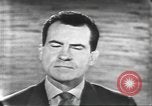
Nixon and Kennedy comment on the Cold War and Communist prestige during a presidential election debate in Washington DC.
The second Kennedy-Nixon Presidential Debate in Washington DC, United States. Edward P. Morgan of ABC News asks Republican candidate U.S. Vice President Richard M. Nixon to comment on whether the United States was doing well in the Cold War. Nixon states that they were not doing as well as they should have in the Cold War because of the presence of the Communists on the international scene. He says that the Communist prestige in the world is lower than the American prestige. He comments on cost cuttings on programs like mutual security and defense by the Democratic Congresses. Democratic candidate Senator John F Kennedy disagrees with Nixon's statement that the Congress has not provided funds for national defense. He also disagrees on the question of U.S. position in the United Nations. He mentions that various reports of Congressional committees indicate that the relative strength of the U.S. compared to that of the Soviet Union and the Chinese Communists together has deteriorated in the past years. Alvin Spivak of United Press International asks Kennedy how the losing prestige can be regained, and programs accomplished without damaging economy. Kennedy talks about the breaking off of the sugar quota with Cuba, passing of an authorization, and the development of the Inter-American Bank. He states that the U.S. has looked at the needs of Latin America. He states that instead of concentrating aid on surplus military equipment in Laos, the aid should have been concentrated in long-term loans. He concludes that Americans should identify themselves not only with the anti-Communist fight but also with the fight against poverty and hunger. Nixon presents his views and states that along with the necessity for economic assistance, the need for technical assistance should also be developed. Americans should not only think in terms of fighting Communism but also in terms of the interests of these countries. He concludes and mentions American ideals of independence, right of freedom and right of progress.
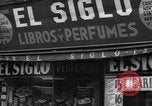
Exteriors of Cuban and Puerto Rican stores and shops in Harlem, New York City, United States.
Hispanic businesses of Harlem, New York City around 1940. Signs in Spanish on stores and shops of community from Cuba and Puerto Rico, along 5th Avenue in Harlem, New York City, including "El Siglo" books and perfumes store, and the "Casa Siegel" furniture, record, and electronics store at 1393 5th Avenue, New York City, near the corner of 115th Street (owned by Sidney Siegel). Exterior marquee of the "Hispano" movie theater. View of the storefront for the "C. Mediavilla Licores " liquor store. A resident leans out of a window above shops. View of the "Garcia & Pena" clothing store at 1357 5th Avenue, New York City.
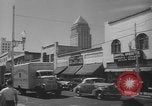
Joint Civilian and Air Force activities related to Hurricane detection and warning. Hurricane Hunters.
Street scene in Miami, Florida. Three men on a golf course. Horses start race at Hialeah Race track. View from window of WB-29A in flight through stratiform clouds. View from ground near a building, of gathering storm clouds. Inside the building, U.S. Air Force personnel (military and civilian) of the Joint Hurricane Warning Center at work. Hand seen annotating a Weather chart, displaying isobars. Military meteorologists looking at weather reports (Grady Norton in background). Weather personnel gathered in a classroom setting. Using a sketch on a blackboard, a supervisor discusses movement of a tropical storm heading toward Cuba. Grady Norton, Meteorologist-in-charge.stands alone, looking down on weather data (not seen). A woman brings him a cup of coffee.