


 Francais
 Deutsch
 Italiano
Refine Your Search
D-Day stock footage and images
- Showing 1561 to 1566 of 4856 results more
more Hide
Hide
LA Dodgers beat Chicago White Sox in 6th (final) game of baseball 1959 World Series
Newsreel clip entitled "Dodgers Win World Series," shows highlights from game 6 of the 1959 World Series between the Los Angeles Dodgers and Chicago White Sox. Shot of packed stands at Chicago's Comiskey Park. White Sox ace pitcher Early Wynn gives up walk to Wally Moon and home run to Duke Snider. Snider seen rounding third as announcer notes this is his 11th World Series home run, a National League record. In fourth inning, Wynn gives up run-scoring hit to Maury Wills and is replaced by Dick Donovan, who gives up run-scoring double to Charlie Neal and home run to Wally Moon. White Sox first baseman Ted Kluszewski, in his famous sleeveless jersey, slugs a three-run homer into the right field stands to score the Sox' only runs of the day. Dodgers bring on pitcher Larry Sherry to retire Luis Aparicio and end the White Sox threat. Dodgers go on and win 9-3 to clinch the series ( their first world championship since leaving Brooklyn for the West Coast after the 1957 season).

German propaganda film about the battle of Belgium commencing 10 May 1940, in World War II
Film opens with date: 10 May 1940 (date of the German invasion of Luxembourg, Holland, and Belgium, in World War 2). Huge precise formation of German soldiers is shown. Alternating closeups of individual soldiers and camera pans across the formation. Animated map shows Germany, Belgium, France and Holland, plus Rein River, City of Lille, and Paris. It shows positions of English and French armies, ostensibly attacking from France, across Belgium and Holland, toward the German Ruhr region (but actually moving to repulse the German offensive). Belgian troops advancing on motorcycles past sandbagged buildings. The French border being opened followed by many French military vehicles, including trucks, trailers, artillery pieces, and some French Lorraine 37 tracked vehicles. A steam locomotive pulls a boxcar troop train. French and British Expeditionary Forces seen on the train. Many of the Allied soldiers sit in its doorways with their legs dangling. A French Char B1 heavy tank rumbles along a road. French light tanks. More views of Allied troops, including French Colonials, marching through towns and villages. Closeup of the Commander-in-Chief of the British Expeditionary Force, General the Viscount Lord Gort, with another British Commander. British troops in armored personnel carriers. British troops participating in Battle of France seen marching as someone is heard singing in background, about "washing day on the Siegfried line." Several British self-propelled heavy guns in motion. German army engineers detonating a charge followed by large explosions.
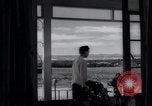
Places in New Mexico, familiar to Ernie Pyle
Views of Ernie Pyle’s familiar places in New Mexico. Opening shot shows a man stepping from the porch of Ernie Pyle’s house, with great expanse of desert landscape in the background. A car driving along a quiet mountain road. People picnicking at a roadside table. Views of mountains and sky and a man leading a horse walking slowly up a sandy hillside. Horse-drawn wagon in the Pueblo of Isleta. A farmer plowing a field with a team of horses. Pueblo women placing rugs on a line and baking bread in an ancient clay outdoor oven. Pueblo residents celebrating Corpus Christi Day. They walk slowly carrying banners and flags. The local Priest says prayers for American soldiers away in World War 2. Inside the church, a Pueblo mother lights candles for her son, overseas, against a backdrop of stars representing each local man away in the war. Car is seen driving across a low bridge over the Rio Grande River. It drives slowly into the town of Sandoval, where a man leads a cow across the road in front of the car. Farmers cultivating rows of crops by hand. A woman sings accompanied by a guitar. A sheep ranch where shepherds on horseback move a flock. Sheep being herded into pens. View of sheep being sheared by team of men. Wool being piled into a truck. Mailman delivering mail to a country mailbox on a street in Albuquerque, New Mexico. Two girls in jeans walking in town. A girl comes out of a building and embraces a young soldier in uniform, who was waiting for her. Pedestrians on the sidewalks in the commercial district. Women with cut roses; playing cards; baking a cake; and cutting a lawn with a manual reel mower. A wedding party walking along the sidewalk. Two girls reading. People in various settings reading the Albuquerque Tribune (or the Journal) newspaper. Movie houses that show films in Spanish and English. Students walking on the grounds of the New Mexico State University in Las Cruces. More views of ordinary people in towns including people of Hispanic descent or Mexican Americans. Sheriff Harold Hubbell of Bernalillo County, who served with the 200 Coast Artillery on Bataan, in 1942, is seen mailing a letter. Former Governor, Clyde Tingley, now Mayor of Albuquerque, comes down steps of a building. A Navajo indian reading a newspaper. A rancher rolling his own cigarette. A young Spanish American boy (Muchacho). Girl (Muchacha) rides a bicycle. A Navajo man followed by his family. Sign reading “Bataan Relief” announcing a talk by a Bataan veteran of World War 2. View of the speaker, in uniform, speaking to a group of mostly women. (Narrator states they lost a whole National Guard Regiment to the Japanese after the Pearl Harbor attack in 1941.) Another glimpse of students at the State University. Another repeat glimpse of Pueblo women baking bread in outdoor oven. Views of girls and women. Various Views of Ernie Pyle with American troops overseas during the war.
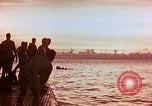
Australian prisoners of war at sea rescued and the survivors helped aboard by U.S. submarine crew members in Philippines (WW2)
Rescue team members on the deck of a U.S. submarine (both USS Sealion (SS-315) and USS Pampanito (SS-383) participated in the rescue) . Crew members carry Australian survivors found clinging to wrecked parts of the Rakuyo Maru, a Japanese prison ship, that had been carrying the prisoners, during World War II. The Rakuyo Maru had been torpedoed by U.S. submarines including these same rescue ships, days earlier. Exhausted survivors pulled on deck with the help of rescue line. They are covered with fuel oil. Men help the survivors aboard. Crew members with other survivors on the submarine.
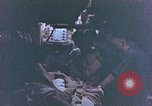
Australian survivors from wreckage of Japanese prison ship Rakuyo Maru rest inside U.S. submarine near Philippines after rescue (WW2)
Australian prisoners of war rescued by crews of U.S. Navy submarines USS Sealion (SS-315) and USS Pampanito (SS-383) days after sinking of the Japanese prison ship Rakuyo Maru at sea in Philippines, during World War II. The rescued survivors rest on beds in the submarine. Crew members talk to them.
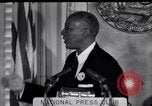
United States Civil Rights leader Philip Randolph speaks about Civil Rights to National Press Club in Washington DC.
Speaking two days before the famed "March on Washington for Jobs and Freedom", the United States Civil Rights leader A. Philip Randolph addresses a gathering of the National Press Club in Washington DC. Speaking at the podium, he talks about the rights of African Americans and asserts that African American people seek the exact same rights that White citizens possess, including all same social, economic and political rights. Flags in the background.
CRITICALPAST.COM: About Us | Contact Us | FAQs - How to Order | License Agreement | My Account | My Lightboxes | Shopping Cart | Advanced Search | Featured Collections | Website Terms & Conditions | Privacy Policy ©2026 CriticalPast LLC.
License Agreement |
Terms & Conditions |
Privacy Policy
©2026 CriticalPast LLC.