


 Francais
 Deutsch
 Italiano
Refine Your Search
D-Day stock footage and images
- Showing 1585 to 1590 of 4856 results more
more Hide
Hide
Man speaks on 'Immorality of racial segregation' in Little Rock, Arkansas.
Man says he is an "integrationist'" concerned more about the "Immorality" of segregation than he is about its "Illegality". He criticizes the Court Orders during Civil Rights movement that require the school board to allow only a token number of African American students into previously all white schools. He criticizes Southern politics. High school students leaving Little Rock Central High School at end of day. Many board school buses.

Four British labor exchange visitors return home after several weeks visiting war plants and labor organizations in America (WW2)
A British guest on labor exchange program visit spends his last day as a house guest of his counterpart American's family, in Los Angeles, California. He is seen with the father in their living room with two children, while the mother prepares dinner in the kitchen. The children are sent to bed and the men and the wife, named Ellen sits down to dinner with the two men. The British guest waves goodbye to the family at their doorstep. Scene shifts to another of the British labor exchange visitors leaving the family where he had been hosted in a different city. Next, the four British labor exchange visitors are seen seated opposite representatives of American labor organizations including the American federation of Labor (AFL), the Congress of industrial Organizations (CIO) and the Railroad Brotherhood. They had met them a few weeks ago when they first arrived in the U.S. One of the labor representatives asks them about their impressions of America. They uniformly praise the effectiveness of the U.S war effort, extolling the efficiency and productivity of her war plants. One of the commenters calls for more international unity in the labor union movement. A spokesman for the American labor representatives expresses need to support the United Nations movement. Film closes showing the four British exchange visitors boarding a U.S. Army Air Corps C-54 transport plane to fly them home to England. They are checked in by an airman who wears a leather jacket with the Air Transport Command logo on it. The aircraft is seen taking off and climbing out over hangars at the airfield. (World War II period)

Dayton, Ohio plans to increase the number of persons employed in its war plants (WW2)
Film opens showing large factory building with all its lights on at night. Smoke stacks at industrial plant emitting white smoke against dark sky. Sparks flying outdoors from a steel plant at night. War production workers inside a fabricating plant drawing a ribbon of hot steel from a roller and dragging a newly made sheet of metal across the floor. Two men with shovels stoking a furnace. Men shaping parts on forging machines. A group of men using sledge hammers to drive down pipe supports under a large piece of sheet metal. Women employees at work inspecting U.S. Army helmets on an assembly line. Workers in a crowded machine shop. A sign reading: "500 workers needed NOW Training on the job." A display of job recruitment announcements in newspapers. A room full of idle manufacturing machinery (ostensibly due to labor shortages). Sign on iron fence outside a building, reads: "Essential WAR WORK Day or Night Men and Women" and "We have a war job for you. Apply here." Some more similar signs. Animated chart of Labor Needs with Labor supply lagging behind, superimposed on a drawing of a defense plant. Map of the USA highlighting areas of industrial might where labor shortages exist. Camera zooms in on Dayton, Ohio on the map. Aerial views all over the city of Dayton, Ohio. View from a tall building overlooking a major Dayton commercial street. The Gem City Savings building, with clock tower on top, at the corner of Third and Main streets. On April 7, 1943, two hundred leading citizens of Dayton are seen attending a meeting at which Stanley C. Allyn, President of the National Cash Register Company, is speaking. He speaks about the danger of Dayton falling behind its war production goals because of manpower difficulties. View of the audience, which includes several military officers in uniform. Allyn speaks of the potential for war work being moved elsewhere because of this, and challenges Dayton's leaders to solve the problem without requiring action from Washington. Next, an emergency committee of community leaders is seen around a table. Camera pans over attendees, including labor leaders from AF of L and CIO; Government officials present, including Area Director and Deputy Regional Director of the War Manpower Commission, and Chief of Program Requirements for the Region; leading industrialists and retailers are shown. Local officials seen include the Mayor of Dayton and Secretary of the Chamber of Commerce as well as the Commanding Army Air Forces Generals of Wright Field and Patterson field. In final scene, Stanley Allyn is seen at the head of the table, speaking to the group. He outlines three ways to obtain more war workers from the Dayton population during World War II.

Recruitment of American women during World War II labor shortage in Dayton,Ohio.
A road to Dayton Ohio, crowded with cars of the 1930s. Men hitch-hiking near a sign reading: "Dayton 47." A steam locomotive pulling a passenger train,speeds past the camera. Arrows on map of Ohio, show areas around Dayton, from which defense workers are being drawn. Closeup of car wheel and tire. Another hitch-hiker at 48 miles from Dayton. Cars converging on the city of Dayton. A line of patrons extending out onto the sidewalk outside the Virginia Cafeteria at 28 East 3rd Street. Another queue of patrons with bags of clothes outside a laundry and dry cleaners establishment. A long line of patrons on the sidewalk outside of a motion picture theater, showing a Western movie starring Johnny Mack Brown and Tex Ritter. A woman places a "No Vacancies" notice over Plaza Apartments sign. Other "No Vacancies" signs posted elsewhere. Men and women war plant workers queue up to board buses to factories. Some men step over a rope line to get ahead of others. Closeup of workers crowding into the entrance of a commuter train. View from inside as workers (mostly women) try to board. A long line of men and women on the sidewalk outside a corner cafeteria in a large building. Woman removing "rooms to let" sign from her apartment wiindow. A man posting a "No Vacancy" sign. The office of the War Manpower Commission Area Director. Seated around a table are are seen members of The Dayton Local Labor Management Committee (Dayton War Manpower Committee). Inquiries being received by manufacturers hiring 8 persons or more, as well as personnel officers of the local Army Air Forces Air Fields, seen in uniform. Other employers answering the inquiries. Employers signing letters to the War Manpower Commission, pledging to stop hiring full-time workers, except those approved as war essential, with the understanding that part-time workers would be referred to them as substitutes. A woman in the War Manpower Commission office types a report to the Washington office. Draftsmen at work in an office. Two women going from house-to-house soliciting women war workers to work in the war effort. Views of various women being interviewed. One watching her young son climb on her porch railing, has to rescue him during the interview, and declined to participate. Next, a woman is seen taking small children to a building labeled "Day Nursery." View inside as women leave their small children in the care of other women providing care for them. Many children seated at tables having a meal. Closeups of some of the children. Street scene in busy downtown Dayton, Ohio with with many women pedestrians walking on sidewalks. A publication called "The War Worker," showing an illustration of a man and a woman side-by-side going to war jobs. It lists war jobs open to women (and men). A team of motion picture workers filming a woman operating a machine, in a publicity shot encouraging such war work. View of a finished film called "Dayton Women are Marching to War !." Men and women in a movie theater watching the film. Views of the faces and expressions of the audience watching the movie, and views of the movie screen. Reporters for radio stations WHIO and WING, interviewing women in defense plants. View inside a local home where women playing bridge are listening to the interviews on a large console radio during card game. Views of the City of Dayton with large outdoor advertising billboards encouraging people to get jobs to help the war effort. Newspaper headlines related to the status of the ongoing World War 2. Closeup view of newspaper headlines and of advertisements inside the newspaper encouraging women to get wartime jobs. Glimpse of the city. Brief view of many women inside a war plant seating at a table filled with cylinder shaped instruments. A man moves a finished cylinder to a table. (These are possibly parts of aircraft bomb sights). Aerial view of the city of Dayton Ohio.
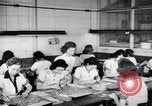
Blind, deaf, disabled and old American workers assisting in the war production effort in Dayton, Ohio, during World War II
Disabled and elderly war production workers contributing to the labor force during World War 2, in Dayton Ohio. Opening scene shows a woman supervisor observing deaf mute women in a lens factory, cleaning segments of bifocal lenses. Closeup of supervisor and one worker communicating by American sign language. A blind man in a shop, using a snap gauge to check finished parts for conformity. A man on crutches taking his place on a war production line. Older men in the shipping department of a factory, packaging and sealing boxes labeled, "Delicate instruments. Handle with care." and placing them on a dolly. Women can be seen at work in another part of the plant. Members of the Dayton Junior Association of Commerce, lined up applying for part-time employment of 4 hours a day, to help the war effort. Students leaving a High School building. (Narrator states schedules were re-arranged for students who would take part-time jobs.)
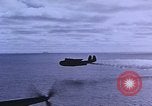
Search and rescue mission for PBM Mariner George I, in Antarctica during Operation High Jump
Relates to the U.S. Antarctic expedition,Operation High Jump in 1946. Reconnaissance aircraft take off for a search and rescue mission in Antarctica. Crew members of a PMB-5 Mariner aircraft fly above the Antarctica in search of a crashed airplane crew - the crew of the Mariner George 1. The missing crew is located on Thurston Island after 13 days by Commander Howell, supplies are dropped for the survivors and they are rescued finally. Aerial scenes of the crew discovered and the names of the dead painted by the survivors on the plane wing. Three did not survive: Max Lopez, Bud Hendersin, Fred Williams. Captain George Dufek welcomes the survivors. Survivors Captain Caldwell, Moore, Robbins, Kearns, McCarthy, eating their food (not including seriously injured "Frenchie" LeBlanc). Coastguard icebreaker arrives. Supplies and equipment are loaded back on the ships. Admiral Richard E. Byrd is seen. Animated map shows the statistics of Operation High Jump.
CRITICALPAST.COM: About Us | Contact Us | FAQs - How to Order | License Agreement | My Account | My Lightboxes | Shopping Cart | Advanced Search | Featured Collections | Website Terms & Conditions | Privacy Policy ©2026 CriticalPast LLC.
License Agreement |
Terms & Conditions |
Privacy Policy
©2026 CriticalPast LLC.