


 Francais
 Deutsch
 Italiano
Refine Your Search
D-Day stock footage and images
- Showing 1687 to 1692 of 4856 results more
more Hide
Hide
Billy Casper wins Canadian Open playoff, by 4 strokes with a six under par 65 in Canada.
Americans, Billy Casper and Art Wall, tee off on the 18th hole at Canadian Open Golf Tournament in Montreal. Casper's approach shot falls within 8 feet of the pin. He one-putts for a birdie. Wall two-putts and they end the hole even. The next day, Casper wins the playoff by four strokes, shooting a 65. He stands with his young son on the green.
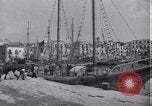
Allied Military Government working to provide medical care and food to Italians in liberated parts of Italy during World War II
Relief activities of the Allies in Italy during World War 2. Opening scene shows a sailing Schooner under Allied Navy control, docked at a port in Italy following the Allied invasion of Italy in 1943. This schooner is being loaded with Allied Military Government (AMG) medical supplies. Closeup of wooden crates containing the supplies. American medical corpsmen checking a stream of water for mosquitoes, and then spraying the area from a DUKW. A hospital building and interior with Italian women holding their infants as they await checkups and vaccinations against disease. Italian citizens in a street anxiously seeking food from the AMG. Local Italian police work to control the crowd in which some persons become unruly and have to be removed. American troops of the U.S. 5th Army marching along Italian roads. Troops riding on a Sherman tank and on a truck pulling an artillery field piece. Supply yard stacked high with food supplies for U.S. troops. (Narrator states it required 750 tons a day to feed the 5th Army.) Views of Naples harbor cluttered with 30 large ships and 300 smaller ones blown up or scuttled by retreating German forces. Firemen manning hoses to fight fires at the waterfront. Smoldering ruins in the port. Three months later, U.S. forces are seen operating supply missions through the port. View from a hill of the port with barrage balloon overhead. Closeup of flour being offloaded from holds of ships by derricks. Italian soldiers unloading the flour bags and placing them aboard trucks for transport to Italian commercial food companies. A U.S. Army Captain at a table with Italian businessmen who purchase the flour from AMG at a fair market price. Italian purchasers examining the flour. Flour being transported to bakers who bake it into bread. Young men busy making and baking loaves of bread. Loaves stacked up at the bakery. A big tray of fresh loaves being sampled by Italian officials and distributed to local Italian civilians who enjoy it.
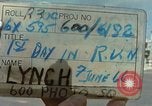
Personnel of United States Air Force arrive at Saigon Tan Son Nhut Airport and move to their base, in South Vietnam.
First day of duty of the United States Air Force personnel in Vietnam A Trans International DC-8 airplane arrives at Saigon Tan Son Nhut Airport Terminal. Marshalling the airplane. Various personnel of the United States Air Force descend from the plane. Air Force personnel put their luggage in a truck. They then move in to a bus. (Vietnam War period).
Christian altars and religious objects at liberated Dachau concentration camp in Germany, at end of World War II
Dachau concentration camp in Germany, after liberation in final days of World War 2. Sign on railroad station building 'Dachau'. Free standing corner post decorated with figures on top, showing three German soldiers in one direction and a German soldier pointing two German musicians in the other direction. One musician has a bass fiddle on his back and carries a folded umbrella. The other carries an accordion. Sign on the entrance to the Concentration Camp: 'Quarantine, Typhus. This concentration camp is off limits to all civil and military personnel. By order of General Patch, CG, Seventh Army'. Christian altars with Mother Mary, a monstrance, and an altar card at the concentration camp. Pile of dead bodies of victims of Nazi atrocities carried in horse carts by German civilians wearing gas masks.
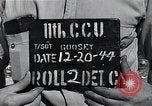
B-29 , tail number 42-224802 on Guam, Mariana Islands during World War II.
Camera pans across North airfield on Guam, Mariana Islands, in World War 2. Next a large group of Airmen are seen standing around a shiny B-29 bomber parked on the ramp. It has "K333" stenciled on left side of its forward fuselage. Its tail number is 42-224802. (This B-29 is named "Purple Shaft," but that is not stenciled on its left side.) The airmen walk around and examine it. Next, The aircraft commander, Lieutenant Warren Richard Aylsworth is seen speaking with a Captain, as they stand next to the plane. Others join in the conversation. (Note: The plane is scheduled to fly to Tinian this night, the 20th, but will land at Saipan, instead, because runway lights were not yet operational on Tinian. The "Purple Shaft" will be the first B-29 to arrive at Tinian, the following day, December 21, 1944.)
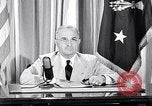
President Harry Truman of the United States speaks about dropping atom bomb on Hiroshima, hours before attack on Nagasaki.
President Harry S. Truman of United States addresses the United States following his return from the Potsdam Conference in Germany, during World War II. President sitting at a desk at the White House explains the choice of Hiroshima as a target for the atomic bomb due to its focus as an industrial rather than a residential center. (This speech is made on the same day as the dropping of the atomic bomb on Nagasaki, but either before the Nagasaki bombing occurred, or before it was confirmed and announced publicly). President Truman warns of additional atomic bomb attacks on more industries in Japan and says the Japanese can foresee what will happen in a future atomic bomb attack, based on what happened at Hiroshima. Truman reminds about the number of warnings issued to the Japanese by the US, Chinese and British governments and how the Japanese rejected them. In a foreshadowing of the attack on Nagasaki, Truman says "I urge Japanese civilians to leave industrial cities immediately, and save themselves from destruction."
CRITICALPAST.COM: About Us | Contact Us | FAQs - How to Order | License Agreement | My Account | My Lightboxes | Shopping Cart | Advanced Search | Featured Collections | Website Terms & Conditions | Privacy Policy ©2026 CriticalPast LLC.
License Agreement |
Terms & Conditions |
Privacy Policy
©2026 CriticalPast LLC.