


 Francais
 Deutsch
 Italiano
Refine Your Search
D-Day stock footage and images
- Showing 1705 to 1710 of 4856 results more
more Hide
Hide
B-29 bombers bomb Japanese targets in Formosa Island (Taiwan) and return to their base in Saipan (WW2)
Boeing B-29 Superfortress bombers bomb factories and other targets in Formosa Island (present day Taiwan) and return to their base in Saipan, during World War II. Crew members attach guided bombs at dawn to the bombers. The bombers take off. Flying over Formosa Island over clouds they drop bombs on Japanese targets. Antiaircraft guns fired. The B-29 lands after a successful bombing mission. Crew of the B-29 'Tokyo Rose', first plane to fly over Japanese positions, honored at the Saipan base. Insignia on the nose of the plane. Brigadier General Hansel attaches medals on the uniforms of the crew members.

People in quaint costumes during a public procession at Santa-Cali-Gon Fete celebrations in Independence, Missouri.
People in quaint costumes during a public procession at Santa-Cali-Gon Fete celebrations in Independence, Missouri. A huge crowd on both the sides of streets watches as natives at a procession in quaint costumes re-enact old stories and impersonate characters of old days. Couples and men in quaint dresses. Man in soldier's dress sitting on a horse, smokes cigar. (World War II period).
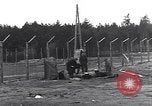
Living inmates cook food around open fire near barb wired fence Wöbbelin concentration camp in Ludwigslust, Germany.
Footage from three days after liberation of the Wobbelin Nazi concentration camp (Wöbbelin) in Ludwigslust, Germany. Inmates who survived are seen cooking food around an open fire near barb wired fence at the concentration camp. Man wearing uniforms among the inmates. An inmate lies on the ground. Inmates draw water and fill buckets from a hand pump. (World War II period).
Buildings, barracks and inmates at the Wöbbelin concentration camp in Ludwigslust, Germany.
Three days after the liberation of the Wobbelin (Wöbbelin) Nazi concentration camp in Ludwigslust, Germany. Buildings and barracks at the concentration camp. A jeep and supply truck near the camp barracks. Inmates and guards at the entrance of the concentration camp.
A British Royal Artillery officer, in charge of Belsen concentration camp at Lower Saxony, Germany speaks after liberation.
An officer of the British Royal Artillery, in charge of the Bergen-Belsen concentration camp operated by Nazi Germany at Lower Saxony, Germany. The officer speaks after liberation about the conditions at the camp when Allied forces reached there. Seventeen thousand prisoners buried by them. The prisoners had no food for six days and they ate turnips. The officer informs about the cook house since organized at the camp. Clip is part of Nuremberg Trials prosecution exhibit 230. (World War II period).
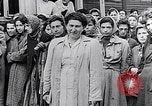
Speech of a woman doctor who was a liberated prisoner and in charge of female section at Belsen concentration camp in Germany
The Bergen-Belsen concentration camp of Nazi Germans in Lower Saxony, Germany after liberation by British Army during World War II. A woman doctor, prisoner and in charge of the female section, describes conditions of the camp. She indicates there were no beds, little food and water a day. Epidemics of typhus spread. No medicine available. More than a thousand died daily. Various gynecologic experiments performed on girls around nineteen years of age. Guards in the men's camp took out liver and heart of dead men and ate them. Food and chocolates distributed by Red Cross just before British forces arrived. Medical experiments included giving heavy Benzene injections to the prisoners. Women liberated from the camp stand around her. Clip is part of Nuremberg Trials prosecution exhibit 230
CRITICALPAST.COM: About Us | Contact Us | FAQs - How to Order | License Agreement | My Account | My Lightboxes | Shopping Cart | Advanced Search | Featured Collections | Website Terms & Conditions | Privacy Policy ©2026 CriticalPast LLC.
License Agreement |
Terms & Conditions |
Privacy Policy
©2026 CriticalPast LLC.