


 Francais
 Deutsch
 Italiano
Refine Your Search
D-Day stock footage and images
- Showing 2233 to 2238 of 4856 results more
more Hide
Hide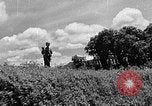
Railway travel through Formosa during the Japanese colonial period
View out window of a railroad train moving through countryside in Formosa (present day Taiwan), during Japanese colonial rule. Two adults and a group of children stand on embankment and wave as the train passes just before it enters a tunnel. View from moving train toward rear of train, as it rounds a bend over a wooden trestle, shows that the steam locomotive is pushing the train, backwards, rather than pulling it. Mountains are covered in trees and other foliage. Vertical sign post written in Chinese. More bucolic scenery until the train approaches a large group of people with luggage and belongings, waiting beside the track, as if planning to board. A sign identifies the location as “Fun kiko” (Chinese characters read as “hu qi fen”). The train is stopped, and passengers have boarded. One woman is placing baggage in a lower compartment accessible by door in exterior of train. Underway, again, view from end car of train (front, since it is moving backwards) as switchman actuates control and train moves onto a parallel track, while another stopped oncoming locomotive waits for it to clear. The train returns to the main line again, having circled the stopped locomotive. Cargo of heavy timbers and similar things being moved on another train.
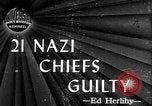
Nazi German officials are tried in a court in Nuremberg, Germany for their World War II war crimes and atrocities
The Nuremberg Trials in Nuremberg, Germany after the conclusion of World War 2. Official cars passing on roads guarded by policemen. A signboard on a barricade on a road reads 'Stop, Halt'. A court building with Allied flags displayed on the fence of the building. A few men and women entering through the gate to the court. Guards at the entrance gate. A motorcyclist is stopped at the entrance by a guard. The guard standing with a gun. The defendants, Nazi officials, climbing up the steps to the court room. Russian, French and British officials seated in the courtroom during the trial. A judge lists the inhuman activities and atrocities of the Nazi leaders for which they are being tried. Flashback views from concentration camps: An emaciated prisoner at a camp. Bodies of exterminated prisoners laid on the ground in a camp. Bodies of tortured prisoners lying on the ground. Nazi officials seated in the courtroom listening to the proceedings. Guards standing behind the Nazi chiefs seated in a cubicle. The judge, seated with other officials, reading from a document. Other officials seated in the courtroom. Piles of paper strewn on the floor of the courtroom after the end of a day's proceedings. The people in the courtroom listen to Sir Geoffrey Lawrence as he pronounces sentences including death by hanging for Goering, life imprisonment for Hess, death by hanging for Joachim von Ribbentrop and for Streicher. Nazi officials listen to the verdict, 11 of them would be hanged till death, 6 of them would be jailed and 3 would be acquitted. Other Nazi officials listen to the verdict. Guards standing behind them. Men on a platform prepare for a Nazi official's hanging. Brief gallows scene at end of clip of an unidentified war criminal being hanged.
U.S. President Eisenhower briefs press about his 2 1/2 week trip to nine countries during a press conference in Washington DC
U.S. President Dwight Eisenhower's 175th press conference in Washington DC, United States. Several correspondents from different nations arrive for the President's 175th press conference. Men prepare cameras mounted on tripod stands at the back of a hall. President Eisenhower with an official walks past the newsmen seated in the hall. The President makes an announcement of his two and a half weeks' trip starting from December 4, 1959. The newsmen taking notes. The President says that he would be visiting nine countries and would be making brief informal visits to Rome, Ankara, Karachi, Kabul and would be in New Delhi for the inauguration of the American Exhibit at the World Agricultural Fair on December 11. He says he will visit Tehran and Athens on his way to Paris for the Western Summit meeting. He gives details of the 3 main days. December 4 - when they would be developing legislative program for the coming year, December 11 - the beginning of the World Agricultural Fair, and December 19 - when he would be in Paris for a meeting. A newsman asks the President the purpose of this extensive visit. The President states the importance and need of being the first U.S. President to make an extensive visit to a strategic continent like Asia. He expresses his interest in visiting India and millions of people who are struggling to raise their standard of living. He says that he will visit Pakistan, Afghanistan, Iran and other nations on the way. The President further says that he hopes to build in that region of Asia and in many other parts, a better understanding of the United States. A correspondent asks the President whether Mrs. Eisenhower and his family members would be joining him for the visit. The President says that some of his family members would be joining him but may be not his wife.
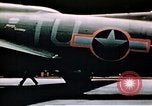
Activities of 351st Bomb Group while stationed at RAF Polebrook, England, during World War II
U.S. B-17s, of the 351st Bombardment Group, at RAF Station Polebrook, Northamptonshire, England during World War II. The Group's maintenance officer, a Major, is seen smoking a cigar as he checks on the status of repairs on the unit's bombers. Maintenance crews seen working on a B-17 named "Argonaut." They use a small crane to lift a propeller for one engine.US Airmen riding bicycles on English country road on a Sunday. They stop at a 900 year old church, remove their caps and walk toward the church. At the base hospital, a Catholic chaplain, Father O'Connell, celebrates mass outdoors. One of the flyers sings Ave Maria.Scene shifts to the next day showing missions scheduled for the 351st Bomb Group, and records of raids they have accomplished to date.
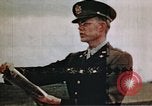
Military award ceremony for members of 351st Bomb Group At RAF Station Polebrook, England, during World War II
During World War 2, Group Adjutant reads 8th Bomber Command orders of the day, on July 7th, 1943. Members of the 351st Bomb Group stand in formation in front of B-17s during an award ceremony. The decorations, including Silver Star, Distinguished Flying Cross,and Soldiers Medal, are arranged on a table for presentation. The recipients are lined up at attention. Narrator points out Bombardier Stevens receiving the DFC and other airmen and their awards.
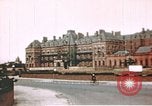
American servicemen enjoy rest and relaxation at Seaside resort run by Red Cross in England during World War II
Seaside hotel converted to a Red Cross rest and recuperation center for U.S. servicemen stationed in England during World War 2. A sign reads: "Welcome to your American Red Cross Service Club." Uniformed man and woman Red Cross officials seen at the facility. U.S. Army airmen arriving at the resort in a jeep. Several airmen see Captain Clark Gable on the grounds and run over to see what's going on. He tells them photographers will follow them around for a day and they won't have to say a word. Airmen, accompanied by young women, riding on a coach pulled by team of horses. View of a huge seaside swimming pool filled with English patrons. Among them are seen several U.S. airmen using the slides and diving boards and having fun in the pool. The Allied rest and recreation center is the Palace Hotel, Birkdale, Lancashire and the pool appears to be Southport Lido.
CRITICALPAST.COM: About Us | Contact Us | FAQs - How to Order | License Agreement | My Account | My Lightboxes | Shopping Cart | Advanced Search | Featured Collections | Website Terms & Conditions | Privacy Policy ©2026 CriticalPast LLC.
License Agreement |
Terms & Conditions |
Privacy Policy
©2026 CriticalPast LLC.