


 Francais
 Deutsch
 Italiano
Refine Your Search
D-Day stock footage and images
- Showing 2281 to 2286 of 4856 results more
more Hide
Hide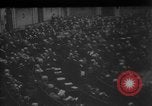
U.S. President Woodrow Wilson asks Congress for a declaration of War against Germany
Film opens showing the U.S. Congress filling the U.S. Capitol chamber on April 2, 1917, when President Woodrow Wilson asked Congress to declare war against Germany. Four days later, on April 6th, President Wilson is seen in black topcoat and top hat delivering an address from a building in Washington, DC announcing that Congress approved his request for a declaration of War. Former President Wiliam Howard Taft sits nearby. View of President Wilson dressed in summer white, relaxed and very casual, speaking impromptu to a group of persons in front of a brick building. Patriotic bunting is seen nearby. Change of scene shows Woodrow Wilson's youngest daughter, Mrs. W.G. McAdoo,Eleanor Randolph Wilson McAdoo. An unidentified old woman is nearby.

Various models of cars with luxury features compete in an international automobile show, New York.
An international automobile show in New York City. The makers of new models of cars from all over the world compete in the 3rd International Automobile Show at the New York Coliseum (present day site of Time Warner Center. 10 Columbus Cir, New York, NY 10019, United States). Various models of cars. People look luxury features of different models of cars.

Andrew Higgins designs and supervises construction of boats in New Orleans, Louisiana.
A tribute to Andrew H. Higgins and his workers in developing and producing invasion boats in New Orleans, Louisiana. The Navy's need for landing crafts. Landing crafts at sea. Soldiers climb a cargo net. Landing crafts head towards a beach. Soldiers disembark from the landing crafts and move towards a sandy beach. Exterior of a building in New Orleans. Andrew Higgins works in his office. He talks over a phone. He makes a rough sketch of a sample boat. Andrew Higgins and his workers discuss and look at designs of an invasion boat. A Higgins tug boat at a canal. Higgins supervises construction of a boat. Ship builders work night and day. Navy officers get off from vehicles and meet Higgins. They inspect an LCVP (Landing Craft Vehicle Personnel). An army tank being driven aboard the LCVP. Higgins and officers board the LCVP. The ramp of the LCVP is closed. It gets underway at sea. It stops at a shore. Higgins and the officers disembark from the LCVP. They climb up a flight of steps and talk. Higgins receives rush orders from the navy. Ship builders at work. Workers build a boat. They assemble the parts of the boat and paint it. LCVPs are transported. Exterior of a boat building plant. Constructed LCVPs and ships. (World War II period).

Battle of Britain scenes: German planes bomb British shipping lanes and London, and Winston Churchill inspects the ruined city
Scenes of German aerial blitzkrieg attacks in United Kingdom during World War 2. The battle of Britain begins on August 8, 1940: British ships underway at sea. German warplanes in flight. The German aircraft drop bombs on British shipping. Ships explode. Explosions and smoke rise. Anti aircraft guns are fired at German planes. German plane is shot down. Houses and buildings burn and dock yards in flame after German blitz begins in earnest on September 7, 1940. Scenes of devastation in London in the months September through November of 1940 as German day and night blitz raids continues. Ruins and damaged buildings, cathedrals, and homes. British school children are evacuated in buses to outlying areas and other countries. British boys and girls are seen waving goodbye, loading into buses, and the children are then seen in transit out of the city for their safety. Blitzkrieg bombing damage scenes in England are shown. Firemen douse fire with water hoses. View of fires in London from Luftwaffe Blitz. British Prime Minister Winston Churchill inspects the ruined city and talks with workers and firemen. Views of London residents, smiling and cheering with spirit of triumph over evil during World War II.
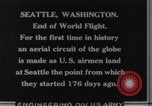
Douglas World Cruisers aviators are greeted in Seattle, Washington after their first flight around the world.
U.S. Army Air Service Douglas World Cruisers (DWC) in Seattle, Washington after their first flight around the world. In Seattle, the point from which they started 176 days ago. The world cruisers in flight. A world cruiser coming in for a landing. Major Frederick F. Martin greets Lieutenant Lowell H. Smith, Lt. Leigh Wade and Lt. Erik H. Nelson. The pilots in uniforms pose. Animations of the North American continent pinpointing Alaska where Major Frederick F. Martin crashed into a mountain. The path over which the world cruisers flew pinpointing the place where the cruiser flown by Lt. Wade was forced down and wrecked. Then the course to Seattle is shown.
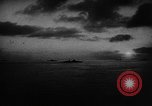
U.S. Navy ships bombarding Okinawa and fighting off attacks by Japanese Kamikaze aircraft in World War II
Conclusion of U.S. Navy film: "The Fleet That Came To Stay." Role of U.S. Navy Task Force 58 during the Battle of Okinawa in World War 2. Opening scene shows ships of U.S. Task Force 58 sitting quietly in waters off the coast of Okinawa, at dawn on May 9, 1945 (VE Day, when Germany surrendered in World War 2). Navy gunners silhouetted against the dawning sky, with twin Bofors anti-aircraft guns. Silhouettes of sailors on early watch. Sailor walks on deck of an aircraft carrier, past parked aircraft with it's vertical stabilizer and rudder riddled to pieces by battle damage. An escort aircraft carrier and other warships are moving slowly past the camera ship. A Douglas Dauntless dive bomber, with only a pilot aboard, takes off from a carrier. Brief glimpse of aircraft taking off from a carrier. It carries a bomb underneath and displays the number 559 on its engine cowling. Numerous American aircraft in formation above the ships. A U.S. cruiser in the distance. Closeups of capital ships bombarding Okinawa with heavy guns and firing anti-aircraft guns at attacking Kamikaze aircraft. Black flak clouds and tracer bullets tracking a Japanese aircraft. Superimposed slate tallies Japanese aircraft shot down: "May 12th: 164; June 3rd: 45; June 6th: 67; June 8th: 30." A kamikaze plane crashes into the sea. Gunners aboard a ship work rapidly to reload their anti-aircraft guns. View of an Essex class aircraft carrier with black flak clouds overhead. Two explosions occur next to her hull. Gunners track a Japanese airplane flying low and close to the water. It passes a carrier and crashes into the sea. More views of sailors working at speed to reload anti-aircraft guns. A sailor firing an Oerlikon 20 mm cannon from gun position atop a ship. A Kamikaze plane crashes at starboard side of an Escort aircraft carrier underway. View of long line of anti-aircraft guns firing simultaneously from beside the flight deck of an aircraft carrier. Smoke rising from the firing and driven by the wind. Remains of a Kamikaze plane spin down amid black flak clouds, after being hit by gunfire. Slate reads "4232 (Japanese planes shot down). The spinning pieces of the Kamikaze plane crash well clear of a nearby Cleveland class light cruiser. Against background of flak filled sky, a Washington Post Newspaper headline is shown reading: "Navy Okinawa Casualties near 10,000 and 2 more ships hit."
CRITICALPAST.COM: About Us | Contact Us | FAQs - How to Order | License Agreement | My Account | My Lightboxes | Shopping Cart | Advanced Search | Featured Collections | Website Terms & Conditions | Privacy Policy ©2026 CriticalPast LLC.
License Agreement |
Terms & Conditions |
Privacy Policy
©2026 CriticalPast LLC.