


 Francais
 Deutsch
 Italiano
Refine Your Search
D-Day stock footage and images
- Showing 2311 to 2316 of 4856 results more
more Hide
Hide
Presidential election debate in Washington DC. Richard Nixon, debating John F. Kennedy, speaks about the spread of Communism.
The second Kennedy-Nixon Presidential Debate in Washington DC, United States. Moderator Frank McGee introduces the candidates - Republican candidate U.S. Vice President Richard M. Nixon and Democratic candidate Senator John F Kennedy. The Moderator tells the rules to the candidates regarding questioning by the reporters. The reporters include Paul Niven, Edward P. Morgan, Alvin Spivak, and Harold R. Levy. Paul Niven asks Nixon to comment on whether Truman Administration was responsible for the loss of China to the Communists. Nixon answers and says that he disagrees with Senator Kennedy's statement that Cuba is lost and certainly China was lost because of Truman Administration. He talks about the decrease in the number of dictators in Southern and Central America in the past years. He speaks about Kennedy's book 'The Strategy for Peace' which prohibits the Americans from interfering in internal affairs of any other state. Kennedy presents his views and says that he never suggested that Cuba was lost. He criticized Nixon because in his press conference in Havana in 1955, he praised the competence and stability of the Batista dictatorship. He criticized the failure of the administration to use its great influence to persuade the Cuban government to hold free elections. He hopes that some day Cuba would rise if the U.S. changes its policies towards it.
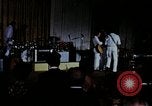
People applaud as the Osborne Brothers perform for U.S. President Nixon and his family at the White House in Washington DC
The Osborne Brothers perform for the First Family of the United States at the White House in Washington DC, United States on March 17, 1973. Wearing an oversize green satin bow-tie President Nixon arrives on a stage. He explains that he wears the green tie because it is St. Patrick's Day. He also notes that Mrs. Nixon also wears green and that it is her birthday. The crowd applauds. The First Lady of the United States Pat Nixon, her daughters Tricia Nixon Cox and Julie Nixon Eisenhower and sons in law Edward F. Cox and David Eisenhower seated. President Nixon joins his family after introducing the performers and commenting on this being an evening with "American" music. The Osborne Brothers perform a song called "Rocky Top."The crowd applauds. (This Osborne Brothers' performance marks the first ever performance of Bluegrass Music at the White House.)
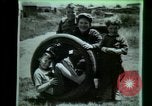
Prior to U.S. Presidential Election of 1968, Richard Nixon recounts his past and speaks about the death of his brothers.
Self-portrait of Republican nominee Richard Nixon aired during his 1968 presidential run against Hubert Humphrey and George Wallace in the United States. Richard Nixon's childhood picture showing him with his brothers. He recounts his past and speaks about the death of his younger brother Arthur Nixon and older brother Harold Nixon from tuberculosis. A picture of his service station. He recalls a day in the past when his family did not have money to buy firecrackers.
A political advertisement critical of Democratic nominee Hubert Humphrey during the 1968 presidential campaign
A political advertisement from the Nixon campaign or Republican party during the 1968 Presidential election campaign portrays Democratic party challenger Hubert Humphrey in a negative light. Still images show Democratic presidential nominee Hubert Humphrey at the party's convention in Chicago, Illinois. Riots in the United States following assassinations of prominent leader in the African American civil rights movement, Martin Luther King, Jr., and Senator from New York Robert F. Kennedy, in 1968. U.S. soldiers battling the enemy in Vietnam during the Vietnam War. A picture depicting poverty shows a poor family. Images of Humphrey are interspersed throughout, portraying him as disconnected from the issues of the day.
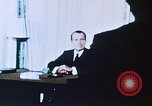
From the Oval Office in the White House, President Nixon talks to Apollo 11 astronauts after their landing on the moon.
Telephone conversation between U.S. President Richard Nixon and the astronauts of Apollo 11, while they are on the moon, July 20th, 1969. President Nixon seated at a desk in the Oval Office of the White House in Washington DC, United States. Technicians setting up video cameras. Nixon talks over a phone. Men setting up a monitor screen. Flickering moving images of the astronauts beside the Lunar Lander, on the surface of the moon. A camera focuses in on a document titled: DRAFT 'Talk to men on the moon' on the desk. The opening sentence reads: "This is an epic day in the history of man." A split image on the screen shows President Nixon talking and the astronauts on the moon. President Nixon talking to an astronaut on a phone at his desk in the Oval Office. Picture of "Earthrise" as seen from the moon, on wall in the Oval Office. NASA Astronaut, Frank Borman,who commanded the Apollo 8 mission,in 1968, comes before the cameras in the White House and makes speaks on behalf of NASA astronauts involved in the Apollo missions.
German civilians and U.S. soldiers view dead bodies of prisoners at Wöbbelin Nazi concentration camp in Ludwigslust, Germany.
Scenes from the Wöbbelin concentration camp in Ludwigslust, Germany, four days after the camp's liberation, towards the end of World War II in Europe. German civilians come out of a barracks building of the Wobbelin concentration camp building after viewing dead bodies of prisoners. U.S. soldiers entering and leaving the same building.
CRITICALPAST.COM: About Us | Contact Us | FAQs - How to Order | License Agreement | My Account | My Lightboxes | Shopping Cart | Advanced Search | Featured Collections | Website Terms & Conditions | Privacy Policy ©2026 CriticalPast LLC.
License Agreement |
Terms & Conditions |
Privacy Policy
©2026 CriticalPast LLC.