


 Francais
 Deutsch
 Italiano
Refine Your Search
D-Day stock footage and images
- Showing 2455 to 2460 of 4856 results more
more Hide
Hide
U.S. military cemeteries on recaptured islands in the Pacific; aerial bombing of Japan in WW2
Brief views of Allied bombing raids in Japan during World War II. A group of United States Army Air Force aircraft flying over Japan. An army cemetery in front of a building in the Pacific. United States Army Air Force aerial machine gun strafe Japanese positions on the Aleutian Islands. A chaplain praying over a coffin with the American flag draped over it. Aerial view of bombs falling and exploding into Japanese positions in China. Consolidated B-24 Liberator dropping bombs over Wake Island. View of Wake Island. Graves of U.S. troops on Wake Island, Burma, and other recaptured Pacific islands. Allied Airborne Infantry on the jungles of Burma (Myanmar). Gunshots are heard on the background. Two United States Consolidated B-24 Liberator aircraft flying to the Philippines. Allied bombardment of Hollandia (present day Jayapura, Papua, Indonesia). Grave of an unidentified soldier. United States troops land on a beach. A Howitzer is towed across a river. Soldiers rolling a barrel of oil. Snowplow truck clearing snow in front of a bomber. United States troops unload supplies at a snow-covered airbase.
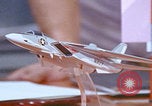
Mechanics working Grumman F-14 Tomcat fighter at NAS Miramar, California
A small-scale model of the Grumman F-14 Tomcat fighter on display. Two United States Navy officials discuss sortie schedules and the weather of the day. Mechanic climbs on top of a Grumman F-14 Tomcat fighter aircraft. Petty officer touring a newly hired female officer shows Grumman F-14 Tomcat fighters being repaired. A chief mechanic tells his subordinate to check the whole system while repairing a fighter. Officers talking inside the Fighter Squadron 124 office at NAS Miramar California (Miramar Way, San Diego, CA 92145, United States). VF-124 squadron patch and words “ANYTIME BABY” on display.
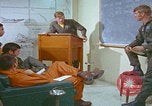
United States Navy VF-124 squadron pilots discuss test flight during a meeting
United States Navy VF-124 aircraft pilots hold a squadron briefing at NAS Miramar (Miramar Way, San Diego, California 92145, United States). Diagrams and blackboard on the walls are seen. The squadron pilots discuss the test flights with the F-14 fighter for the day. African American pilot looks at his notes during the orientation. Pilot talks behind the podium.
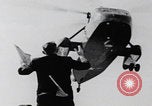
President Kennedy observes a Polaris missile test while onboard USS Observation Island
A man signals to United States Marine Corps (USMC) UH-3A helicopter. United States President John F. Kennedy arrives at the U.S. Navy ship USS Observation Island (EAG-154) by helicopter. A sailor plays his bugle and salutes. The president meets the ship's commander and other officers. President Kennedy observes a Polaris missile test with the USS Andrew Jackson submarine (SSBN-619) firing the missile. Other officials accompany President Kennedy to watch the missile test. President Kennedy gives a short speech on board USS Observation Island. Later in the day, President Kennedy speaks to Major General Davis and Launch Operations Director Kurt Debus in Florida before boarding the Air Force One (VC-137C SAM 26000).
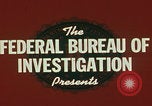
Serology unit of the FBI laboratory gathers and analyzes blood samples from a crime scene
Technicians working at the serology unit of the FBI (Federal Bureau of Investigation) laboratory. A technician collects blood sample from a shirt belonging to a suspect. The examiner drops benzidine reagent and dilute hydrogen peroxide into the blood sample in cotton swab. The blood sample turns blue. The examiner writes down notes and cuts a sample from the shirt for microchemical hemoglobin test. He places the sample on the microscope slide. The examiner applies a reagent on the sample in the microscope slide. The slide is warmed before being placed under a microscope. The examiner uses the microscope. Red crystals indicating the presence of hemoglobin found under a microscope. The examiner runs test for origin and blood group of the sample. The examiner also gathers samples from the unstained part of the cloth. The samples are placed on test tubes which are placed on a rack. The examiner marks the locations where the samples were taken in the clothing. The examiner writes notes on his worksheet. Blood serums are added to the samples. The rack containing samples are placed inside a refrigerator overnight. The examiner brings out a vial containing liquid blood sample from the same refrigerator. The liquid blood sample is centrifuged, and samples are gathered for a liquid blood grouping slide. Testing solutions are added to the samples. The slide is agitated to expedite the grouping reaction. The examiner reads the slide through a microscope. The examiner brings out vials of samples from blood-stained fabric gathered the day before. The test tubes are placed on the centrifuged machine. Blood samples on vials are placed in small rack. The examiner determines blood sample to be of human origin. Centrifuged grouping samples are placed in grouping slides to determine blood type. Examiner reads samples microscopically. A technician fills out a worksheet. Law enforcement officers read a laboratory report from the FBI.

French bombers and paratroopers over Indochina; refugees flee communist North Vietnam
Aerial view of Dien Bien Phu showing craters from shelling after the Battle of Dien Bien Phu in the First Indochina War preceding Vietnam War. French Aéronavale (naval air) Consolidated PB4Y-2 Privateer Maritime patrol bomber in flight. A French pilot radioing from the cockpit. Paratroopers with parachutes drop from bombers. A bomber airdrops supplies. A French camp in Vietnam. French cannons and artillery shooting enemy positions. French troops evacuate injured soldiers from the battlefield. Vietnamese civilians scavenging in Hanoi after the end of the First Indochina War. An elderly woman sat in front of a doorway. A child looks up. French troops leave Vietnam. Communist North Vietnam flag on flagpole in Hanoi. North Vietnamese troops marching. World leaders convene at the 1954 Geneva Conference to decide the fate of Vietnam. Deputy Defence Minister Ta Quang Buu of Vietnam signs the Indochina Conference Armistice Agreement in Geneva on 21 July 1954. Delegates shake hands after the Geneva Conference. Refugees carry their belongings and children as they flee North Vietnam for South Vietnam. Vietnamese refugees crowd in United States Navy boats heading to South Vietnam. Refugee children help United States sailors swab the deck of a ship. The refugees disembark from ship upon arrival in Saigon, South Vietnam. 1954 map of Indochina countries such as Laos, Thailand, Cambodia, and North and South Vietnam. Mountains in the border between North and South Vietnam. President of North Vietnam Ho Chi Minh meets and plays with children. A happy girl clapping. Children surround Ho Chi Minh. A child plays with Ho Chi Minh’s beard and Ho Chi Minh smiles. Farmers build new huts in South Vietnam. South Vietnamese men and women but ballots into ballot box during voting. A woman wearing sunglasses and Ao Dai dress smiles after voting in the election. Packs and sacks of rice from the United States government in South Vietnam. Civilians distribute sacks of rice. Farmers receive new equipment and plows from the United States. Farmers harvest rice in rice paddies. Vietnamese men rowing in small boats and traditional Junk. Delegates arrive in Manila, Philippines for the Southeast Asia Collective Defense Treaty September 8, 1954. The Southeast Asia Collective Defense Treaty is signed. Delegates clapping after the treaty is signed. Vietnamese civilians gather concrete blocks and build houses. A car with bullet holes in window. A dead South Vietnamese politician in car murdered by North Vietnamese agents. North Vietnamese guerrillas hike in the jungle. Men running in front of a burning house in a village under siege by North Vietnam. Burned houses, rubble, and dead civilians in village after a North Vietnamese guerrilla attack. A portrait of Ho Chi Minh above a North Vietnam flag.
CRITICALPAST.COM: About Us | Contact Us | FAQs - How to Order | License Agreement | My Account | My Lightboxes | Shopping Cart | Advanced Search | Featured Collections | Website Terms & Conditions | Privacy Policy ©2026 CriticalPast LLC.
License Agreement |
Terms & Conditions |
Privacy Policy
©2026 CriticalPast LLC.