


 Francais
 Deutsch
 Italiano

Refine Your Search
D-Day stock footage and images
- Showing 319 to 324 of 4874 results more
 Hide
Color Sound
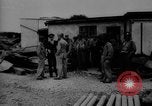
Towing operations of phoenix units, a Lobnitz pier head and a whale unit constructed by the Seabees in Normandy, France.
Creation of an artificial harbor and bridges by the Seabees ("Operation Mulberry") in Normandy, France during World War II. U.S. Navy Captain Augustus Dayton Clark, in charge of the Operation Mulberry landing operations at Omaha beach, is seen in discussion with Commander E.T Collier from the 108th Naval Construction Battalion (Seabees). Towing operations are shown: Tugs used for towing phoenix units. The tugs take a whale unit in tow. A tug takes a phoenix unit in tow and another with a whale unit in tow. Lobnitz spuds in tow. A formation of Allied fighter aircraft in flight overhead protecting the convoy. Seabees crew and gun crew on phoenix unit. 40mm anti aircraft gun on the phoenix unit. View at H-2 hours before D-Day of skies overhead with transport aircraft towing gliders with troops on board for the D-Day landing operation.

German perspective on Allied attack and German defensive actions during the Allied invasion of Normandy, France.
German newsreel about the D-Day Invasion of Normandy. English narration overlaid by the U.S. Office of Strategic Services. German people read bulletin boards and newspapers describing the invasion. A map shows location of England and Germany. Information of assault broadcast in Germany by German radio stations. Announcers shown relaying information at switchboards. Alarm bells ring and German troops in bunkers grab rifles and stand ready to proceed. German antiaircraft guns and artillery fired at incoming Allied aircraft and and explosions seen at night. Allied Airborne troops incoming, according to narration, as nighttime artillery barrage continues. Naval units near mined waters. Germans soldiers in Atlantic Wall fortifications fire artillery and machine guns. Closeup views of German soldier faces, looking determined. Heavy artillery are fired at Allied troop units. Allied naval ships as seen from German perspective on shore in early morning light on D-Day. Shells are loaded into artillery and railroad guns and fired on the Allied warships from German gun emplacements and fortifications on the coast of France. British troops land on shore near the River Orne at the Normandy village of Ouistreham. Heavy bombardment from both sides. Germans examine Allied Landing Craft on the beach. Commentator says the British troops in them were annihilated or taken prisoner. Camouflaged German tanks move into position and fire on invading Allied ground troops. German forces pass wrecked gliders and an Allied parachute hung up in a tree. Allied Airborne troops are shown taken as prisoners by German forces and marched. Pan view of many Allied gliders, some crashed in a large field. British gliders seen. Close views of crashed gliders. German forces roll an intact Allied jeep out of a crashed glider and drive it away. Captured prisoner Canadian troops seen. Shoulder patch of one reads "North Nova Scotia Highlanders", and on another reads "1 Canadian Parachute Battalion Airborne". Interrogation of captured Canadian troops is seen. German holds a prisoner's "Soldier's Pay book". (World War II period).
Allied victories over Nazis in European Theater in 1944 and 1945 during World War 2
Eastern Front battle of Soviet army as it repels the German Wehrmacht from a Soviet city, and captures German POW's. The German prisoners are marched into Soviet camps in winter snow covered landscape under guard of Russian Army soldiers. Aerial view of massive invasion force in English Channel on D-Day for the the Invasion of Normandy. View from landing craft of American infantry going ashore. Allied soldiers taking fire from German enemy during D-Day beach landings. Allied armies moving inland through France seen in combat with Germans in French villages and towns. Many German prisoners rounded-up and seen marching toward prison camps under British and U.S. Army guard.
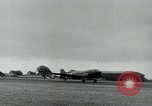
Gliders, carrying Allied infantry, take off for the invasion of Normandy in World War II.
A British Dakota (or U.S. C-47) taking off from an airfield towing a British Airspeed AS.51 Horsa glider. Both aircraft are painted in D-day stripes. Formation of C-47 aircraft towing WACO CG-4A Gliders. A C-47 in D-day stripes parked in front of a hangar.
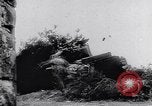
German forces defending against British air attacks during the invasion of Normandy in World War II.
German forces moving to defend against the Allied invasion of Normandy during World War 2. German troops run past a disabled American Sherman tank as they take cover from attacks by British fighter bombers. Several German Stug III tank destroyers make their way along a dirt road. They are covered in natural foliage as camouflage. A German infantryman with rifle in a trench, looks up as Allied aircraft attack. German artillerymen firing Flak 18 (88mm) antiaircraft guns at the British planes. Another German gunner, seated and firing a 20mm Flak 30 light antiaircraft gun. British Hawker Typhoon IB fighter bombers dropping bombs from low altitude and strafing. Smoke rising from bomb bursts. Germans firing a Flak 36 (88mm) antiaircraft gun. View of Hawker Typhoon flying close overhead with rockets and gun barrels protruding from wings. An airplane with slight smoke trail. Another close low altitude pass by a Hawker Typhoon aircraft. German gunner seated at his antiaircraft gun. Half a dozen British aircraft making bombing runs. British Typhoon aircraft in D-day stripes, flying past, low and climbing. German gun crew firing as bombs continue to burst. A British airplane is hit and burning. Closeup of some burning unrecognizable aircraft wreckage in a grassy field. German gunners, carrying small arms, jump over their emplacement wall and run to a British Typhoon aircraft in D-Day stripes, that has crash landed not far away, near the shore. Four armed German soldiers search around the downed aircraft. The German antiaircraft gun crew paint another white ring on their gun barrel, to credit a plane shot down.
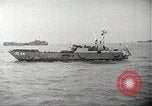
LSTs unload equipment and ammunition Omaha Beach in Normandy, France during World War II.
LCI(L)s approaching the Omaha Beach shore during the D-day invasion of Normandy in World War 2. Among those see is LCI(L)541. Officer calling with a megaphone from ship's deck. The LCIs advance toward the beach. Explosion seen ahead. U.S. troops wade from LCIs under continuous German machine gun fire. Larger Landing Ships Tank, including USS LST-282, waiting out of range of enemy fire. U.S. troops and motorized equipment on shore. Burning U.S. truck. Fallen U.S. soldiers in the sand.M4A1 Sherman tank with bulldozer blade and "DT-7" painted on its side, moving along Utah Beach. LCI(L)88 pulls up to a transport ship to load more troops for transport to the shore. Vehicles being transferred from an LST to a LCT. Larger vehicles, such as tanks, being transferred to "Rhino Ferries" (powered barges) to be taken ashore.Troop reinforcements being landed at the beachhead. Major General Charles H.Corlett, " Cowboy Pete," Commander of XIX Corps,US 1st Army, seen speaking on the radio, after landing on D-Day+4 (June 10th) at Omaha Beach, near Colleville-su-Mer. Army trucks drive ashore in surf. A buldozer moves in the surf.
CRITICALPAST.COM: About Us | Contact Us | FAQs - How to Order | License Agreement | My Account | My Lightboxes | Shopping Cart | Advanced Search | Featured Collections | Website Terms & Conditions | Privacy Policy ©2026 CriticalPast LLC.
License Agreement |
Terms & Conditions |
Privacy Policy
©2026 CriticalPast LLC.