


 Francais
 Deutsch
 Italiano
Refine Your Search
D-Day stock footage and images
- Showing 3793 to 3798 of 4856 results more
more Hide
Hide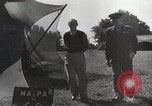
American Airborne assault on Netherlands and battle for Aachen, during World War II
U.S. General Dwight D. Eisenhower and British Marshal Bernard Montgomery walking together and consulting a map, during World War 2. Sky filled parachutes of American paratroopers dropping from U.S C-47 airplanes over the Netherlands, including point of view shot from camera attached or held by a parachuting soldier. View of soldiers at open door of aircraft as the paratroopers jump out. A German airplane shot down and crashing with an explosion. U.S. C-47 aircraft towing gliders. U.s. Gliders landing in farm fields, some upending in the process. Paratrooper using crash an ax in attempt to rescue injured soldier from a crashed glider. U.S. military vehicle driving across the Rhine River on the Remagen bridge. A fallen soldier on the bridge sidewalk. U.S. forces driving through Eindhoven, Netherlands. U.S. Army artillery firing on AAchen, Germany. U.S. P-38 aircraft bombing the city.Views of destroyed buildings in Aachen. A U.S. Sherman tank exiting tunnel to a street. Sign above tunnel reads: Aachen-RotheErde. Urban warfare in and around Aachen. U.S. tank destroyer firing. U.S. tanks firing. U.S.infantry firing small arms. House-to-house combat.German prisoners being escorted under armed guard. American flag being raised on municipal building in Aachen, Germany. German refugees from the city with their belongings. A German woman ,with her family, talks with an American soldier.
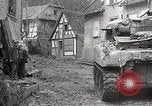
U.S. troops entering Germany during World War II. Rain causes much mud. General Eisenhower visits troops in the mud.
Allied forces entering Germany during World War 2. The German population is not welcoming. Rainy weather makes it difficult for armor and vehicles to move. U.S. soldier bailing water out of his trench. Troops slogging through mud with their mess kits. General Dwight D. Eisenhower visiting U.S. infantry at the front in the mud.
Operation Market Garden in Holland (1944) and Allied crossing of the Rhine, Germany (1945) in World War II.
U.S. paratroopers of the 82nd Airborne Division are seen silhoutted against sky as they board C-47 transport aircraft in Operation Market Garden mission to Grave and Nijmegen, Holland, in September, 1944, during World War 2. C-47 starts engines. C-47s take off towing gliders. Change of subject to Allied operations crossing the Rhine River into Germany in 1945. U.S. Army troops in a long boat powered by an outboard motor. U.S. troops board U.S. Navy amphibious assault boats on shore of the Rhine (Rhein) River. View from above of assault boats undergoing fire from German defenders during the crossing. U.S. troops moving quickly out of the assault boats on German soil. Scene shifts to airborne operations. View in cockpit of U.S. transport aircraft carrying U.S. paratroopers of the 17th Airborne Division, on joint British-American Operation Varsity, to drop paratroopers on the German side of the Rhine River. A C-46 transport aircraft, in flight, bearing Tail Code "H.". View from cargo compartment as 17th Airborne Division paratroopers exit very efficiently, by jumping from both doors of the C-46. Sky filled with parachutes. Scene shifts to ground operations. U.S. Army troops stand shoulder to shoulder on a section of pontoon bridge, as it is pushed across a river by Army engineers in two small power boats. U.S. tanks and vehicles crossing pontoon bridges. Supreme Allied Commander, Five-star General Dwight D. Eisenhower, stands with Lieutenant General William Hood Simpson, commander of the U.S. Ninth Army, as they observe Allied operations. American soldiers taking German prisoners of war. German POWs being escorted under guard and large numbers of them in an open field under U.S. guard.
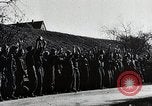
U.S. troops liberate American prisoners of war and enter a German concentration camp in World War II
U.S. troops liberate American prisoners of war at German camp during World War 2. Lieutenant Generals George Patton and Omar Bradley, together with General Dwight D. Eisenhower, and a U.S. Major General, walk through a liberated German concentration camp, followed by numerous other officers. The grounds are strewn with bodies of emaciated dead prisoners. Some are stacked up like cordwood. Some dead are carried off. Survivors are given medical attention and placed in ambulances or trucks. German civilians plundering shops and warehouses, and carrying off goods on carts.German women fighting over goods. Old man sleeping in street.
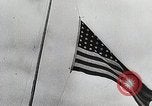
United States and Soviet soldiers meet at the Elbe River during World War II.
U.S. flag being lowered as bugler sounds and narrator alludes to the death of U.S. President Franklin D. Roosevelt, near the end of World War II. American troops and tanks rolling through German cities identified by narrator as Madeburg, Nuremberg and Leipzig, at end of World War 2 in Europe. U.S. troops cleaning out last vestiges of resistance in street fighting. Numerous German citizens lining sidewalks in city and waving white flags. On April 25, 1945, U.S. Army Second Lieutenant William Robertson with soldiers Frank Huff, James McDonnell and Paul Staub, meet Soviet Lieutenant Alexander Silvashko and several Soviet soldiers on the remnants of the Elbe bridge of Torgau. A U.S. Army Brigadier General mingling with Soviet officers. On April 26,1945, Major General Emil F. Reinhardt Commander of the U.S. 69th Infantry Division, walks with Soviet Major General Ruskovof the Soviet 58th Guards Rifle Division near Torgau. They are accompanied by other U.S. and Soviet officers. U.S. and Soviet officers exchange mutual salutes. U.S. and Soviet soldiers mingle, as a Soviet soldier plays accordian and some drink toasts, smoke cigarettes, and pose together. View of the Nazi party rally grounds in Nuremberg where a U.S. soldier is seen near the huge Swastika atop the Zeppelin Grandstand. Flashback views of Nazi rally there. Heinrich Himmler, Adolf Hitler and Viktor Lutze at the rally. Three American soldiers walking along the same walkway in the rally grounds. Explosion seen as the Nazi swastika symbol atop the Zeppelinfeld grandstand in Nuremberg is blown up by American troops.
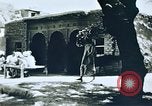
USIA film explaining its mission, inter alia, to correct misconceptions that people in foreign countries may have about America
Opening scenes shows men in in a South Asian village having intense discussions. (USIA wishes to inform such discussions.) The free world also has practical interests throughout the globe. Film shows two geologists holding up what appear to be sheets of mica. Women at work in a factory. Narrator suggests they are using scarce industrial materials (like tungsten). Men in a factory cutting mica. A man shoveling an agricultural product. Men carrying hemp and placing it on poles to dry. Impoverished Asian families. A man (ostensibly Communist agitator) speaking to Arabs. Marchers carrying large cartoon signs in Arabic, depicting "workers" striking down Uncle Sam and other Western powers. Narrator says deeds are more important than words. An American agricultural adviser is shown in a field with a native farmer. President Dwight D. Eisenhower seen standing with him, while Theodore Streibert is sworn in as first Director of the new U.S. Information Agency. Chart shows USIA absorbing information programs formerly administered by the Mutual Security Agency and State Department. Chart stating USIA mission is to: 1. Unite the free world; 2. Get the facts to people behind the iron Curtain; 3. Bring hope to captive peoples.
CRITICALPAST.COM: About Us | Contact Us | FAQs - How to Order | License Agreement | My Account | My Lightboxes | Shopping Cart | Advanced Search | Featured Collections | Website Terms & Conditions | Privacy Policy ©2026 CriticalPast LLC.
License Agreement |
Terms & Conditions |
Privacy Policy
©2026 CriticalPast LLC.