


 Francais
 Deutsch
 Italiano
Refine Your Search
D-Day stock footage and images
- Showing 3853 to 3858 of 4856 results more
more Hide
Hide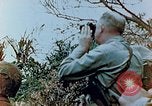
Brigadier General Edison with marines of the 2nd Marine Division on Saipan in World War II
Brigadier General Merritt Austin Edson, Assistant Commander of the 2d Marine Division looks through binoculars on Saipan, in World War 2. After surveying the battlefield, he discusses the situation with his staff officers. Marine gunners manning an M101, 105mm howitzer, under camouflage netting. They rapid- fire the howitzer. Numerous shells striking and Smoke drifting across the battlefield.
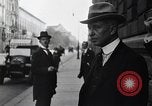
Dignitaries including Ellis Loring Dresel gather for signing of the U.S.-German Peace Treaty of 1921 in Berlin.
View of Ellis Loring Dresel, United States commissioner to Germany and chargé d'affaires for the United States in Germany, seen standing beside a building in Berlin. Men gather for the signing of the United States peace treaty with Germany in Berlin, almost three years after the World War I armistice was signed. Mr. Dresel and two other diplomats enter a 1920's car parked on the street, as a small crowd stands by. The Treaty document is shown for the camera, bearing the signature of Ellis Loring Dresel.
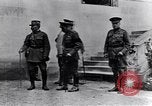
Britain’s King George V and Field Marshal Haig, meet with French Marshal Foch and Gerneral Petain just before the Armistice ending World War I.
Historic Meeting of Britain’s King George V with French Marshal Ferdinand Foch, British Field Marshal Douglas Haig, and French General Henri-Philippe Pétain, in France, on the eve of the Armistice, ending World War 1. King George V, wearing black mourning armband, begins to organize them to pose for photographs, at the foot of some stairs. They all do some shuffling to arrange themselves with due respect to rank, etc and end up with King George V in center of front row, with Haig and Petain to his left. To his right is Marshal Foch, French General Louis Franchet D'Esperey and British General Henry Rawlinson. Complete change of scene shows a clean shaven British military officer speaking with British Prime Minister David Lloyd George. The local city mayor is with them, dressed in ceremonial robes. A statesman, in top hat stands nearby. A uniformed man carries the Mayor’s maces. Next, Lloyd George and the British officer inspect troops, walking between flanks of British soldiers holding shouldered rifles.

How American women contributed to U.S. war efforts during World War II as well as World War I
Film begins showing women looking at a bulletin board advertising free war training classes, during World War 2. Women are seen in a classroom learning to be quality control inspectors in factories. Their instructor uses a large-scale model of a micrometer to illustrate its use. A giant slide rule is mounted on the wall in the background. Women are shown working in an aircraft factory drafting room, preparing drawings for parts. Scene changes to women war production workers being trained as welders. A woman is seen teaching another to operate a drill press. Another woman is being trained to us a metal turning lathe in a machine shop. An employee patch on her right shoulder reads: "Bendix Aviation." Next, a woman is seen guiding a DC-3 commercial airplane into its parking place on an airport. A crew of women works to clean and maintain commercial aircraft in a hangar. Another crew of women climbs aboard a steam locomotive to clean and otherwise maintain it. A woman working as a commercial bus driver, picks up a passenger. Women serving in a messenger service company. A woman running an elevator in an office building. A woman making milk deliveries to a home. Women driving tractors on the large farms of the Midwest. Others run a harvester pulled by a team of 20 mules. A few men express reservations about the ability of women to work outside the home while still caring for families. Complete change of scene shows newsreels from World War 1 with men in uniforms marching. Nurses served overseas at base hospitals. But teams of women also supplemented for missing men in other occupations. One scene shows them shoveling debris into railroad open cars. Another showed women working in a lumber yard and also plowing fields on a farm. So-called Yeomanettes (World War I version of later era Waves) are seen on parade in uniform. Old newsreel shows U.S. Secretary of the Navy, Josephus Daniels, reviewing Yeomanettes, as his assistant Secretary, Franklin D. Roosevelt, converses with Vice Admiral William Sims. Film shifts back to World War II showing women in Army uniforms parading, glimpse of others who appear to be pilots. Film ends with montage of views seen earlier in the film.
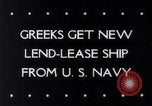
President Roosevelt presents a Lend-lease Patrol Craft to the Greek Navy, at the Washington Navy Yard, Washington DC
Greece receives a lend-lease Submarine Chaser (USS PC 622) in Washington DC. President Franklin D. Roosevelt, and Officers and sailors of the U.S. and Royal Hellenic Navy attend the formal transfer ceremony at at the Washington Navy yard. Greek sailors wear caps displaying the words, "B Naytikon." The United States flag is lowered and the Greek flag hoisted on the ship. (The Greek Navy renamed the ship the "Vassilefs Georghios II.")
Saigon City Hall in Saigon, Vietnam.
The Saigon City Hall in Saigon Vietnam. A large picture of Premier Ngo Dinh Diem can be seen over the front entrance of the city hall (Số 86 Đ. Lê Thánh Tôn, Bến Nghé, Quận 1, Thành phố Hồ Chí Minh 710212, Vietnam). Motorists and cyclists pass by the hall entrance.
CRITICALPAST.COM: About Us | Contact Us | FAQs - How to Order | License Agreement | My Account | My Lightboxes | Shopping Cart | Advanced Search | Featured Collections | Website Terms & Conditions | Privacy Policy ©2026 CriticalPast LLC.
License Agreement |
Terms & Conditions |
Privacy Policy
©2026 CriticalPast LLC.