


 Francais
 Deutsch
 Italiano
Refine Your Search
D-Day stock footage and images
- Showing 3991 to 3996 of 4856 results more
more Hide
Hide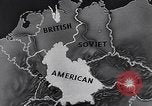
Military and German Police try to stop gun runners and black marketing and conduct free elections in Germany after World War 2
A map shows the United States, British and Soviet occupied zones in Germany after World War II. American and French police checks papers and belongings of Germans entering their zone. They chase and capture a gun runner car and remove a weapon from the back seat. Scene in a building depicts young Nazi die hard followers in a "werewolf gang" meeting in secret to plot how to continue Nazi Germany. German civilians gathered exchanging items in black market activity. U.S. occupation soldiers sell cigarettes in black market to German civilians. German police raid a black market exchange area and arrest many German citizens, rounding them up and loading them onto a truck. A captured German woman cyring. German de-nazification trials at a court in session. At a news conference, U.S. Army General Lucius D. Clay speaks about measures to build democratic processes in Germany, starting with local elections. A leader speaks at a political party meeting. German civilians vote at first free elections after World War II. A German man acts with servility before a U.S. officer and looks vindictively in direction of officer after leaving his room. Narrator describes German people post-war as egotistical people.
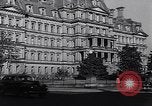
British, Soviet and U.S. officials meet and discuss industrial, agricultural and civil rebuilding of Germany after World War II.
Industrial, agricultural and civil rebuilding of Germany after World War II. State Department building in Washington DC. Secretory of States, James F. Byrnes dictates to secretary. General Luicius D Clay speaks to the members of British Occupational government. Ernest Bevin, Vyacheslav Molotov and James F. Byrnes pose for a group photograph. German farmers in an agricultural field. Men and woman plow farm by horse cart. Worker watches a factory kiln with molten metal. Cavaliers of American Military Police on horse back patrol on the streets in Germany with a destroyed cathedral in the background. They cross a bridge with sign Herkules Bridge. German workers make farm equipment and a German family with young children eats a meal.
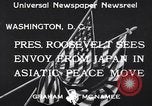
Japanese envoy Viscount Ishii and others received by U.S. President Roosevelt and First Lady at White House in Washington DC.
Japanese diplomat Viscount Ishii Kikujirō and other delegates received by United States President Franklin D Roosevelt and First Lady Eleanor Roosevelt at the White House in Washington DC. Military officials salute the dignitaries. Envoy Ishii shakes hands with President Roosevelt and poses for a photograph. Mr. and Mrs. Roosevelt and the guests pose for a group photo prior to an important conference regarding Japanese military policy in Manchuria.

16 million men register themselves in United States for the WWII draft, and President Roosevelt addresses from White House.
As World War II heats up, 16,500,000 men between ages 21 to 36 register themselves throughout the United States, signing up during the first peacetime conscription in U.S. history. (This was triggered by passage of the Selective Training and Service Act of 1940, also known as the Burke-Wadsworth Act, the genesis of "Selective Service.") Opening scene shows men lining up to register for the draft before the United States entered World War 2. Views of men filing out their registration forms. At 00:22 famous prize fighter, Barney Ross, is being registered. (He jokes that the registrar shaking his hand has too strong a grip.) At 00:34 Hollywood cowboy Gene Autry is seen registering. Close up view of street signs at Chinatown intersection of Bayard Street and Mott Street in New York City. Sign below it notes "School Street. Drive Slowly. Make no unnecessary noise." Line of many registrants of Chinese-American descent waiting in line, and processing paperwork. Scene changes to another area of the city, where a line of mostly African American men wait outside a registration building. Some cheer and wave for the camera. A police officer at the entrance hustles them inside, pulling some of them along. View of the exterior of the White House in Washington DC. United States President Franklin D Roosevelt addresses the nation's men of draft age, telling them that the call up of 800,000 men for training in year one, and less than one million men in each subsequent year, is a program of defensive preparation only. Roosevelt says to the registrants that "Democracy is your cause. The cause of youth." ( Note: clip is silent except for President Roosevelt speaking at the end.)

General Eisenhower and other generals of Allied Forces visit Feldafing Displaced Persons' (DP) Camp in Wolfratshausen, Germany.
Generals of the Allied Forces visit the Displaced Persons' (DP) Camps in Wolfratshausen, Germany. General Dwight D Eisenhower, General George S Patton and Major General Louis Craig, CG 20th Corps visit Feldafing Camp. The car of the Generals. General Eisenhower talks with other officers. Generals watch children at the camp. People surround and watch curiously as the Generals enters a barracks area with a red cross symbol over the door. Images inside are dark, but they appear to be touring the barracks facility and talking to staff. Final brief scene shows the generals entering a building that appears to have been setup as a synagogue. (World War II period).
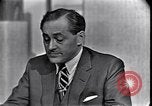
Elected officials from various states arrive at Andrews Air Force Base, to pay last respect to former President Kennedy
View of airfield at Andrews Air Force Base in Washington D.C. where dignitaries are arriving to pay last respects to the Kennedy family after the assassination of President Kennedy. Governor Reed of Maine is seen leaving the air base in a car. Governor Ross Barnett of Mississippi arrives in C-47 aircraft at the air base. President Johnson is seen entering his Vice President's office.
CRITICALPAST.COM: About Us | Contact Us | FAQs - How to Order | License Agreement | My Account | My Lightboxes | Shopping Cart | Advanced Search | Featured Collections | Website Terms & Conditions | Privacy Policy ©2026 CriticalPast LLC.
License Agreement |
Terms & Conditions |
Privacy Policy
©2026 CriticalPast LLC.