


 Francais
 Deutsch
 Italiano
Refine Your Search
D-Day stock footage and images
- Showing 4447 to 4452 of 4856 results more
more Hide
Hide
British prosecutor Shawcross presents crimes by Nazi leaders during Nuremberg Trials; scenes from Molotov-Ribbentrop Pact signing
Trial of Nazi leaders for war crimes in Nuremberg, Germany soon after the end of World War 2. British Chief Prosecutor Hartly W Shawcross presents count no 2, crimes against peace involving wars of aggression in violation of international treaties and agreements. A document reveals Adolf Hitler's plans to occupy Poland. Footage showing Soviet Leader Joseph Stalin and Germany's Joachim Von Ribbentrop as they sign non-aggression pact between Russia and Germany on August 23, 1939 (also called the Molotov-Ribbentrop Pact). Germany prepares to occupy Poland as Pope Pius XII and President Franklin D Roosevelt appeal for peace just before start of World War II.
German invasion of Poland and Denmark at start of World War II
Adolf Hitler addressing the Reichstag, meeting in the Kroll Opera House makes fun of an April 1939, letter from President Franklin D. Roosevelt. Hitler reads a list of countries that FDR asked him not to invade. As he drones on through the extensive list, it becomes comical and the Reichstag member burst out in laughter. Next heavy guns are seen firing and formations of German Junkers JU-52 airplanes flying overhead as narrator cites September 1st 1939 and the German invasion of Poland as start of World War 2. Motorized German forces, and infantry are seen rushing across the landscape. German 17 cm Kanone 18 guns are seen firing. Formations of German JU 87 Stuka dive bombers in flight and Heinkel He 111 bombers dropping bombs on Poland. Bombs exploding and devastation on the ground with buildings burning and collapsing. Aerial view of Polish city being bombed. Huge number of disarmed Polish Army prisoners of war walking along roads. German troops marching into Copenhagen, Denmark in 1940
FDR announces formation of Civilian Conservation Corps (CCC) and many work in Forest Service improving fire control
Crews of American young men loading up and organizing for training in fire fighting duties, circa 1920. Unemployed workers in lines and waiting queues in 1933 during Great Depression. President Franklin D. Roosevelt announces the formation of Civilian Conservation Corps. Civilian Conservation Corps men of the forest service, at work, setting up telephone poles, stringing wire, building roads, building fire lookout towers, and helping to fight fires.
General Ridgway takes over as the Supreme Commander of the UN forces in Korea amidst a mixed opinion back home.
United States President Harry S. Truman dismisses General Douglas MacArthur during the Korean War. General Matthew B. Ridgway takes over as the Supreme Commander of the U.S. and UN forces in Korea after General MacArthur's dismissal. United States Capitol in Washington D.C., United States. Various Congressmen express their opinion over the issue of the dismissal of General MacArthur. Representative Morgan supports President's decision to dismiss General MacArthur. Senator Ferguson from Michigan speaks against the decision to dismiss him. Whereas Senator Hill believes that the matter must be judged on its merit rather than on politics.
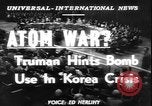
Truman hints potential of atomic bomb use in Korea; At UN, Korea questions Chinese delegates about Chinese aggression in Korea
Korean War and the World politics of the times. United States President Harry S. Truman during an address in Washington D.C. states that United States believes in a peaceful world order. He also hints of nuclear weapons use in Korea if peace is threatened. United States forces in Korea face the Red Chinese armies. Artillery being fired and explosions occur at the front. At the United Nations Security Council meeting in New York representative of Republic of Korea questions the Chinese delegates regarding the Chinese aggression on Korea. United States delegate Warren Austin also expresses worry over the fate of world peace in the light of Korean War.
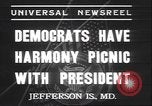
Democrats enjoy a picnic with President Roosevelt as they play baseball at Jefferson Island, Maryland.
U.S. President Franklin D. Roosevelt on a picnic with Democrats at Jefferson Island, Maryland. Members of the Democratic Party prepare to play baseball. A baseball game underway. The Democrats gather around President Roosevelt as they laugh and greet the President. The Democrats walk down a pier after the picnic.
CRITICALPAST.COM: About Us | Contact Us | FAQs - How to Order | License Agreement | My Account | My Lightboxes | Shopping Cart | Advanced Search | Featured Collections | Website Terms & Conditions | Privacy Policy ©2026 CriticalPast LLC.
License Agreement |
Terms & Conditions |
Privacy Policy
©2026 CriticalPast LLC.