


 Francais
 Deutsch
 Italiano

Refine Your Search
D-Day stock footage and images
- Showing 445 to 450 of 4874 results more
 Hide
Color Sound
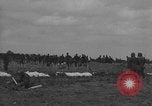
Graves being prepared for fallen U.S. troops at the temporary American St. Laurent Cemetery, in France, during World War II.
German prisoners of war at work digging graves for fallen American soldiers, at the temporary American St. Laurent Cemetery, established by the U.S. First Army on June 8, 1944, shortly after the D-Day invasion of Normandy (Operation Overlord). This is the first American cemetery on European soil in World War II, and located on a cliff overlooking Omaha Beach and the English Channel, east of St. Laurent-sur-Mer and northwest of Bayeux in Colleville-sur-Mer. (It is now the Normandy American Cemetery and Memorial.) Vertical posts with dog tags attached, mark the gravesites of the fallen troops. American soldiers sit near covered dead bodies of the fallen and perform tasks of identification and grave assignment. Covered remains of one soldier are carried across the field on a stretcher. Barrage balloons are seen in the sky overhead.
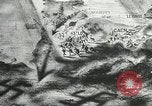
U.S.troops advance to Saint Lo in operation Cobra. U.S. 3rd Army advancing rapidly into Rennes, France, in World War II
Map showing path of Allied advance after D-day invasion in World War 2. German Marshal Rommel with staff. German artillery and armor firing. American heavy artillery, armor, and infantry advancing toward St. Lo in operation Cobra. Lieutenant General Omar Bradley, Lieutenant General Lesley James McNair, and Major General J. Lawton Collins, walking near the battle front. U.S. Army Air forces B-26 bombers dropping bombs at the front lines.(General McNair was killed by friendly bombers on July 25th in these operations.) U.S. infantry entering Saint Lo. House to house fighting and German soldiers taken prisoner.U.S.Sherman tanks firing point blank at houses and buildings.Large number of German prisoners being marched under guard with their hands over their heads. A wounded Allied officer being helped into a vehicle. Women and children refugees walking and in horse drawn wagons.French woman sorts through rubble trying to salvage some belongings. African American tank crewmen of the 761st Tank Battalion, operating with the U.S. 3rd Army, seen relaxing against a stone wall; cleaning their tank guns; and driving their Sherman tanks at high speed along dirt roads.General George Patton, Commander of the 3rd Army, looking through binoculars. French civilians waving enthusiastically as American armor drives through their villages. American forces arriving in Rennes, France, greeted by huge crowds and church bells ringing.
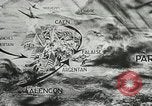
Allied forces closing in on German forces at Falaise, France, during World War II
Animated map depicts Allied and polish troops advancing toward Falaise, and American forces advancing toward Argentan, France, during World War 2. German forces stringing communications wire in the battle area. Allied forces setting up heavy field artillery. British Typhoon aircraft being armed and taking off. U.S. Army Air Forces Martin Marauder B-26 aircraft flying low overhead. U.S. and British soldiers in fox holes waiting with weapons at the ready. Close-up of African-American soldier's face. Suddenly, all artillery begins firing. A U.S. P-38 strafing and a P-47 aircraft dropping a bomb. U.S. artillery gun with "comment-Charlie" written on its barrel. Formation of British Avro 679 Manchester bombers in D-Day stripes. Allied pilot at controls in cockpit of bomber. Formation of U.S. Martin B-26 bombers in flight. Pilot in cockpit. Formation of British Hawker Typhoon aircraft. They peel off and two are seen firing rockets. American artillerymen firing heavy guns. British infantry pinned down on a roadside and firing mortars from foxholes. American troops firing mortars. German troops running to surrender. German soldiers surrendering under a white flag. Allied gun camera footage of a vehicle being strafed on a road. Several U.S. P-51 fighter aircraft with striped wing invasion paint roaring overhead. More surrendering German soldiers running forward. A U.S. B-26 bomber on bomb run with view of bombardier inside. Smoke and explosion scenes present throughout the footage.
U.S. soldiers in England, install wire cutters on U.S. jeeps before shipping them to France, during World War II.
U.S. soldiers of the 87th Chemical Battalion (mortar) make field modifications by installing wire cutters on army jeeps, at the D-Day Marshalling Area Camp in Shiphay, Torquay, (Devon) England during World War 2. U.S. soldier paints an angle iron vertical post (wire cutter) fastened on bumper of a jeep. He pastes U.S. flag on the windshield and writes OK in chalk on the front bumper. Line of modified jeeps travel along road after completing check ups. Soldiers use hack saws to cut pieces of metal and hand drills to put holes in bumpers where angle iron wire cutters will be fastened. They use files to take sharp edges off the angle irons. A soldier slips washers and bolts on an angle iron and tightens them with an adjustable wrench. (Note: These angle iron vertical rods, mounted on a vehicle front bumper, were meant to protect jeep occupants by catching and cutting wires that might be strung across roads to injure or kill unprotected drivers of open vehicles, such as Jeeps.)
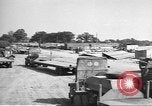
U.S. Waco CG-4 assault gliders being assembled at RAF Station Greenham Common , England during World War II.
U.S. gliders being assembled at RAF Greenham Common, England, in preparation for the D-Day invasion during World War II. Truck trailers arrive at the airfield. Packing crates placed on field. Workmen assemble U.S. Waco CG-4 assault gliders. Man directs arriving vehicles. Light tractor pulls crate loaded with glider part. Truck loaded with men arrives. Men work under the wing of a glider.
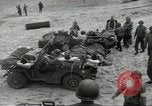
Wounded U.S. soldiers are transported to LST (Landing Ship Tank) beached in Normandy during World War II.
Wounded U.S. soldiers are transported from beach to LST (Landing Ship, Tank) after D-Day Allied invasion of Normandy in World War II. Jeeps and trucks loaded with wounded soldiers pulling away on beach. Landing craft beached in the background. DUKW (six-wheel-drive amphibious truck) leaves shore and goes into water. DUKW enters LST. Wounded soldiers lying in rows of cots aboard the LST. View of many LSTs in the shallows.
CRITICALPAST.COM: About Us | Contact Us | FAQs - How to Order | License Agreement | My Account | My Lightboxes | Shopping Cart | Advanced Search | Featured Collections | Website Terms & Conditions | Privacy Policy ©2026 CriticalPast LLC.
License Agreement |
Terms & Conditions |
Privacy Policy
©2026 CriticalPast LLC.