


 Francais
 Deutsch
 Italiano
Refine Your Search
D-Day stock footage and images
- Showing 577 to 582 of 4857 results more
more Hide
Hide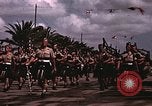
U.S. Army General Eisenhower and a French General review troops during Victory Day parade in Tunis, Tunisia.
Victory Day parade in Tunis, Tunisia during World War II. Troops of Allied nations march during the parade. A British military band playing instruments moves in the parade. A French military band follows it. A car with motorcycle escorts passes during the parade. U.S. Army General Dwight D. Eisenhower and a French General inspecting the troops. Other officers walking behind them. The Generals mounting a reviewing stand. The officers standing behind the stand watch the Generals. The Generals and the officers stand at attention on the stand. American, French and British flags on poles on the reviewing stand. Horse mounted troops march past the reviewing stand. A French Army band marching on the road. Troops holding guns march in formation during the parade.

Troops of Allied nations march during Victory Day parade in Tunis, Tunisia during World War II.
Victory Day parade in Tunis, Tunisia during World War II. Troops of Allied nations on armored vehicles during the parade. A few officers standing in front of a crowd on the side of a road and watching the parade. Armored tanks and trucks moving in the parade. U.S. Army General Dwight D. Eisenhower and a French General on a reviewing stand with other officers. The Generals and the officers talking. An army jeep with officers and motorcycles moving on the road during the parade.
Franklin D Roosevelt entertains Churchill, King Farouk, King Ibn Saud aboard a ship following the Yalta conference.
U.S. President Franklin D Roosevelt and other officials at a conference in Alexandria, Egypt, during World War 2. On February 12th Roosevelt flies to Egypt with an escort of fighter planes and lands at an airport. The President's daughter, Mrs Boettiger (Anna Eleanor Roosevelt Dall Boettiger) steps off the plane, first. Insignia of the United States. President Roosevelt leaves by car for Great Bitter Lake on the Suez canal to board the warship which awaits him. The sailors salute King Farouk of Egypt when he visits Franklin D Roosevelt on the warship. Roosevelt and the King and his officials take lunch on the ship. The flag of the United States. Roosevelt and King Farouk seated. Emperor Haile Selassie of Ethiopia arrives and greets Roosevelt and his daughter. The President and the Emperor sit and talk. Next day another warship arrives. King Ibn Saud of Saudi Arabia, his sons and entourage. The King (also called King Abdulaziz) is escorted aboard to meet U.S. President and other officials. The sailors salute. Arab chieftains accompanying him seated on the deck. The King's four sons sit with Roosevelt. Colonel William A Eddy a retired Marine officer U.S. minister to Saudi Arabia acts as interpreter. King Ibn Saud of Saudi Arabia returns to his ship and leaves. Roosevelt leaves for Alexandria. At Alexandria British Prime Minister Churchill and his daughter join Roosevelt on the ship for further talk. As he came aboard he is greeted by Admiral William D. Leahy. Mr Harry Hopkins already on ship. Edward Stettinius U.S. Secretary of State gets off and joins them, then ambassador Winant joined they are greeted. Officials pose for a photograph.
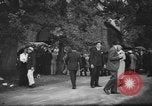
Franklin D. Roosevelt , Jr. marries Ethel du Pont at a ceremony in Christ Church Christiana Hundred, Wilmington, Delaware, United States
Events of 1937. Wedding of President Franklin D. Roosevelt's son Franklin D. Roosevelt, Jr. in Wilmington, Delaware. Several prominent figures arrive to attend the wedding including James Farley, Cabinet Secretaries, Daniel Roper, and Henry Wallace. American socialite and bride Ethel du Pont arrives. Attendants carry the train of Ms. Du Pont’s veil. Ethel du Pont smiles on her wedding day. Exteriors of the Episcopal Christ Church Christiana Hundred (505 Buck Rd, Wilmington, DE 19807, United States). The newlywed couple Franklin D. Roosevelt, Jr. and Ethel du Pont pose after the wedding. President Franklin Roosevelt along with his wife Eleanor Roosevelt.

Company D, United States 87th Chemical Mortar Battalion soldiers dig emplacement and assemble a chemical mortar near Carentan, France.
Soldiers of Company D of the United States 87th Chemical Mortar Battalion near Carentan, France during World War II. A soldier, Corporal George Kowach, takes target information from a forward observer team over a field phone at a mortar command post. He relays this information to his platoon leader, First Lieutenant Charles W. Kidd, who plots the target on a map and writes coordinate information into his notebook. The target plot will be passed to the gun positions for firing. Company D soldiers dig an emplacement in a field. Soldiers assemble 4.2 chemical mortar in preparation for the fire mission. (Note: On this day, Company D, operating in support of the 12th Infantry Regiment, 4th Infantry Division, fired 85 rounds on strong points and hedgerow defenses.)
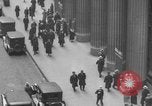
Man exchanges guitar for basket of fruits in the barter system after inauguration of Franklin D Roosevelt in Washington DC.
Great Depression footage after the inauguration of Franklin D Roosevelt as the President of the U.S. in Washington D.C. in 1933. During a bank holiday two day after the inauguration of Franklin D Roosevelt as the President of the US, vehicles move on the streets. Long lines of civilians move on the streets. Man makes a genuine hand made "depression dollar." which is made out of rubber. He demonstrates how it can grow for inflation by stretching. He displays the dollar designed for inflation. Other man stretches the dollar. Man approaches a merchant. He exchanges his guitar for basket of fruits under the barter system which was common in the depression. Footage is from a 1958 newsreel recounting events 25 years earlier.
CRITICALPAST.COM: About Us | Contact Us | FAQs - How to Order | License Agreement | My Account | My Lightboxes | Shopping Cart | Advanced Search | Featured Collections | Website Terms & Conditions | Privacy Policy ©2026 CriticalPast LLC.
License Agreement |
Terms & Conditions |
Privacy Policy
©2026 CriticalPast LLC.