


 Francais
 Deutsch
 Italiano
Refine Your Search
Dong Tam Vietnam 1968 stock footage and images
- Showing 2383 to 2388 of 4393 results more
more Hide
Hide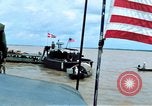
PBR crewmen check ID cards and an injured Vietnamese at the Binh Thuy Air Base, Mekong Delta, Republic of Vietnam.
A feature film about PBR (Patrol Boat River) at Binh Thuy Air Base, Mekong Delta, Republic of Vietnam. A camera boat approaches. American flags on the camera boats. A small sampan pass by. The stern of a PBR to a sampan along the port quarter. Vietnamese on the stern of the sampan. An interpreter talks to the Vietnamese. A PBR crewman talks to an elder woman on the sampan. South Vietnamese flags seen on the sampans. A crewman checks paperwork and he steps aboard the sampan. The Vietnamese on the stern is apparently a detainee. An injured Vietnamese being helped and bandaged on the deck of the PBR. A Vietnamese carries a wounded woman from the boat. The woman lying on the pier. Vietnamese carry off the injured woman on a stretcher. (Vietnam War period).
U.S. Army Special Forces in operation during the Vietnam War
U.S. Army Special Forces operating near Ba Me Ga west of Ban Me Thout, Vietnam. A Special Forces Mobile Strike Force (Mike Force) soldier slits open a Vietcong rice bag. The team encounters a dying Vietcong soldier in brush. Mike Force member searches the VC's body for documents. Information about Vietcong anti-tank mines and tax collection documents are reportedly found on the VC. ( Note: It has also been reported that some elements of the Mike Force unit drove over an uncharted anti tank mine on the way back to base, after the mission, killing and wounding members of Special Forces, Australian Army Training Team Vietnam, and Montagnard strike force troopers.)
Captain James S. Walbridge being interviewed in Thailand about his experiences during a mission in North Vietnam.
United States Air Force Major James Walbridge being interviewed at Korat air base in Thailand during Vietnam War. Major James S. Walbridge being interviewed by Captain Charles D. Pellow with a United States F-105D aircraft in the background. Major Walbridge narrates his experiences of a mission in North Vietnam during the Vietnam war. He talks about how while carrying 750 lb bombs to strike North Vietnam his aircraft caught fire. He jumped from the plane with a parachute and landed up on the trunk of a tree. He speaks about the rescue from the jungle. He stresses upon the importance of radio as he states how he called for help from his radio. Audio explains about Walbridge's rescue from the jungle. Walbridge emphasizes upon the importance of a survival kit.
Training of soldiers at Fort Riley, Kansas, before deployment to Vietnam.
U.S. Vietnam veteran Army Sergeants instruct troops prepaing for deployment to Vietnam. Live fire training at a firing range. "Quick Kill" weapon pointing technique is taught, using "BB" air powered gun and aluminum disks. M-16 training. Two-week refresher course, at Fort Riley, Kansas, for Non-commissioned officers, preparing to return to war in Vietnam. (Vietnam War period).
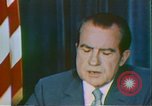
U.S. President Richard Nixon works for peaceful end of Vietnam War, improves domestic conditions and controls drug traffic.
U.S. President Richard Nixon speaks about aftermath of immediate withdrawal from the Vietnam War. U.S. military prisoners of war held by North Vietnam stand before press reporters in Vietnam. President confers with U.S. Secretary of State Dr. Henry Kissinger at his office. Vietnam War draftees being selected by traditional lottery system. Men stand in front of machines that churn out numbered balls for new draft lottery system. Nixon transforms budget expenditure on human needs. Criminals caught by police walk, some covering their faces from the media, as they are led away by police and investigators. Illegal drugs seized by efforts of Nixon administration. View of seized heroin manufacturing equipment. Nixon speaks about the opium farming in Turkey during one of his speeches and mentions agreement with the Turkish government in Ankara to cease all opium poppy production. Customs officers check illegal drug traffic on the border of Mexico and America. Drug enforcement officials search cargo hold of a ship for illegal drugs. Views of drug control officers finding illegal stashed hidden drugs in hiding places in cars and vehicles. Nixon speaks about increased budget to control illegal drug traffic and rehabilitation of drug abusers and drug addicts. He creates the office of Drug Abuse Enforcement and he speaks saying "We must wage what I have called Total War against public enemy number one in the United States: The problem of dangerous drugs." From a pro-Nixon "documentary" called "The Nixon Years: Change Without Chaos" covering President Richard Nixon's first four years in office. Released during his 1972 reelection campaign.
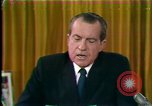
U.S. President Richard Nixon addresses nation about Vietnam War, from White House, Washington DC.
Stand of U.S. President Richard Nixon on Vietnam War. President Nixon addresses the nation about the Vietnam War from White House. He explains what has been described as "The Nixon Doctrine" regarding U.S. involvement in war, foreign policy support, and defense of freedom. He discusses the concept of helping other nations fight wars, rather than fighting wars for them. He illustrates this approach in describing U.S. efforts in Vietnam. He promises that 20% of U.S. combat forces will return by mid December. He notes he will not reveal withdrawal decisions that will compromise efforts at the Paris talks. He indicates he will pursue a path seeking a just peace through a negotiated settlement or through continued vietnamization.