


 Francais
 Deutsch
 Italiano
Refine Your Search
Eboli Italy 1944 stock footage and images
- Showing 91 to 96 of 7969 results more
more Hide
Hide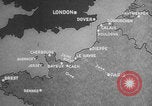
German troops reinforce defenses in Southern France after Allied 1944 invasion of Normandy in World War II
Film opens with map of western coast and towns in France. Camouflaged trucks filled with German infantry drive along rural French road in World War 2. Closeup of smiling soldiers in one truck. A makeshift sign reads (in German) "One-way street to the front." A soldier passes out newspapers to other soldiers riding bicycles. Closeup of a soldier reading the newspaper. Closeup of the paper has headline reading (in German) "Eisenhower has not surprised us." Troops on bicycles ride through a village. Large wooden sign warns (in German) that the enemy understands things you might say about military activities. Camouflaged vehicles drive along a road, passing overturned civilian vehicles at the sides of the road. View from rear of German soldier on motorcycle, with foliage on his helmet, looking skyward for aircraft. Formations of Allied aircraft are seen overhead, and German troops seek protection in ditches at side of the road. Scene shifts to German troops firing anti-aircraft guns at the planes. Black flak clouds are seen near the Allied airplanes. A lone B-17 bomber is seen overhead. Next, burning wreckage of an aircraft is seen strewn across a field. No markings are visible on the wreckage. A sign identifies the town of Avranches in Southern France. German infantry enter the war-torn town on civilian cars and other vehicles of opportunity and motorcycles. A German half track personnel carrier tows an artillery field piece.
Warsaw bombed by Germans in retaliation to 1944 uprising, various scenes of Warsaw before WW2
Newspapers around the world reporting on the bombing of Warsaw by Nazi Germany as retaliation for the Warsaw Uprising during World War 2. Newspaper headlines read, "Poles Fighting Inside Warsaw," and "Warsaw Being Razed by Hitler's Order," and "Warsaw's Plight" and "Warsaw Poles Fight Tanks in Streets." Scenes of Warsaw in flames as buildings are being bombed by German forces. Montage depicting Warsaw on fire. Scenes of Warsaw before WWII, including scenes such as the Warsaw Old Town Market Square (rynek Starego Miasta, 00-279 Warszawa, Poland), the column of Sigismund III Vasa (plac Zamkowy, 00-001 Warszawa, Poland), the Royal Palace (plac Zamkowy 4, 00-277 Warszawa, Poland) and the Lazienki Park, before World War 2. Statue of King Jan III Sobieski in Lazienki Park. Men strolling near a palace. Baroque gates in park.

Newly naturalized Americans recite the Pledge of Allegiance during the 1944 “I Am An American Day” (WWII)
More than a million people attend the “I Am An American Day” citizenship ceremony in Central Park in New York City, during World War 2. Over 150,000 people attended the ceremony as newly naturalized American citizens. Native American Indians in traditional dress and women and men in military uniform attend the ceremony. Flags of various nations are flown. Wounded Army soldiers and wounded Navy sailors arrive as guests of honor. New York City Mayor Fiorello LaGuardia shakes hands with servicemen, giving tribute to their heroism during World War II. Immigrants stand up to recite the Pledge of Allegiance to the United States of America as part of the naturalization ceremony. Speaker recites the Pledge of Allegiance, which predates the inclusion of "under God" which was added later in the 1950s.

Allied assaults against the German Gustav Line at Monte Cassino, Italy during World War II
Opening scene shows peaceful Italian mountains, including one snow-capped, in Spring, 1944, during World War 2. Camera focuses on the town of Monte Cassino and its historic Monastery, on a mountain above the town. (German forces held the Rapido-Gari, Liri and Garigliano valleys and some of the surrounding peaks and ridges that formed the heavily defended Gustav Line.) Animated relief map shows where, by mid January, 1944, American, Polish, and British forces had cleared the enemy from mountains east of Cassino and drawn up on the east side of the Rapido valley. Map shows progress of subsequent Allied attacks that finally reached Mount Castellone and then up Abbey Hill at Monte cassino, itself. Image of German soldier is superimposed on the scene, using binoculars on Abbey hilltop to observe Allied forces. (Narrator states: On February 9th, 75 yards from the abbey, we were stuck.") U.S. Army Air Forces Douglas A-20 Havoc aircraft are seen starting engines. Closeup of Fifth Army leaflet warning the local people to leave the Monte Cassino Abbey to avoid shelling and bombing. View of U.S. troops packing the leaflets into thin-skinned shells to deliver the warning by artillery fire. Next, 105 howitzer guns are seen under camouflage netting, firing bombardments of warning shells. Formation of A-20 aircraft taking off. Aerial view from high above, of B-25 bomber formation in flight. Formations of B-17s, B-24s, B-26s in flight enroute to bomb Monte Cassino. Bombs dropping from B-25 Mitchell bombers. Bombs exploding on Monte Cassino and the Abbey. Batteries of 155 mm guns firing. Formation of 6 B-25 bombers in formation. More bombs bursting on Monte Cassino. Animated map shows German forces taking up their earlier defenses again following the Allied artillery and air attacks. It also shows supplies streaming in to the German Green Devils Parachute Division (Luftwaffe’s 1st Fallschirmjaeger [Parachute-Hunter] division.) The map illustrates all the locations in the town that they occupied and would defend to the last man. Map also illustrates circling positions of Allied artillery batteries. Camera focuses on Polish troops and M4 Sherman tanks moving forward in an offensive. Glimpse of U.S. Army Air Forces mechanics working on a Douglas bomber engine. M4 prime movers towing 155mm howitzer guns. Gun crews camouflaging their positions with netting. Various views of A 240mm howitzer being put in place by a crane. Soldiers deploy detector microphones to locate enemy gunfire sources. They test them, and then enclose them in water-proof containers, bury and cover them. Sound from the microphones being recorded on film at a machine in the Command Post. The data being plotted on a map and corresponding grid locations phoned to Battalion headquarters. View of bombers resuming attacks again, on March 15, 1944. Formations of Douglas bombers, followed by B-25s, seen dropping bombs that explode in the town of Monte Cassino. Artillery firing. Formation of B-24 Liberator bombers in flight. Formation of B-17s dropping bombs. String of bombs exploding in a line on the town. More views of artillery barrages. More lines of bombs exploding. Allied forces storming the shattered town found German soldiers using destroyed structures as shelters to fire from and rubble obstructing the movements of Allied tanks, so the Allied advance was again stopped. Later, a newspaper headline reports resumption of Allied offensive.
Allied troops fighting toward and entering Rome, Italy during World War 2
British and troop patrols converge on the road to Rome, in the beginning of this film. Soldiers of the 1st Canadian Infantry Division and 5th Canadian Armored Division are seen next, mopping up after breaching the Hitler Line, on 24 May 1944. They are seen leaving the area to advance further. Brief view of soldiers tending to a tank and marching past an abandoned anti-aircraft gun. Captured German prisoners march rearward along a road as a camouflaged (with foliage) Canadian M4 Sherman tank advances along a road. It carries many infantrymen riding along atop it. (Narrator states they are en route to Pontecarvo.) Allied artillery pounds the ruined streets of the city. Canadian troops are seen next,entering the destroyed town of Aquino. British Hawker fighter planes flying over water in trail formation, behind the camera plane. Allied patrol from the Anzio front engages a German strong point, using bazookas and small arms. Glimpse of burning German armored vehicle. Polish troops are seen entering the village of Piedimonte. They pull a German from his hideout in a trench. German prisoners marching under guard. Stretcher bearers carry wounded to an open field where they are being tended. Polish forces hold a ceremonial parade where British General Sir Harold Alexander decorates a Polish soldier. Brief closeup of General Alexander. June 4, 1944, American troops enter Rome. German Sturmpanzer (panzer) IV "Grizzly Bear" tank abandoned on the street. U.S. troops walking about in the city and in area of Piazza Venezia. Altar of the Fatherland in background. Local inhabitants cheering the Americans. Italians mob the local fascist controlled radio studio and force occupants to leave the building, abusing some as they depart. Views of happy crowds. Some showing newspapers announcing the arrival of the Allies.
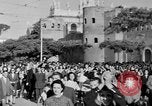
Italians cheer as American soldiers of the 5th Army enter Rome, Italy, during WWII
The United States 5th Army enter Rome, Italy during World War II. Italians fill the streets and cheer for the Americans. Italians gather in front of the Porta San Giovanni (00185 Rome, Metropolitan City of Rome, Italy) near the Archbasilica of Saint John Lateran. Crowds of Italians cheering in front of the Archbasilica of Saint John Lateran. Soldiers on military vehicles, M4 Sherman tanks, trucks and jeeps proceed into the center of Rome, past the Colosseum (Piazza del Colosseo, 1, 00184 Roma RM, Italy) and other ancient structures and landmarks including the Vittoriano and Capidoglio on Capitoline Hill. United States soldiers in truck near the Circus Maximus (Circo Massimo, Via del Circo Massimo, 00186 Roma RM, Italy). Crowds gathered in front of the Altar of the Fatherland (Altare della Patria, Piazza Venezia, 00186 Roma RM, Italy). Men carrying the Italian flag on top of a truck driving in Via del Corso. The American, British and Italian flags hang in front of the Campidoglio. Façade of the Campidoglio (Piazza del Campidoglio, 00186 Roma RM, Italy). Young Italian men and women wave at the camera while marching. Italians hitch a ride with soldiers on a Jeep in front of the Saint Peter’s Basilica (Piazza San Pietro, 00120 Città del Vaticano, Vatican City). Some Italian civilians ride with U.S. soldiers on their trucks. U.S. Lieutenant General Mark Clark consults with two U.S. Major Generals.
CRITICALPAST.COM: About Us | Contact Us | FAQs - How to Order | License Agreement | My Account | My Lightboxes | Shopping Cart | Advanced Search | Featured Collections | Website Terms & Conditions | Privacy Policy ©2026 CriticalPast LLC.
License Agreement |
Terms & Conditions |
Privacy Policy
©2026 CriticalPast LLC.