


 Francais
 Deutsch
 Italiano
Refine Your Search
Eboli Italy 1944 stock footage and images
- Showing 1399 to 1404 of 7968 results more
more Hide
Hide
"Operation Husky" - the invasion of Sicily in World War II.
July 10, 1943, U.S. invades Sicily in Italy. Fleet of warships underway. Navy bombardment of Sicily. Coast Guardsman observes through binoculars. Coast Guardsmen carry troops and supplies in LCVPs (Higgins Boats). LST-356 approaching Blue Beach 2, in the "Cent" area on July 10, 1943, loaded with tanks and other vehicles. A beach master signals with semaphore flags. Troops landing from assault boats. Concentrated enemy air attacks destroy U.S. boats and ships. Enemy aircraft in flight. U.S. troops firing. A map shows Italy. September 9, 1943, amphibious assault on Anzio, Italy. Naval bombardment, followed by troop assault on the beaches.

Queen Elizabeth Bowes Lyon and Princess Margaret visit Ostia Antica and Villa Borghese in Rome.
Queen Elizabeth and Princess Margaret visit Rome, Italy. They visit the archaeological site of Ostia Antica (Viale dei Romagnoli, 717, 00119 Roma RM, Italy) in Rome. They are followed by few officials and a crowd. The Queen Mother and Princess Margaret then visit Villa Borghese (Piazzale Napoleone I, 00197 Roma RM, Italy). They descend the steps of Villa Borghese. A fountain in Villa Borghese gardens. Queen Elizabeth (the mother of Queen Elizabeth II) poses with a man.
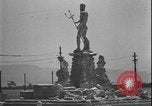
Damage of statues, buildings in Messina after the Allied Invasion of Sicily during WW2
The fountain of Neptune (Fontana del Nettuno) in Messina (Via G. Garibaldi, 98122 Messina ME, Italy) shows damage after the Allied Invasion of Sicily during World War 2. Messina’s waterfront, the Via Vittorio Emanuele II, with damaged structures and rubble strewn all over. The Comune di Messina-Palazzo Zanco at Via S. Camillo, 110, 98122 Messina ME with the word “Vincere” (“win” in Italian) on the side of the building, with the war memorial Monumento ai Caduti (Via Consolato del Mare, 25, 98122 Messina ME, Italy) seen on the left. View from the intersection of Via Antonio Laudamo and Via G. Garibaldi shows Via Antonio Laudamo strewn with rubble, with The Church of Christ the King (Viale Principe Umberto, 93, 98122 Messina ME, Italy ) in the background with a sign “DUCE” (title of Italian Prime Minister Benito Mussolini). Closer view of The Church of Christ the King and the sign “DUCE”. A street in Messina with wrecked vehicles. View of the Strait of Messina, with smoke in the horizon.
Wounded of the U.S. 442nd Regimental Combat Team treated during the Rome-Arno Campaign of World War II, in Italy
U.S. corpsmen at 3rd Battalion Aid station attend to a wounded soldier of the 34th Infantry Division's 442nd Regimental Combat Team (comprising U.S. soldiers of Japanese ancestry) in the Italian Rome-Arno Campaign during World War 2. They carry him from a jeep into a field hospital, where they check an information tag on his uniform. View of his bandaged left foot. Medics attend another wounded solder and bandage his wrist before moving him on his stretcher into the building. Two corpsmen lift a wounded soldier, in sitting position, into a field ambulance, which then drives away. (Note: the opening slate refers to Lt. Frank Morang, 196th Signal Photo Company, who reportedly received a field commission for his outstanding work in the North African, Sicilian and Italian Campaigns.)
Wounded soldiers of the U.S. 442nd Infantry Regiment are brought to a hospital tent in Italy, during World War II.
Wounded U.S. soldiers being treated during Italian campaign of World War 2. Ambulance arrives at a field hospital of the U.S. 3rd Battalion, 442nd Infantry, 34th Division. (Soldiers of the U.S. 442nd Regiment were almost entirely Americans of Japanese ancestry.) Ambulance stops in front of a hospital tent. Injured soldier on litter is removed from the ambulance. An army nurse prepares dressing for a wounded soldier. He lights a cigarette. Surgery performed inside the hospital tent. Wounded men on litters removed from ambulance and carried into tent. (Note: Opening slate showing the name, "Morang,." refers to Lt. Frank Morang, 196th Signal Photo Co.)
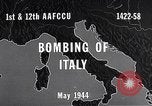
U.S. Army Air Forces A-36 fighter bombers attacking lines of communication in Italy during World War II
Animated map shows areas of targeting, in Rome environs, by U.S. warplanes during Italian campaign in World War 2. Gun camera footage from a U.S. Army Air Forces A-36 aircraft captures strafing from altitude of feet, of loaded Italian transport vehicles on Italian highway 6, connecting Rome and Cassino. Another map highlights a bridge at Civita Castellana. Gun camera shows it being strafed from only 300 ft. altitude, and attacked with 500 pound bombs. Similar attack is highlighted at a road near Frosinone, Southeast of Rome, where A-36 fighter bombers strafe motor transports and bomb the road. Similar footage is shown for targets being attacked at: Monte Si Savino; Sezze; Terracina; Castro de Volsci. Views from one A-36 camera when pilot flies low in a valley looking for targets of opportunity. He strafes vehicles on a road and pulls up sharply to avoid a mountain and then continues attack on the other side.
CRITICALPAST.COM: About Us | Contact Us | FAQs - How to Order | License Agreement | My Account | My Lightboxes | Shopping Cart | Advanced Search | Featured Collections | Website Terms & Conditions | Privacy Policy ©2026 CriticalPast LLC.
License Agreement |
Terms & Conditions |
Privacy Policy
©2026 CriticalPast LLC.