


 Francais
 Deutsch
 Italiano
Refine Your Search
Eboli Italy 1944 stock footage and images
- Showing 1813 to 1818 of 7968 results more
more Hide
Hide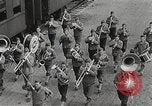
US Army soldiers and heavy equipment transported by railroad trains in the United States, bound for war front in World War 2
Activities of the United States Army in the United States during World War II. A U.S. Army band from the 407th Engineer Battalion playing musical instruments and marching. U.S. Army soldiers board railroad trains at a railroad station for transportation toward the war front. A railway steam locomotive pulling train cars. M4 Sherman tanks are seen on them as well as M2A4 (Mae West) tanks sitting partially turned with their guns out of sight away from the direction of travel.Browning M1919 .30 caliber machine guns are seen in their extra turrets. Army trucks and other military vehicles are also aboard the supply trains. The supply train moves through American countryside. Two women seated under hair dryers converse about the war in a beauty shop or beauty parlor. U.S. troops on troop transport railroad trains at night. Interior of a train car. American soldiers read books, sleep, and some play dice. An African American porter watches the game. A chaplain speaks to the soldiers. Civilians buy newspapers at a news stand. Headline on newspaper reads "London Expects Invasion of Europe at Any Hour" (before the upcoming Normandy Invasion of France in June 1944.)
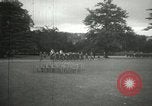
8th Air Force airmen assemble at Wycombe Abbey for a War Bond rally and Glenn Miller concert , during World War II.
Victory Squadron War Bond Rally at 8th Air Force Headquarters (Codenamed PINETREE) at Wycombe Abbey, High Wycombe, England, on July 29th 1944, during World War 2. U.S. Army military band plays the National Emblem March, as they march across a parade field lawn. They stop behind a parked flat bed tractor trailer on which Major Glenn Miller and his Army Air Forces band is seated. While the military band plays, U.S. 8th Air Force airmen march onto the field and take up positions in a large formation at its center. Spectators are gathered around the lawn, outside the airmens' formation, and military policemen are posted inside the circle of spectators.
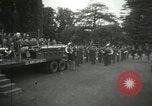
Lieutenant General Doolittle kicks off 8th Air Force War Bond Drive in England during World War II
Kickoff of U.S. 8th Air Force War Bond Drive at Wycombe Abbey, High Wycombe in England on July 29th 1944. Lieutenant General James Doolittle and several staff officers walk to a bandstand set up on a flatbed tractor trailer, where Major Glenn Miller and his Army Air Forces Band is seated. All come to attention as the General and staff ascend the platform. General Doolittle speaks about the good progress of the war and the need for supporting it with war bonds. He steps to a sales booth where he purchases a war bond from a Women's Army Corps (WAC) Corporal, in uniform .She asks him to sign their book of subscribers, which he does.General Doolittle then "sells" a bond to a Sergeant. Doolittle and his staff depart as the military band plays the Army Air Corps anthem.
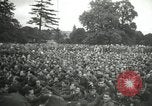
Glenn Miller and his Army Air Forces Band entertain airmen at 8th Air Force War Bond rally in England, during World War II
Major Glenn Miller and his Army Air Corps band play "In the Mood," for large gathering of airmen during 8th Air Force War Bond rally, at Wycombe Abbey, High Wycombe in England on July 29th 1944, during World War 2. The airmen and spectators applaud enthusiastically. The band then plays "Stardust. Glenn Miller introduces his string section that includes classical musicians, who have played with orchestras such as the New York Philharmonic, Boston Symphony, Cleveland Orchestra, and The Philadelphia Orchestra under Leopold Stokowski. The group is headed by Sergeant George Otners, whom Miller introduces, along with the String Section. Major Miller introduces the Saxaphone Section, headed by Sergeant Hank Freeman, who formerly played with the Artie Shaw band. Miller also introduces Sergeant Albert, his bass player.

Major Glenn Miller and his Army Air Corps band entertain airmen at War Bond rally in England, during World War II
Major Glenn Miller's Army Air forces band plays for airmen during concert at 8th Air Force War Bond rally on grounds of Wycombe Abbey, High Wycombe, England, on July 29th 1944, during World War 2. As they begin playing "What do you do in the Infantry," several airmen climb the stage and sing the song together with members of the band.(They also sing some lyrics written for the Air Forces.) An airman sings solo rendition of "I'll Get By (As Long as I Have You)," accompanied by the band. Views of the audience are seen throughout.
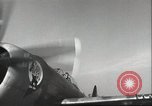
Tactics of U.S. 8th Air Force fighters for escorting bombers over Germany during World War II.
U.S.Army Air Corps P-47s with engines running, taxiing our for takeoff. Army personnel in Runway control unit with signal light.(Few seconds of film reversed.) Among the aircraft seen is P-47D, number 42-28543 named “Pat” piloted by Capt. Gordon S Stevens,of Smithfield,North Carolina, of the 63rd Fighter Squadron, 56th Fighter Group, stationed in England.(He was killed in action, 18 September 1944.) Views of the P-47s enroute to join up with B-17 bomber formations. P-51s and P-38s taking off. P-51s inflight to relieve P-47s of escort duty.US pilot with mission profile inked on back of his hand. Narrator (Ronald Reagan?) describes the way successive relays of U.S. fighters relieved each other performing bomber escort duties. Scenes from captured German film shows alarm sounding and German fighter pilots scrambling in Me-109s and FW-190s to intercept the U.S. bombers. Escorting U.S. P-51s jettison their long range drop tanks preparing to meet attacking German interceptors. Gun camera footage shows many German fighters being destroyed.P-47s, P-51s and P-38s firing their guns. Several Me-109s in formation. German gun camera clip showing many B-17s being shot to pieces by 22mm gunfire and falling, often in flames.
CRITICALPAST.COM: About Us | Contact Us | FAQs - How to Order | License Agreement | My Account | My Lightboxes | Shopping Cart | Advanced Search | Featured Collections | Website Terms & Conditions | Privacy Policy ©2026 CriticalPast LLC.
License Agreement |
Terms & Conditions |
Privacy Policy
©2026 CriticalPast LLC.