


 Francais
 Deutsch
 Italiano
Refine Your Search
Eboli Italy 1944 stock footage and images
- Showing 2053 to 2058 of 7968 results more
more Hide
Hide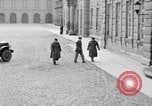
Prosecutor Major Joseph D. Bryan reads a testimony during the World War II war crime trials in Ludwigsburg, Germany.
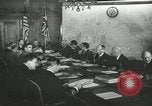
World War II war crime trials in Ludwigsburg, Germany. Trucks arrive at Ludwigsburg Palace. Witnesses and court personnel arrive and leave the palace. Vehicles lined up in the parking outside the palace. A truck arrives at the palace and prisoners exit the truck. The defendants are appearing for trial for killing seven U.S. airmen captured on Borkum Island after their aircraft crashed there on August 4, 1944. In the courtroom prosecutor Major Joseph D. Bryan reads a testimony. Three of the seven judges Colonel Barden, Colonel Jackson and Colonel Hicks are seated. Investigation officer Major Levine points out locations on a map of Borkum Island. Chandeliers hanging from the ceiling.
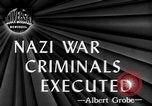
German spies are executed by a firing squad and Germans who killed American prisoners of war are hanged, at end of World War II
Three German soldiers, who were captured in American uniforms, spying behind the American lines, in the Fall of 1944, are executed by a firing squad. In a separate sequence, one of several German civilians is marched toward gallows at Bruchsal prison near Karlsruhe, Germany. They were condemned by a military tribunal for killing six United States Army Air Force aviators who were being held as prisoners of war after crash landing their airplane near the end of the war. A hangman makes preparations. The German criminals are hanged.
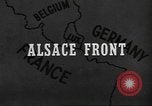
U.S. troops of the 79th Infantry Division engage German forces in the Alsace Front during World War II
Opening shows animated map of Alsace front at junction of Belgium, Germany, and France, in World War 2. Allied forces are schematically shown sweeping toward Wissembourg, Haguenau, and Strasbourg. Next, several U.S. Army M4A3(75) medium tanks are seen driving toward the camera on a rural road, during a pull back by the 7th Army in the first week of January, 1944, from advanced positions at the front. Some are filled with infantry riding atop them. The last of them is seen crossing a bridge 13 miles Northeast of Haguenau. The engineers of the 79th Division place demolition charges to destroy the bridge. Closeup of them placing and then remotely igniting the charge. A huge explosion ensues that completely destroys the bridge. Scene shifts to several U.S. soldiers of an engineer combat battalion preparing 100 pound of TNT in a captured blockhouse at Lauterbach, Alsace. Closeup of engineer carrying the explosives into the blockhouse and preparing the remote detonation device. The engineers string wire in the snow and setup their remote detonation device. One depresses a plunger to ignite the charge and blow up the blockhouse, which explodes in a huge cloud of black smoke. Next, elements of the 79th Infantry Division supported by tanks, are seen moving forward to counter German gains Southeast of Haguenau. (On January 5th the German forces had established a bridgehead across the Rhein (Rhine) river near Gansheim, Germany.) Scene shifts to Drusenheim, Germany where U.S. forces are engaging a Battalion of occupying German forces. Machine gun fire is heard constantly, as American infantry battle the hidden German defenders and tanks drive them from defensive positions near a bridge at the far end of town. Infantry move from behind tanks toward the bridge and are seen crossing it. An M4A3(75) medium tank risks crossing the narrow bridge and is immediately followed by many 79th Infantry troops. The battle continues on the other side of the bridge.

Harry S. Truman and others at the dedication of the Truman Library in Independence, Missouri.
Dedication ceremony of the Truman Library in Independence, Missouri. Former President of United States Harry S. Truman at the dedication ceremony of the library. Dignitaries including Chief Justice Earl Warren, Herbert Hoover, Mrs. Bess Truman, and Eleanor Roosevelt at the ceremony. Ten thousand people gather for the Masonic rites of dedication. Republican Senate leader William Fife Knowland receives a deed on behalf of the government. Interiors of the library that houses 3 ½ million documents of Truman's seven-year term. At the Truman Museum pictures of Truman with former British Prime Minister Winston Churchill. Another picture of Truman after winning the presidential election of 1944.
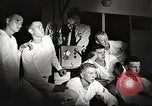
United States Navy sailors watch a movie about naval warfare in the United States; some scenes from World War 2 Pacific battles
A dramatized film about the training of U.S. Navy recruits at various naval training centers in the United States. The training and life of United States Navy recruits at U.S. Navy training center in Bainbridge, Naval Station Great Lakes in Illinois and Naval Base San Diego in California. The sailors watch a movie which depicts historic navy sailors on old masted sailing ships as they fire naval guns at another ship. The reenactment is of a 18th century or 19th century naval battle. The ship being hit by the enemy begins to sink. Sailors from the two ships in combat aboard a ship. Men jump into the sea and try their best not to give up the ship. A tall masted ship sinking. The naval gun canons aboard a ship being fired on another ship. Scene shifts to a mix of both authentic footage and several dramatized World War 2 combat footage scenes in the Pacific, circa 1943, 1944, or 1945, with U.S. Navy sailors on board ships firing at incoming Japanese aircraft. The enemy aircraft being shot down and they fall into the sea. A sailor clicks a picture of Japanese girls against a statue of Buddha. Narrator speaks about Navy recruitment. Sailors lined up on an open field during a ceremony at the U.S. Naval Academy.
Landing craft, tanks, munitions, and gasoline supplies assembled in England for D-day invasion in World War II
Preparations in year 1943 for the June 1944 invasion of Western Europe by Allied Force during World War 2. Conference at Supreme Headquarters Allied Expeditionary Force in London. U.S. Generals George Marshall, Henry H. Arnold and British Field Marshal Bernard L. Montgomery meet at SHAEF (Supreme Headquarters Allied Expeditionary Force). Montage of war scenes: British Lancaster bombers taking off. British men and women monitors working in a British Command and Intelligence Center, tracking aircraft positions on maps. U.S. B-17 bombers in daylight missions over Germany. Allied pilots and crew members in aircraft. U.S. Army Air Force B-17 aircraft at high altitudes leaving contrails behind. Bombs bursting on German industrial targets. Allied agents being airdropped over France. Allied one-man submarines or solo submarines, torpedo boats and Commandos sampling French beaches and soil conditions in the Normandy region for ability to support 30-ton tanks for the invasion of France. British airman loading reconnaissance camera into a British Spitfire reconnaissance aircraft for photographing the planned invasion region. Woman operating microscope analyzing film. Aerial reconnaissance film images being laid out and attached together to create a large overhead viewing map. Arms and equipment being air dropped to indigenous resistance forces in Nazi-occupied Europe. Mulberry floating harbor segments being designed and built to create invasion ports. Allied landing craft training in Devon, England. Allied aircraft strafing a German ship. Meteorological equipment assessing weather along the invasion coast. Wire netting to pave the beaches. Underwater pipelines to carry gasoline or petrol to France. Allied armored vehicles bearing the White Star. Troops being inoculated or vaccinated. Newly built ship going down the ways at an Allied ship yard that builds Navy warships. View of British intelligence officers with headsets at radio equipment, and personnel monitoring German radio broadcasts. Soviet Embassy in Tehran, Iran, where the Big Three are seen meeting at Tehran Conference to finalize invasion plans. Stalin, Roosevelt, and Churchill sitting on the porch of the Embassy building, in 1943. General Eisenhower and Allied Military leaders planning the D-Day invasion. General Omar Bradley, sitting with a British admiral. General Bernard Law Montgomery Aerial view of formation of U.S. Army Air Force B-17 aircraft, flying through Flak bursts. Pilots in B-17 cockpit .Bombs striking German targets. Polish, Scenes including gun camera footage of Czech, and British in Spitfire aircraft striking German railroads and marshaling yards. B-26 bombers and gunner attacking German Luftwaffe Me-109 aircraft.
CRITICALPAST.COM: About Us | Contact Us | FAQs - How to Order | License Agreement | My Account | My Lightboxes | Shopping Cart | Advanced Search | Featured Collections | Website Terms & Conditions | Privacy Policy ©2026 CriticalPast LLC.
License Agreement |
Terms & Conditions |
Privacy Policy
©2026 CriticalPast LLC.