


 Francais
 Deutsch
 Italiano
Refine Your Search
Eboli Italy 1944 stock footage and images
- Showing 2275 to 2280 of 7968 results more
more Hide
Hide
Allied Forces Build up in Algeria to prepare for Spring offensive against German forces in Tunisia during World War II
At start of film, Allied forces are digging in after retreating from counterattacks by German forces in Tunis, during World War 2.. Rains create mud everywhere. A Lockheed P-38 fighter plane parked in foreground. Ground crews use shovels to free nose wheel of a B-24 Liberator bomber with engines running. A truck tows a C-47 transport plane from mud. Army trucks travel over road inundated by running streams. Soldiers standing in a jeep submerged in water. M2 tanks stuck in mud. Airmen huddled around an outdoor fire. P-38 fighter aircraft parked in the background. Soldiers eating around an outdoor fire. Animated map shows Allied battle lines stabilized in Algerian mountains, while German forces occupy the plains in Tunisia. German artillery batteries firing. British troops sheltering in damaged building. Allied wounded being transported atop, as well as inside a field ambulance. Interior of a transport plane configured for evacuation of wounded on litters. U.S. airmen including a woman in leather flying jacket, presumably an Army flight nurse, tend to the wounded aboard the medical evacuation flight. Wounded being transferred from an airplane to an ambulance. British patrols moving through the night. Heavy artillery firing. British soldiers silhouetted at dawn. They return carrying a wounded comrade on a litter. The British soldiers ("Tommies.") trying to clean mud from themselves and their weapons before heading out on patrols again at dusk. Allied soldiers moving on mules in a long line to obtain needed food and supplies. More views of the interminable mud. A British Hawker Hunter fighter plane taking off. A formation of Hawker Hurricanes peeling off to engage German aircraft. Closeup of one rolling over. A German Heinkel 111 bomber being attacked and trailing smoke. Pilot pressing gun firing button in cockpit and a German Dornier Do 17 bomber hit as British fighter plane passes it in cloud of black smoke. The German plane diving to crash in a fireball on the ground. U.S. B-24 Liberator bombers taking off and flying in formation. Formation of American B-17 bombers in flight. The American planes dropping bombs on Italy, Sardinia, and Sicily. Gunners in the bombers firing machine guns at attacking German fighter planes as their bombs keep dropping. Back on land in Algeria, mud still halted any Allied advance. Animated map showing both Allied and German forces building up on their respective sides of the front. Supply lines illustrated all the way back to factories in the United States and Britain. Allied war plants making bombers and munitions. Allied Soldiers assembling Army vehicles at a port. Lockheed lightning fighters being rolled out of a factory. Sign reading "Railroad Equipment Assembly Plant No. 1." Complete trains from locomotives to freight cars being completely assembled, loaded with freight and sent on their way. A formation of P-38 aircraft equipped with long range fuel tanks being ferried in flight from Brazil. It is led by a B-17 flying fortress bomber providing navigation. British Spitfire and Hawker Hunter airplanes heading to the front are seen taking off from an airfield in Gibraltar. A caterpillar tractor moving earth for a new road at the front. Trucks dropping materials for the road bed as soldiers with shovels smooth them on the surface. Soldiers installing Mardsen Matting pierced steel planking for an airfield surface as C-47 transport planes operate on the field. Crates of food supplies being unloaded at a port. War materiel stored in a large yard at a port.
Curtiss R3C-2 , Gloster Napier III and Maachi Flying Boat in flight during the Schneider Cup Race in Baltimore, Maryland.
The Schneider Cup Race for the fastest seaplane in Baltimore, Maryland. A Curtiss R3C-2 (US Air Service) at the race and U.S. airmen stand around the plane. U.S. Army Air Service Lieutenant James H. Doolittle in the cockpit. Airmen push the plane in water. Gloster Napier III seaplane of England is being pushed into the water. Maachi Flying Boat of Italy in the water. Seaplanes in flight. The race is won by Curtiss R3C-2 (US Air Service). Lt. James H. Doolittle leaves the R3C-1 and is being congratulated by Mrs. Doolittle and the Chief of U.S. Army Air Service Major General Mason M. Patrick.

Kennedy and Johnson speak about peaceful aims of the United States in 1963 during the Cold War.
"To keep the peace" about need for peace, during Cold War. Expansive farm field of wheat waving in breeze under a sunny to partly cloudy sky in the United States. Wide shot of ocean waters and sun breaking through low clouds near dawn or dusk. President John F Kennedy delivering a speech on peace and nuclear testing, on July 2, 1963, in Naples Italy at NATO headquarters. Kennedy says, "The purpose of our military strength is peace. The purpose of our partnership is peace. So our negotiations for an end to nuclear tests and our opposition to nuclear dispersal are fully consistent with our attention to defense--these are all complementary parts of a single strategy for peace." Shortly after President Kennedy's death, President Lyndon B Johnson addresses a joint session of Congress on November 27, 1963. Shows segment of speech where President Johnson says, "We have proved that we are a good and reliable friend to those who seek peace and freedom. We have shown that we can also be a formidable foe to those who reject the path of peace and those who seek to impose upon us or our allies the yoke of tyranny."
USAAF P-38 aircraft heading to Sicily on bombing mission, from North Africa, in World War II
P-38, of the U.S.Army Air Forces 14th Fighter Group, raises dust as it taxis close to the camera on Telergma airfield in Algeria, North Africa. Several 3-plane flights of P-38s take off, join up in formations, and fly overhead. A series of views, from inside a P-38, of others in formation as they fly over North African territory en route on bombing mission to Sicily, Italy, during World War 2.
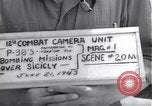
P-38 aircraft of the U.S. Army Air Forces 14th Fighter Group fly various formations over Telergma airfield in Algeria, during World War II
Cameraman slate notes that subject matter deals with bombing missions over Sicily, Italy, during World War 2. View from ground as two flights of four P-38 aircraft, from the USAAF 14th Fighter Group, fly overhead in formation at their base, Telergma airfield in Algeria. Then more are seen flying in vertical stacked formation over the field. Two land side-by-side on dusty runway. A "V" formation of P-38s flies overhead. The formation comes in over the field and individual P-38s peel off and circle to land. P-38s buzz the field in pairs, and then in flights of four.
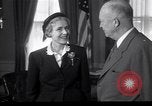
President Dwight D Eisenhower and Clare Booth Luce pose for photographers in Washington DC.
United States President Dwight D Eisenhower and Clare Booth Luce on occasion of her appointment as United States Ambassador to Italy. They pose for photographers at the White House (1600 Pennsylvania Avenue NW, Washington, DC 20500, United States) in Washington DC.
CRITICALPAST.COM: About Us | Contact Us | FAQs - How to Order | License Agreement | My Account | My Lightboxes | Shopping Cart | Advanced Search | Featured Collections | Website Terms & Conditions | Privacy Policy ©2026 CriticalPast LLC.
License Agreement |
Terms & Conditions |
Privacy Policy
©2026 CriticalPast LLC.