


 Francais
 Deutsch
 Italiano
Refine Your Search
Eboli Italy 1944 stock footage and images
- Showing 3043 to 3048 of 7968 results more
more Hide
Hide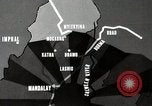
American and Chinese forces advance and capture Japanese held Bhamo in Burma, during World War II
Animated map shows American and Chinese forces advancing from Myitkyina to Bhamo, while British forces move to Mogamng to Katha, in Burma during the India-China-Burma campaign of World War 2. Mandalay, Lashio, the Burma Road, and Salween River are also shown on the map. Chinese troops are seen with pack animals moving along road marked by sign reading: "Bhamo Road." Chinese and American troops cross the Irrawaddy River by Pontoon bridge. A heavier item (M3 Lee medium tank) moves via a raft. M3 tanks also cross at affordable locations. Advancing troops move to extreme sides of road for security. Aerial view of Bhamo, on river's edge. Allies employ artillery and U.S. Army Air Forces P-39 Bell Air Cobra planes drop bombs. A Republic P-47 airplane is also seen dropping bombs. Chinese troops fire Browning M1917 machine guns and automatic rifles, as they advance upon the town. Another aerial view of smoke rising at various places in Bhamo. Lieutenant General Daniel Isom Sultan, Commander India-Burma theater, speaks about subsequent advance to the Ledo Road.
Construction and completion of the Ledo Road from India to China during World War II
Film opens showing road sign reading: "LEDO Mile 00.00." Scene shifts to rail lines at terminus of the Assam-Bengal railroad in the Indian Province of Assam. Surveyors are seen working in jungles. Engineers use machetes and construction machinery, like caterpillar tractors, to cut through the dense growth. Others saw and chop down trees and use explosives to clear the land. Explosives are seen detonating and tractors clearing the debris. Earth moving equipment and jack hammers being used to form a roadbed. View of two engineers setting and detonating a charge in a rock. A steam shovel loads earth into a dump truck. Road scrapers work in parallel to smooth the dirt roadbed. View of road after monsoon rains reduced one roadbed to a sea of mud and another inundated by water. To avoid these problems, rebuilding efforts begin by construction of causeways and bridges. Teams of workers lay planks for this. Closeup of worker tightening a clamp on a pontoon bridge under construction. Work gangs rolling and placing heavy logs as part of a bridge. Workers use a crane to lift segment onto a steel bridge under construction. Men bulding wooden and steel truss bridges. Aerial views from an airplane flying over various sections of the finished Ledo Road. A truck covered by a painted canvas reading: First Convoy over the Ledo Road, Pick's Pike Lifeline from India to China." Brigadier General Lewis A. Pick, Chief Engineer for the project, is seen, next, shaking hands with Lieutenant General Daniel Isom Sultan, Commander India-Burma theater, as he prepares to lead the convoy. View of the convoy starting out, led by the decorated truck. (Narrator states the road was now called, "The Stillwell Road." Views of the trucks proceeding and crossing causeways and bridges. Aerial view of the road twisting and turning across the high mountains. The convoy arriving in Kunming China greeted by Chinese troops and flags. Later, the convoy drives through the city streets of Kunming, with General Pick standing in a jeep, leading the way, and crowds of Chinese people cheering from the sidelines. In final scene, General Sultan states that the next project is a pipeline along the road.
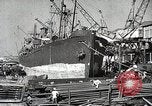
Construction of India-Burma-China Pipeline during World War II
Opening scene shows a large transport ship at a dock in Calcutta, India, during World War 2. It is surrounded by cranes unloading it. In the foreground, numerous sections of pipe are piled up on the dock. Closeup of group of pipe sections being lifted by crane from the ship's hold. Some individual pipes are seen moved by groups of Indian workers carrying them over their heads. Other Indian workers roll pipe sections onto barges that are seen clustered together near a steel bridge. A convoy of trucks is seen carrying the pipe sections along the Ledo road. Some bundles of pipe sections are carried on jeeps. View of an Army Air Forces C-47 transport plane taking off. Sections of pipe being offloaded from a C-47 plane. Numerous pipe sections in organized stacks near the airfield. Sections of pipe being fastened together. Engineers re-condition the road bed using construction equipment. Long connected pipe lines being pulled through water. Caterpillar tractors working on a muddy section of the road. Workers installing pipe near graves of workers who died from disease and other causes. Workers sending a bundle of pipe segments across a river by means of a Zip line. A worker's camp of tents in the background. Workers dressed in rain gear and boots carrying a pipe section through water during the Monsoon. Workers using machetes to chop their way through jungles. An open utility train moving Chinese troops along a single-track rail line, passes pipeline workers standing aside. Engineers and other pipeline workers distributing pipe sections along the rail line from railroad flatcars. Trucks driving the road, in Burma. Various views of the pipeline in including one showing lines of pipe forming a suspension bridge across a river. Other scenes show the pipeline crossing ravines, submerged under rivers, climbing vertical cliffs. Aerial views of the pipeline from low flying aircraft. A vehicle marshaling yard filled with army vehicles. M3A3 Stuart light tank moving past a yard filled with them. Army trucks moving out of their parking yard. Aerial view of large airfield with many parked Air Transport Command C-47 airplanes. B-29 bombers being refueled at an airfield. One is seen taking off. Lieutenant General Daniel Isom Sultan, Commander India-Burma theater, comments that the pipeline is a lifeline to our beleaguered ally and that the Chinese are in on this. Views of Chinese soldiers engaged against Japanese forces. They fire artillery pieces and heavy machine guns. British soldiers carrying Bren guns and struggling to move artillery pieces in the mud. They are seen firing artillery from under camouflage canopies and firing Vickers machine guns. Aerial view of the British controlled port in Calcutta, India, where war materiel is seen being unloaded. Tanks being transported on an Indian railroad. War supplies moving on a barge line and on roads. View of a British airfield in India. North Burma Chinese troops with their weapons and army vehicles. U.S. troops advancing on roads in the jungles. Chinese Marshal Chiang Kai-shek with U.S. President Franklin D. Roosevelt and British Prime Minister Winston Churchill, at the Cairo Conference of November 22–26, 1943. General Sultan concludes the film by reassuring American soldiers that they are in the China-Burma-India theater in the common allied effort to fight against Japan.

General Douglas MacArthur returns to the Philippines (WW2)
General MacArthur returns to the Philippines in World War II. Gun footage show Allied airplanes bombard Japanese ships in Mindanao, Philippines. Allied airplane in dogfight with a Japanese airplane. Japanese airplane gets hit and goes down. Allied airplanes attack a Japanese anti-aircraft tower. Allied airplanes bombard Japanese airfield on Mindanao. Allied ships bombard Leyte in Philippines and carrier-based plane bombard the Island. United States prisoners of war captured by the Japanese. General Douglas MacArthur and General Jonathan Mayhew 'Skinny' Wainwright VI and Admiral William Frederick Halsey can be seen. General Douglas MacArthur and his men after landing on Leyte beach.

Red cross volunteers pack red cross parcels for prisoners American imprisoned in Germany (WW2)
Red Cross volunteers pack Red Cross parcels for American prisoners imprisoned in Germany during World War II. Parcels include food cans, cheese, cocoa powder, box of Jack Frost, box of raisins, cream, cigarettes, biscuits, Milkao milk. Stacks of soap bars and multi vitamin tablets for Allied prisoners. Red Cross parcels move through conveyer belt into a truck.
Uruguay Military Academy marks 59th anniversary
Uruguay Military celebrates its 59th anniversary. Sign reads Escuela Militar. Uruguayan President Juan Jose de Amezaga arrives at the ceremony. Other dignitaries present at the anniversary are Director of Military Academy Colonel Toscano, Defense Minister Kampos, Army Inspector General Laguardia. Colonel Toscano delivers a speech during the event. Cadets are honored. Cadets parade at Military Academy in Montevideo, Uruguay.
CRITICALPAST.COM: About Us | Contact Us | FAQs - How to Order | License Agreement | My Account | My Lightboxes | Shopping Cart | Advanced Search | Featured Collections | Website Terms & Conditions | Privacy Policy ©2026 CriticalPast LLC.
License Agreement |
Terms & Conditions |
Privacy Policy
©2026 CriticalPast LLC.