


 Francais
 Deutsch
 Italiano
Refine Your Search
Eboli Italy 1944 stock footage and images
- Showing 5563 to 5568 of 8000 results more
more Hide
Hide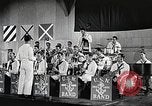
Non-military diversions and graduation day for recruits at the U.S. Great Lakes Naval Training Center during World War II.
A U.S. Navy band swing ensemble practices at an auditorium in the U.S. Great Lakes Naval Training Center during World War 2. Sailors and family members stroll out of a building together. Scene shifts to a football stadium, filled with sailors watching a game. A large formation of sailors in white uniforms march to a large chapel. Inside, a choir of sailors leads the congregation in the hymn, "Onward Christian Soldiers." Glimpse of a large formation of trained recruits, followed by view of one standing alone, casting shadow on otherwise empty parade grounds. Successive groups of recruits are added until an entire regiment is seen. Two Naval officers, in blues, walk past a formation of graduating recruits. A Petty Officer Third Class band master leads a military band that marches ahead of a color guard bearing the American flag and that of the Great Lakes Naval Training Center. They are followed by contingents of graduating recruits identified by their training unit flags. Scene shifts to several U.S. battleships underway at sea in formation. They fire their heavy guns.
General Dwight D. Eisenhower introduces Joint British-American film, "The True Glory"; scenes of German forces massed for war
A film titled 'The True Glory' based on Allied invasion and conquest of Western Europe during World War II. Supreme Commander of Allied Expeditionary Force General Dwight D. Eisenhower introduces the film and speaks about Nazi defeat on Western Front in World War II. Animated map shows Germany and surroundings darkened on a world map. Nazi Fuhrer Adolf Hitler giving an impassioned and animated speech. Nazi Propaganda Minister Joseph Goebbels stands with other German officials. German troops parade. Massive columns of German soldiers marching in formation. German men beat drums. Barrel of a naval-type heavy gun firing. Huge explosion on the ground. Views of the German Atlantic Wall defenses including large fortifications and bunkers. German Field Marshal Wilhelm Keitel, Chief of Staff of the German High Command, inspecting the massive gun emplacements and coastal bunkers.
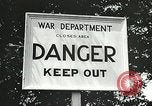
Allied troops undergo training in Devon, England,before Allied invasion of Western Europe during World War II.
Allied troops undergo training during World War 2, in North Devon, England. Sign reads ‘War Department - Danger - Keep Out’. Allied troops train on an obstacle course. Troops fire guns in prone position and scale cliffs during the training. Men row a boat in rough sea. In Germany, Nazi Generals confer and plan strategies.
D-Day in World War II. British and American forces landing on Normandy beaches, and fighting their way inland.
D-Day invasion of France by Allied Force during World War 2. American troops wade ashore from landing crafts at Omaha Beach, Normandy. Wounded huddle together on Omaha Beach. Allied troops care for wounded on litters at the beach. Fallen American soldiers covered and lying on beach next to a dozen captured German prisoners of war. Allied ship burning offshore. Reinforcements coming from other beaches and from more landing craft. Troops wading ashore from landing craft. German soldiers firing rifles and mortars. A crashed Allied glider. "Screaming Eagle" insignia of 101st airborne Division on sleeve of paratrooper. German reinforcements of armor and infantry arriving from Berlin. British infantry leaving landing craft on another Normandy beach. They move rapidly off the beach and then fight their way inland, crawling at times. British artillery support firing. Views of British soldiers and American soldiers advancing in coastal towns of Normandy region. The steeple of a church falling to shellfire. British General Bernard Montgomery jumping down from an amphibious vehicle at a beach in Normandy. Allied troops riding armored vehicles into a French town. Formation of U.S. Air Forces P-38 fighters in flight overhead. Wide shot of formation of British aircraft flying low over water. Closeup view of a single British De Havilland Mosquito bomber in flight. British Mosquito aircraft pilot in cockpit. Gun camera footage of Allied aircraft in close support, flying low and strafing German ships, flak towers, and fortifications. British Hawker Typhoon aircraft in action.
Allied reinforcement and resupply operations on Omaha Beach, Normandy, several days after D-day, in World War II
View of Omaha Beach,and Allied reinforcement and resupply operations following the D-Day invasion of Normandy in World War 2. Barrage balloons above the shoreline. Boats in the water, some sunken. Large supply ships and Landing Crafts tank (LCTs) moving Sherman tanks,armored vehicles, jeeps, trucks and equipment ashore. Wounded Allied soldiers being carried on litters to be ferried out to the larger ships. British Army soldiers holding their ears as they fire mortars. Scottish troops setting up outside Caen and exchanging mortar fire with German defenders. Scottish soldiers cleaning weapons. One with a pet cat. Scots soldiers crawling through grass and firing machine guns. Jeep with red cross carrying wounded on litters. Battle in city of Caen. Allied soldier carrying wounded comrade on his back. Medical dressing station set up in the city. MPs and medics tending to wounded. Army ambulance rushing wounded to field hospital behind the lines. Medical team performing surgery on wounded soldier. Narrator says they could not stop bleeding. View of dog tags on a white stake in the ground signifying burial spot for a dead soldier.
American troops advance through hedgerows outside Cherbourg after D-Day landings in Normandy during World War II.
The Allied invasion of Normandy, France during World War 2. Improvised port facilities being erected in "Operation Mulberry." Ships carrying troops and supplies pull up to the Mulberry piers. Troops and vehicles moving on the piers toward the shore at Normandy. A severe storm tears up the mulberry port facilities. A man crawls a rope invertedly to get to a ship. War materiel moving on the Normandy beaches. A map of Normandy. View of Seaport at Cherbourg, France. Allied and German forces moving to battle over the Cherbourg port. Large formation of Allied aircraft. United States troops battling Germans in hedgerows, on the way to Cherbourg. A United States soldier uses a SCR-536 Walkie-talkie while in hedgerow. Soldier smoking a cigarette in hedgerow. French farmers collecting hay with pitchforks. United States troops being welcomed by French residents. Meeting heavy resistance at outskirts of Cherbourg, the U.S. employs batteries of field artillery. Some infantry engaged in street fighting. Nazi German General Karl-Wilhelm von Schlieben surrenders to the American forces in Cherbourg.
CRITICALPAST.COM: About Us | Contact Us | FAQs - How to Order | License Agreement | My Account | My Lightboxes | Shopping Cart | Advanced Search | Featured Collections | Website Terms & Conditions | Privacy Policy ©2026 CriticalPast LLC.
License Agreement |
Terms & Conditions |
Privacy Policy
©2026 CriticalPast LLC.