


 Francais
 Deutsch
 Italiano
Refine Your Search
Eboli Italy 1944 stock footage and images
- Showing 5587 to 5592 of 8000 results more
more Hide
Hide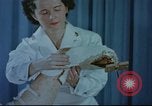
Successful movements of amputated limbs of U.S. soldiers wounded in combat operations during World War II.
Amputation of U.S. soldiers wounded during World War II, United States. Nurse treats patient with amputated limb. Limb of patient after amputation. Nurse lifts amputated leg of a patient. She covers the amputated leg and bandages it. She applies medicine to amputated leg and ties a knot. A cord being attached to limb connecting it with an instrument on bed post. Three amputees lying on beds. Amputees show successful movements of their limbs after amputation.
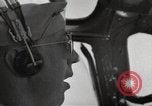
U.S. Navy PB4Y-1 Liberator bombers on mission in Marianas Islands during World War II.
Interior of U.S. Navy PB4Y-1 Liberator bomber in Marianas Islands during World War Two. Pilot at controls in PB4Y-1. His hand on the throttles. Instrument panel visible. Navigator shooting sunlines with sextant in top canopy. Radio operator tuning radios. Copilot in his seat in cockpit. Navigator charting aircraft position and course using weems plotter. View of other PB4Y-1 in flight.
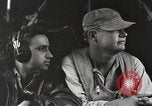
U.S. Navy PB4Y-1 Liberator bomber in flight on mission in Marianas Islands during World War II.
Loose formation of U.S. Navy PB4Y-1 aircraft on a mission in the Marianas Islands during World War II. Crewmen aboard a PB4Y-1 in flight. Aircraft in flight over clouds. Pilot in the cockpit. Crewman placing a label on a container with "APS-1" stenciled on its side. Waist gunner drinking coffee. A crew member resting. Gunners pose at positions (not firing guns). Gunner eating a sandwich. Aerial view of Japanese airfield on Guam. It appears that smoke is rising from exploding bomb on ground.
Camouflage techniques used by Japanese snipers in jungle against U.S. Marines deployed on Pacific islands during World War II.
Training film titled 'Notes on Jungle Warfare' on deployment of U.S. Marine Corps on islands of Pacific during World War II. U.S. Marines advance inland into jungle after disembarking from amphibious vehicles. Wounded and dead Marines lying on beach. Crosses at a cemetery. Marines caring for a wounded man. Jeep is driven in the jungle. Marine comes out of a foxhole. Japanese prisoners marching under guard on an island. U.S. Commander in Chief of Pacific Ocean Areas Chester Nimitz decorates a soldier. U.S. platoon advance into jungle. Camouflage techniques used by Japanese snipers in jungle shows an isolated U.S. Marine attacked by a sniper hiding under bushes. U.S. Marines counter such Japanese tricks and techniques by setting his own traps. Platoon leader sends a signal for location of sniper. Second U.S. platoon moves ahead. Shows two Marines find a dead sniper. Japanese sniper fires from a spider trap. Sniper is handled by grenade attack. Soldiers in foxhole are shot down.
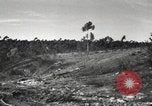
Japanese soldiers using human decoy technique in jungle against U.S. Marine Corps deployed on Pacific islands in World War II.
Deployment of U.S. Marine Corps on islands of Pacific and Japanese tricks of attack used against them during World War II. Japanese snipers attack U.S. Marine and fire gun from hilltops on island. Japanese mannerism of attack shows Marines advance through open field and lanes. Human decoy trick include Japanese sniper attacking Marine from a tree. Dead Japanese sniper after being shot by Marine. Japanese soldiers camouflaged with foliage, covering mouth of wounded Marine and hiding themselves behind bushes. Japanese soldiers look through binoculars. Japanese soldiers fire machine guns towards Marines come to rescue their wounded buddy.

U.S. Marines being attacked by Japanese soldiers at night on Pacific island during World War II.
Deployment of U.S. Marine Corps on islands of Pacific and Japanese tricks of attack used against them during World War II. Marine advance on island in night. Marines hear animal sounds in jungle. Marine lights a cigarette and being attacked by Japanese soldier. Machine guns of Marines fire tracer rounds at night. Blast in the jungle.
CRITICALPAST.COM: About Us | Contact Us | FAQs - How to Order | License Agreement | My Account | My Lightboxes | Shopping Cart | Advanced Search | Featured Collections | Website Terms & Conditions | Privacy Policy ©2026 CriticalPast LLC.
License Agreement |
Terms & Conditions |
Privacy Policy
©2026 CriticalPast LLC.