


 Francais
 Deutsch
 Italiano
Refine Your Search
Egypt 1953 stock footage and images
- Showing 235 to 240 of 1095 results more
more Hide
Hide
East German women being airlifted by a British European Airways aircraft in Berlin, Germany.
An Allied airlift in West Berlin, Germany. British European Airways office at Berlin Tempelhof Airport. Women refugees from East Germany sign flight papers. Refugee women in a waiting room as they look at an aircraft. Two women smiling. The women board a British airplane (G-AMSR). A clerk marks a British European Airways bulletin board listing the number of refugees who left the area on March 8th, 1953.
Released POW eating food what will probably be the last meal before leaving Korea in Panmunjom, Korea.
Operation Little Switch in which released POW are taken from Panmunjom, Korea to Tachikawa, Tokyo, and then on to the United States during repatriation of former prisoners late in the Korean War. The released POW (Prisoners Of War) eating food that will probably be the last meal there before leaving Korea. Food items kept in a shelf and on a table. A cook severs food in bowls to U.S. soldiers. Injured or former POW seated on a bed eating a bite of chicken is A/2C Robert L. Weinbrandt of El Cajon, California, a B-29 Super Fortress tail gunner captured after his plane was shot down the night of January 28-29, 1953. A wounded POW drinks soup and eats food kept on his bed. Liberated former prisoners drinking. Another former prisoner eating food. (Alarger Operation Big Switch followed in August.)
Men carry released sick prisoners on a stretcher with their luggage out of annex ward in Panmunjom, Korea.
Operation Little Switch (first phase of Operation Big Switch) in which released U.S. Army and U.S. Air Force POW (Prisoners Of War) are taken from Panmunjom, Korea to Tachikawa, Tokyo as part of repatriation effort late in the Korean War. Medical staff carry a number of sick or injured US military personnel (former prisoners) on stretcher. The first one seen is A/2C Robert L. Weinbrandt of El Cajon, California, a B-29 "Super Fortress tail gunner captured after his plane was shot down the night of January 28-29, 1953. He is seen being transported with his luggage out of annex ward. Several views of the released, former POW including several taken on stretchers out of the ward, and others that walk out on foot, smiling. Soldiers grab packs of Lucky Strike cigarettes from a basket. A car parked in the background. Officers and nurses in the hospital. General Shambora shakes hands with a released U.S. Army soldier.
U.S. Colonel Kirkpatrick awards Purple Hearts to a group of injured former POW late in Korean War.
Operation Little Switch effort underway for repatriation of former prisoners of war near end of the Korean War. Released POW (Prisoners Of War) had been taken from Panmunjom, Korea to Tokyo, Japan. A number of injured former POW U.S. Army soldiers are seen receiving Purple Heart awards from U.S. Army Colonel Kirkpatrick. Several views of Colonel awarding Purple Hearts to six soldiers, including two African American soldiers. The medals pinned on the robes of the hospital patients. (A larger Operation Big Switch followed, in August 1953).
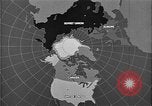
Cold War scenes: Soviet military on parade in Red Square; U.S. Army placing gun batteries in U.S. residential areas
Opening scene shows animated map of northern part of the earth, centered on the North Pole. It depicts the shortened flight paths between various parts of the Soviet Union, and the United States via polar routing, representing bombing threats. The Soviet Red flag flying on a flag pole. A large number of Soviet Tupolev Tu-2 bomber aircraft parked at an airfield. (They are equipped with four-bladed AV-9VF-21K variable pitch propellers.) Aerial view of several Russian Tu-2 aircraft in flight. Closeup of aircraft's twin tail showing dihedral angle between them, as viewed from tail of the aircraft. View of military parade in Red Square, Moscow. Numerous open army trucks, filled with Soviet troops, drive in formation. In a closeup, the Soviet State Museum building dominates the background. Closeup of Georgi Malenkov (who was named premier and first secretary of the Communist Party of the Soviet Union, upon the death of Joseph Stalin, in March 1953). He reviews the parade from the Kremlin. Soviet Secret Police Chief, Lavrentiy Beria, stands beside him. Army motorcycle troops pass in formation. Lenin Mausoleum and Kremlin Walls in background. Closeup of Soviet military veterans in civilian clothes, with medals, watching the parade. More troops in open trucks. They pass large posters of Lenin and Stalin. Closeups of Soviet civilians including women and children. A group of Asian persons watching the parade. View from a high point overlooking Red Square showing lines of army trucks snaking around both sides of St. Basil's Cathedral, as they leave the square, past Lenin's Tomb. Closeup of Soviet soldiers saluting with rifles as they pass reviewing stand. Their truck is towing a field howitzer equipped with two tires on each axle. Closeups of several towed howitzers. Scene shifts to Elizabeth, New Jersey, United States, where army jeeps and artillery pieces maneuver on the city streets, in preparedness exercises during the Cold War. A woman hanging laundry out to dry on a line. Artillery being placed in a vacant lot near a residential neighborhood. A woman looks out her apartment window at the gun being placed in the lot. Soldiers uncover it, revealing a 120 mm M1 anti-aircraft gun. Young boys watch the activity from a backyard, where clothes are on a line to dry. The soldiers erect a radar antenna on a fire control trailer. Two women watch the activity from their apartment window. Closeup of the gun installed and ready. A radar antenna rotating in the field. A battery of several antiaircraft guns installed in the field. Cars and pedestrians on busy streets and sidewalks in the city. Children playing on monkey bars in a park. Distant view of military temporary buildings and guns installed near apartment buildings. An alarm clock. A rotating radar antenna. A civilian asleep in his bed. A soldier steps from his unit's orderly room and blows a whistle. The disturbed civilian in bed looks at his clock reading 5:30 AM and expresses disgust. He is next seen with friends, registering a complaint with an Army Captain in his office, who agrees to resolve the matter. An Army Officer is seen standing at a large chalk board explaining how and why anti aircraft guns are being installed across the area, as civilians watch and listen to his explanation
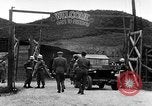
Military Police at Operation Big Switch in Korea. Exchange of prisoners of war at end of the Korean conflict.
Activities of the U.S. Army Military Police during the Korean War. MPs are active in Operation Little Switch repatriation effort involving exchange of prisoners of war. A sign on an entrance gate: "Welcome, Gate To Freedom". Military Police (MPs) standing at the entrance gate to Freedom Village. The U.S. and UN flags and Korean flags fly from flag poles. Red Cross vehicles arrive. Wounded are carried on stretchers. Men walk with belongings. Korean prisoners board buses. Red Cross workers transfer the wounded. (Operation Little Switch was a first phase and was followed by Operation Big Switch in August 1953).