


 Francais
 Deutsch
 Italiano
Refine Your Search
Egypt 1953 stock footage and images
- Showing 283 to 288 of 1095 results more
more Hide
Hide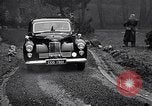
President Dwight D. Eisenhower meets Konrad Adenauer in Europe and presents his final report before the U.S. Congress.
A biographical documentary shows the life of Dwight David Eisenhower who was the President of the United States from 1953 to 1961. A Humber Pullman with a British flag driving. President Eisenhower is greeted by Konrad Adenauer, the Chancellor of Germany. Eisenhower talks to Adenauer. They sit and laugh. The Parliament Hill in Ottawa, Canada. He is greeted by another person. He walks with soldiers standing in rows on either side. He sits with other men and talks to them. President Eisenhower arrives in Washington DC. He meets and kisses his wife, Mrs. Mamie Eisenhower. He holds one of his grandchildren. He presents his final report before the U.S. Congress.
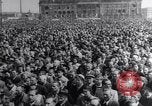
Status of Berlin during growing separation of East Berlin and West Berlin in 1961.
Rally of communists and youth in East Berlin. Small socialist flag on table. A boy reads during a rally. Historical view of parade by German soldiers in 1930's Berlin Germany. Russian tanks repel people on streets during anti-Communist protest of 1953. Aerial view of Brandenburg Gate area and refugees fleeing in thousands from East Berlin to West Berlin. Revitalized West Berlin, with new construction. A building in construction and another new building seen. Modern stores with show windows displaying abundant goods including cameras and foods. People at a a busy food or deli counter and in sidewalk cafes and restaurants. Busy streets of West Berlin with early 1960s automobiles. Enduring flame monument in West Berlin Inscription on the pedestal reads 'Freiheit Recht Freide' meaning Freedom, Rights, Peace. At a conference with allies including Britain in 1960 Soviet Premier Nikita Khrushchev walks down steps and gets into car. British Prime Minister Harold MacMillan with others walks down steps. Animated Khrushchev addresses gathering in Russian, forcefully and defiantly. MacMillan responds encouraging peaceful negotiations and no force. Newly elected Mayor Willy Brandt of West Berlin addresses people. United States President John F Kennedy with Premier Khrushchev, Secretary of State Dean Rusk and others at meeting in Vienna Austria. British flag at Headquarters of Berlin British Sector. Military police jeep stops near a sign. Soldier looks through binoculars at East West border of Berlin before Berlin Wall was substantial. During free elections in West Berlin people put their vote in ballot box. Box opened and counting of votes progresses. People see results on board. Nearly empty streets of East Berlin. Destroyed buildings of East Berlin still not repaired after World War II. The Spittelmarkt area, formerly a busy shopping market, now deserted and desolate. Mayor Brandt meets refugees and speaks over the microphone.
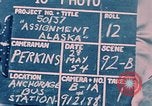
Bus pulls out onto street at Anchorage Bus station, Alaska. Serviceman arrives home at base housing
Bus pulls out onto street at Anchorage Bus station, Alaska. Next seen is living quarters and housing units for military personnel in Anchorage. U.S. military serviceman coming come drives a 1953 or 1954 Chevrolet Bel Air sedan 4 door car in neighborhood. He arrives in front of a housing building. Family members come out to greet him before they head into housing.
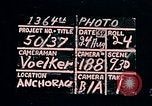
Street scenes of Anchorage, Alaska, in summer of 1954
A 1953 Cadillac sedan, covered with dust, drives along a road, passing homes in Bootlegger Cove residential neighborhood of Anchorage, Alaska. Next sequence shows Fourth Avenue south of C street, with vehicles moving along the street and several pedestrians on the sidewalk . A hotel is identified by its sign. Street level closeup of the pink-colored MacKay building, at 337 E 4th St, at corner of E 4th and Denali Street. ( It opened in 1951 as Mount McKinley Apartments, was renamed the MacKay building, and decades later, renovated and called the McKinley Tower.)

Atoms for Peace. Founding of United Nations International Atomic Energy Agency.
A technician sits in front of an oscilloscope and takes readings. Rotating figure appears on scope. Tracks of subatomic particles seen in a cloud chamber. Scientists at an atomic pile. Animated representation of an atom. Image of the earth in rotation. An advanced version of the atomic pile in which Enrico Fermi achieved the first sustained nuclear reaction at the University of Chicago, in 1942. Images of famous scientists, including: Albert Einstein speaking into a microphone; Otto Hahn, of Germany at a microphone; Niels Bohr, of Denmark; Madame Curie; and Hideki Yukawa of Japan. Technicians removing vials of radioisotopes from nuclear reactors. International students studying in classroom and laboratory at a nuclear institute. Elevated famous landmark views and vehicle and bicycle traffic in city of Copenhagen, Denmark. U.S. President,Dwight D. Eisenhower, delivering what became known as his "Atoms for Peace" speech at the United Nations, December 8, 1953, where he proposes formation of the International Atomic Energy Agency (IAEA). View of the hall and attendees listening. UN Secretary-General, Dag Hammarskjold, taking notes. Attendees applauding President Eisenhower. Scientists from 16 nations arriving and greeting one another at the first International Congress of Nuclear Engineering, held at the University of Michigan (Ann Arbor) on June 20, 1954, hosted by the American Institute of Chemical Engineers. Views of the first atomic library established in November, 1954, and translations of its technical papers being readied to be sent to various nations,beginnning with Japan.
World tensions after World War II. The Baruch Plan. The Berlin Airlift. The Korean War. The Cold War. The Atomic age. Ballistic Missiles
Speaking before United Nations Atomic Energy Commission (UNAEC) in its first meeting in June 1946, Bernard Baruch proposes international control of all atomic energy -- the so-called Baruch Plan. Low level aerial view of ruined post World War 2 European city. Goods including heavy equipment, locomotives, being loaded aboard ships to aid in the postwar recovery of Europe (The Marshall Plan). Workers in Western Europe making use of Marshall Plan materials to rebuild their national infrastructures. West European farmers restoring agriculture. View from overflying light airplane of parts of postwar Berlin in 1948. Blocked roads and empty railroad tracks leading from East Germany to West Germany, blocked by the Soviet Union. Barge traffic at standstill due to Soviet actions. U.S. C-54 transport aircraft flying supplies into West Berlin (The Berlin Airlift) during the Soviet blockade of that city. West Berlin citizens watching U.S. transport aircraft bringing fuel, food and other essentials into the isolated city. A C-54 flying low over empty railroad lines, as it prepares to land in West Berlin. Supplies offloaded from a DC-3 ( AKA C-47 or British Dakota) equipped with unusual set of rear cargo doors. Supplies being moved on Tegel Airport with many C-54 aircraft in the background. Numerous C-47 aircraft operating at Tempelhof airport. An East German official opening a barricade as Soviet blockade of West Berlin ends on May 12, 1949, and supply trucks begin to move over roads again. Flags of Western nations flying on high flagpoles. Glimpse of Allied warships underway during the Cold War. Formation of P-38 Lightning aircraft in flight overhead. NATO troops marching and NATO armor on parade. Flashes of heavy artillery firing at night. Korean refugees moving South in 1950 with the outbreak of the Korean War. View of UN Security Council meeting in the absence of Soviet representative. U.S. tanks firing guns and American infantrymen in conflict with North Korea in Korean War. American wounded on stretchers.Delegates of both North and South Korea signing the Korean Armistice Agreement in P'anmunjŏm, on July 27, 1953. A rocket is launched. Images of earth from inside a space craft in orbit. Narrator mentions the first satellite to circle the earth, the soviet Sputnik 1 in 1957. View of Soviet pilots in low pressure altitude chamber. A test subject in an aircraft making a maneuver that allows him to experience "weightlessness." Objects in his cockpit float about. A military rocket launch monitored by arrays of radar. An object being retrieved from space by means of a parachute. A nuclear powered submarine. Rockets on display during a military parade in Red Square, Moscow, the Soviet Union. A U.S. Air Force B-52 bomber taxiing. More views of rockets seen during a Soviet military parade in Red Square, Moscow.