


 Francais
 Deutsch
 Italiano
Refine Your Search
Egypt 1953 stock footage and images
- Showing 43 to 48 of 1095 results more
more Hide
Hide
First Battle of El Alamein, Egypt, in World War II
Opening scene of "Desert Victory" shows vast desert in area of El Alamein Western Egypt, during World War 2. Several British Army officers and men gather around a Humber Mk II armoured car serving as an improvised field command post. A soldier holds an aiming compass. Troops attending to themselves and their equipment, being annoyed by flies. Stripped to the waist in desert daytime heat, soldiers are seen huddled in sleeping bags during cold nights. View of approaching sand storm as it rolls over troop positions. Views of German armored columns moving through the desert. Closeup of passing German Army SdKfz. 7 half-track carrying six soldiers. German army vehicles speeding past the camera. One towing a 10.5 cm leFH 18 light howitzer. A Sd.Kfz.222 armored car. A German Stug III self-propelled assault gun. Closeup of a formation flight of German Ju 87 Stuka dive bombers. Closeup of individual Stuka, in flight, with pilot and gunner visible. German Field Marshal Erwin Rommel seen standing in an open car, accompanying his armored forces. He turns to look as they pass a knocked out British tank. Animated map showing El Alamein, where Rommel was headed with his forces. Highlights of the nearby areas of interest. A shepherd and flock in the Nile delta. View from the air of Al Rifa'i Mosque and Mosque-Madrassa of Sultan Hassan, in Cairo, Egypt. Panning view of waterfront in Alexandria, Egypt. View of the Suez Canal. Animated map returns to El Alamein. Barbed wire strung along the Mediterranean coast. Hills overlooking the Quattara Depression and closeups of its salt marsh that vehicles cannot cross. British troops moving toward El Alamein in trucks. British General Claude Auchinleck taking personal charge of the 40 mile front. British troops preparing defensive positions, using pickaxes, jackhammers, and shovels. They dig deep trenches and lay protective mines, set up machinegun positions and anti-aircraft batteries. Closeup of a British soldier manning a Vickers medium machinegun. Soldiers laying camouflage netting over defensive position. General Auchinleck standing in a vehicle, looks through binoculars. British gunners begin firing 25 pounder field pieces. German General Rommel, standing in his staff car, directs his officers. German gunners begin returning fire toward the British positions. German Ju 97 Stuka dive bombers attack and British anti-aircraft gunners defend against them. Bombs striking in the sand. A British gunner marks a 10th victory on the barrel of his anti-aircraft gun. In August, British Prime Minister, Sir Winston Churchill, is seen visiting and mingling with troops at the front. Churchill stands with General Sir Harold Alexander the new Commander-in-Chief, Middle East Command and Lieutenant-General Bernard Montgomery, new Commander of the 8th Army. Copy of directive to General Alexander, ordering him to defeat Rommel's forces.

Milwaukee welcomes major league baseball to the city, 1953
Newsreel clip on the Braves, Milwaukee's first Major League Baseball team, arriving in town for the first time. Girls in theme sweaters hold theme bags to welcome the team. Club owner Lou Perini and Mayor Frank Zeidler wait for the team's arrival. Men lay out a red carpet for the team. Men, women, and children wait to receive and welcome the players. The team arrives at the Union Station. Team manager Charlie Grimm and the players get off the train. A large crowd gathered to witness the event. Players in convertibles ride through city streets crammed with tens of thousands of people. Wisconsin Avenue (renamed Braves Drive for the day) flanked by people on either side. Players, in civilian clothes, wave to the crowds. (Note: the Braves had just moved from Boston. They would stay in Milwaukee only 13 years before moving to Atlanta.)
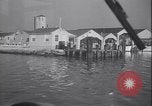
Military facility landmarks and museums and galleries in the Washington DC area in 1953
View from moving boat on Potomac River as it approaches docks for "Suitland Hall" Air Force facility in Washington DC. Scene then changes to view of Andrews Air Force Base and building for the Headquarters of the Military Air Transport Service. A C-121 Constellation aircraft parked on airfield at Andrews Air Force Base. C-47 Skytrain taxis into parking space. Airman pushes hospital ramp up to C-47 Skytrain. Wounded man on litter carried out of the aircraft into waiting ambulance. View of Bethesda Naval Hospital and then a view of the Walter Reed Army Hospital building. Early 1950s era cars parked in front of the Senate Building in Washington DC. 1950s cars move by on roads and streets of Washington DC in front of Federal buildings. Exerior views of the Museum of Natural History, and of the Mellon Art Gallery and National Museum of Art. Inside the American National Air Museum, a close up view of the Bell X-1, USAF aircraft #46-062, nicknamed Glamorous Glennis.

The New York Yankees and Brooklyn Dodgers play game one of the 1953 World Series
Yankees and Dodgers meet on the 50th anniversary of baseball's World Series. Fan holds up official series program. Fans pour into Yankee Stadium; man in Yankees jacket takes tickets. Managers Casey Stengel of the Yankees and Chuck Dressen of the Dodgers shake hands in dugout before the game. Baseball commissioner Ford Frick chats with Dodgers owner Walter O'Malley in the stands. Starting pitchers Allie Reynolds for the Yankees and Carl Erskine for the Dodgers pose for cameras. Yankees' Hank Bauer seen in close up before hitting run-scoring triple. Yankees' Billy Martin seen in closeup before hitting three-run triple. (Note: Martin would be named the MVP of this series.) Dodger fans look disgruntled until Dodgers come back to tie game with a home run by George Shuba and two-run single by Carl Furillo. But Yankees' Joe Collins put his team back in front with a home run.
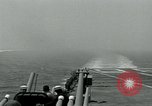
British Royal Navy Vampire aircraft makes arrested landing and then commences take off roll from the U.S. aircraft carrier Antietam (CV-36) during practice operations in 1953.
British Royal Navy de Havilland Vampire jet aircraft makes an arrested landing on the short angled deck of the American Aircraft Carrier, USS Antietam (CVA-36). Once the arresting gear is removed, a large group of sailors push on the wings of the aircraft to move it backwards into position for takeoff. The jet maneuvers slightly on the deck, then the pilot sets its engine to max power holding brakes and then releases them to begin a takeoff roll.
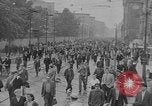
Uprising of 1953 in East Germany: Crowds in East Berlin protest against East German Communist government policies
Unrest in Berlin, East Germany. A large crowd gathers to demonstrate against East German government. A banner carried by some demonstrators calls for free elections. Armed Stasi watch the demonstrators. Demonstrators burn banners and posters and damage public property. People stands on roofs of houses and watch the demonstrations. Armed East German police and some Soviet soldiers watch the demonstrators from their headquarters. Demonstrators tear up and burn signs and start a bonfire. East German Stasi reinforce the checkpoint between the Soviet and American sectors of Berlin. A uniformed Berlin police officer, wearing traditional hat, assists a person who was manhandled by the mob. A building set afire by the demonstrators. View from West Berlin of mob in East Berlin. Sign reads: "You are leaving the American Sector."