


 Francais
 Deutsch
 Italiano
Refine Your Search
Etain France 1944 stock footage and images
- Showing 6199 to 6204 of 9964 results more
more Hide
Hide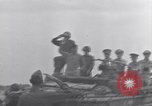
General Bernard Montgomery meets General Mark W Clark in Paestum Area, Italy, during World War II
General Bernard Montgomery in Paestum Area, Italy during World War 2 British General Bernard Montgomery arrives at a U.S. Army encampment in Italy, via a DUKW (amphibious truck). He jumps down from the vehicle and is greeted by U.S. General Mark Clark, Commanding General of the U.S. 5th Army.. Members of General Montgomery's staff and others accompanying him also jump off the DUKW. Montgomery and Clark both climb aboard General Clark's jeep, which displays four stars on its bumper. The Generals walk together into an encampment, exchanging salutes with soldiers they pass. Closeups of Clark and Montgomery standing in camp area of trees and foliage. Montgomery speaks to a smiling group of American officers, and then turns to leave with General Clark.
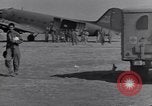
U.S. C-47 aircraft perform air evacuation missions during Operation Torch in Oran Algeria, during World War II
Opening scene shows American soldiers gathered around a C-47 transport plane on a desert field in Oran, Algeria during World War 2. They walk away en masse from the plane. Another C-47 is seen with tail number tail number 42-23507 (Records show this aircraft was delivered to Oran on May 20, 1943 and supported Operation Torch- The Italian Campaign of World War 2.) Scene shifts to interior of a C-47 rigged as an air evacuation aircraft, with wounded American soldiers in stacked bunks on both sides of the aircraft. A nurse and corpsmen are attending to the wounded. Two soldiers carry one of the wounded soldiers on a litter to the aircraft door. View from the outside of the soldier being carried by others to a waiting field ambulance. More views of the wounded being transferred from the plane to waiting ambulances. Scene shifts to ambulances parked on the desert field with a large Red Cross flag above them. A Curtiss P-40 fighter plane taxis past the camera. A large open field tent with a large Red Cross flag flying above it. Nurses and medical corpsmen tend to wounded soldiers lying in ambulances. A nurse serves water to some wounded.
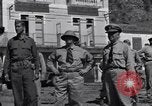
General Mark W Clark receives a jewel as a token of gratitude during World War II in Salerno, Italy.
General Mark W Clark during World War II in Salerno, Italy. General Clark with others, British General Richardson, Major General Alfred Gruenther standing and discussing. All the army personnel along with General Clark walk away and meet the other army personnel standing in a row. General Clark congratulates the soldiers of 82nd Airborne Division. Monsignor Francesco Cuazzo of Maria del Granta Monastery thanking General Gruenther for the contribution in repairing the old church. General Clark receives a jewel as a token of gratitude from the Monastery service men.
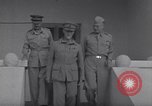
Jan Christian Smuts of the Union of South Africa in Tunis, North Africa.
Tunis, North Africa. Field Marshal Jan Christian Smuts, General Sir Harold Alexander and General Dwight D Eisenhower step down from the stairs of Eisenhower Villa Headquarter. Three of them standing in their army uniform engaged in a discussion.
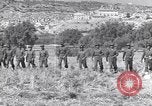
General Andrus presents medals to soldiers of 105th CA (AA) Battalion in Sicily, Italy, during World War II..
Soldiers of 105th CA (AA) Battalion being decorated in Sicily, Italy. About a dozen members of the Battalion march abreast, across a grass field, towards the officers. Brigadier General Clift Andrus, artillery Commander of the 1st Infantry Division, pins silver stars and other decorations on the soldiers. The 105th CA (AA) Battalion is seen drawn up in formation in the background. The 105th CA AA was a battalion, not a regiment. It was attached as a separate battalion to the First Infantry Division for the North Arican and Sicilian campaigns and then to the Thirty-sixth Infantry Division for the Italion campaign. My source is over 100 letters written home by my father during those campaigns.
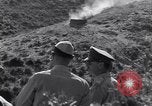
General Mark W Clark along with other army officers observes demonstration of military activities in North Africa.
Demonstration of military activities in Ain-el-Turk, North Africa. General Mark W Clark and General Alexander standing on the hilltop. Smoke from the ground at the side of the officers seen. General Clark and General Alexander walk down the hill. Generals walk by the demonstration ground, discuss and walk towards the jeep. General Clark speaks with the soldiers and then gets into the jeep. Other officer along with General Alexander and General Clark gets into the jeep and drives away. (World War II period).
CRITICALPAST.COM: About Us | Contact Us | FAQs - How to Order | License Agreement | My Account | My Lightboxes | Shopping Cart | Advanced Search | Featured Collections | Website Terms & Conditions | Privacy Policy ©2026 CriticalPast LLC.
License Agreement |
Terms & Conditions |
Privacy Policy
©2026 CriticalPast LLC.