


 Francais
 Deutsch
 Italiano
Refine Your Search
Etain France 1944 stock footage and images
- Showing 229 to 234 of 9933 results more
more Hide
Hide
Animation shows how steam launches V-1 glide bomb via catapult (WW2)
Title card says “Geheime Kommandosache” (“Secret commando operation” in English). “Erprobungsstelle der Luftwaffe Karlshagen” (“Test site of the Air Force Karlshagen” in English). “Flakzielgerät 76 Schnittautnahmen und Trick 6.+9.1.1944” (“Flak target device 76 cut recordings and trick 01/6-9/1944” in English). Close up of Argus engine on V-1 glide bomb as it starts, with variable intake compensating between jet pulses. Animation demonstrating how steam propels the V-1, with arrow pointing at the piston being pushed by steam within the Walter catapult. Various views of the Walter catapult ramp, including an unusual view from below the launch ramp as a V-1 buzz bomb is launched during World War II.
Battle of the Ardennes and Battle of the Bulge, in World War II
Film starts showing silhouettes of British tanks on the move, including one with a bulldozer blade. View from Allied warplane as bombs explode on the ground below. In November, 1944, infantry of the First Canadian Army, with Polish and British units fire Bren guns as they advance in Belgium and secure the Scheldt Estuary, to open a shipping route to Antwerp for the Allies. They traverse a river and cross rail lines while advancing. View of destroyed steel bridge across the Maas (Meuse) river with several British troops wading in water nearby. Silhouettes of German prisoners of war marching single file. View from rear of German prisoners walking under guard with hands resting on their heads. British troops running beside the Scheldt river at Antwerp on September 4, 1944, as huge explosions occur in the river behind them. A column of British troops, marching on tree-lined road, enters outskirts of Antwerp, as local people cheer them. Views of the troops being greeted in the city itself. Columns of Belgian refugees are seen returning to their homes. One,injured, is carried by friends in a wooden cart. A contingent of British troops marching in the city. Glimpses of derricks in the Antwerp port and a ship under construction in a shipyard. An animated map shows German counter offensive through Belgium and Luxemburg on September 4, 1944. Refugees leaving again, ahead of the returning German forces. View of a road sign reading: "Bastogne." American military police checking credentials of some refugees as they leave. American soldiers jammed together atop a Sherman tank parked at a checkpoint. After delaying further German advance, through the Ardennes, on September 16th, American troops are forced back and seen leaving , in trucks and Sherman tanks, from Bastogne, past a road leading to Martelange. As weather cleared on September 22nd, a formation of British Hawker Typhoon ground attack aircraft are seen in flight and diving to attack lines of communication with machine gun fire and rockets. Several different views of the aircraft firing and smoke rising from the ground. Animated map of German advance depicts the so-called "Bulge" extending 60 miles into Allied territory. Captured German films show German troops,one carrying a rifle and another a Sig 44 machine gun, as they pass columns of burning Allied trucks, other vehicles and armor. Closeup of German soldier waving to others to follow him, as he runs ahead past burning Allied equipment. Several German soldiers hunker under a knocked out Allied tank, as a German Jagdpanzer 38(t) Hetzer light tank destroyer passes their position. Closeup of German soldier smoking captured American cigarette. German infantry, walk past barrel of destroyed Allied tank. Several gather and smoke American cigarettes. One of them, with a belt of ammunition around his neck, is Hans Tragarsky aka Walter Armbrusch, of German Kampfgruppe Hansen, a battle group formed during the Battle of the Bulge from SS-Panzergrenadierdivision Regiment 2, an infantry regiment of SS Pz Rgt 2 "Das Reich". (This image is well known but his identity is subject to debate.) Glimpse of German officer walking with a soldier at the front, with background engulfed in flames.. Scene shifts to a formation of U.S. Army Air Forces C-47 transport planes seen, in flight, dropping food and ammunition to beleaguered American troops caught in the Battle of the Bulge. Change of scene to German Jagdpanzer IV tank destroyer moving; Panzer IV tanks firing 7.5 cm KwK 37 L/24 guns; and troops riding on a Tiger tank ( Panzerkampfwagen Tiger Ausf. B). German soldiers riding in a streamlined Volkswagen Kübelwagen. German soldier in an open single seat courier car spattered with mud. Close-ups of him smoking a cigar. German soldiers looking at formation of American C-47 aircraft overhead. A U.S. Army Air Corps B-25 bomber in flight. View from Allied bomber dropping bombs that strike ground with many explosions. View from above of a B-24 Liberator bomber in flight. View on ground of shells and bombs exploding in wooded area and low level black flak clouds. Captured 88mm gun being fired by Allied forces. British soldiers in a Landing Vehicle Tracked, cross a stream and climb up a steep bank. View from British "Wasp" flame-throwing Bren-gun carrier, as it fires and resulting inferno of fires. Views from a long distance of other flame-throwers firing across the stream. Closeup view of one firing with fires burning on the opposite shore.
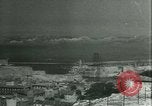
Liberation of several French cities from German Nazi troops in World War II.
Marseilles: View of the French port. British, French and American Naval officers examine German demolition of the port town. Officers survey unfinished U-Boat pens. Toulon: Destroyed German ships in the harbor. Bologne: German coastal guns in ruins. Destroyed artillery. Le Havre: Destroyed buildings and ruins in the town. Unfinished German U-Boat pens. Destroyed artillery. Brest: Destroyed buildings and ruins. German soldiers wave a white flag of surrender on September 18, 1944. U.S, Army Major General. W.M. Robertson , 2nd Infantry Division discusses the surrender with German Colonel E. Pietzonka of the 7th German Parachute Regiment. German soldiers assemble in the main square of the city during the surrender operation.
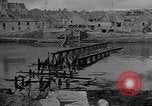
U.S. Army XX Corps units crossing pontoon bridge across Marne River, during World War II
View of bridge across the Marne River destroyed by retreating German soldiers. View shifts to U.S. Army XX Corps troops, trucks, jeeps, halftracks and tank destroyers crossing a pontoon bridge erected by Army Engineers nearby, at the bridgehead captured on 27 August 1944, during World War 2. French civilians watch from the bank of the river and wave as troops pass through their village. Using this crossing, the XX Corps continued its advance on Rheims.
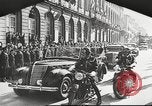
French Marshal Philippe Petain addresses a crowd from the balcony of a building in a French town during World War II.
French Marshal Philippe Petain in a French town in 1944 during World War II. Philippe Petain walks along a street with other officials. A crowd cheers. Petain addresses from the balcony of a building. Petain and staff stand at attention saluting as the crowd sings the national anthem.
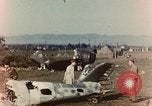
U.S. flyers who escaped from internment in Switzerland examine destroyed German warplanes in World War II
U.S. flyers, who escaped from Swiss internment, examine remains of destroyed German warplanes at a French airfield. A swastika seen on the tail of an airplane and a German cross on the wing of another. Men stand on the tail of a Nazi airplane. A group stands near the wrecked tail of a large German airplane. A U.S. P-47 aircraft is parked in the background. It has a red cowling, identifying it as belonging to the 56th Fighter Group (likely to the 63rd Fighter Squadron, which in Spring of 1944, showed no squadron color on the tail). .Army Air Force L-5 Sentinel aircraft in flight over a field.
CRITICALPAST.COM: About Us | Contact Us | FAQs - How to Order | License Agreement | My Account | My Lightboxes | Shopping Cart | Advanced Search | Featured Collections | Website Terms & Conditions | Privacy Policy ©2026 CriticalPast LLC.
License Agreement |
Terms & Conditions |
Privacy Policy
©2026 CriticalPast LLC.