


 Francais
 Deutsch
 Italiano
Refine Your Search
Etain France 1944 stock footage and images
- Showing 325 to 330 of 9933 results more
more Hide
Hide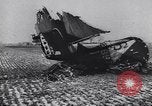
Remains of U.S. 8th Air Force aircraft shot down by German fighter aircraft and flak. U.S.flier POWs during World War II.
Tail and crushed wings of American B-17 bomber, one of several shot down over the Germany-Holland border, during World War 2. Bodies of two U.S. airmen lying on the ground next to the debris. Remains of crashed B-17, Serial number 42-39822, of the U.S. 333rd Bomb Squadron, 94th Bombardment Group, which was shot down by German FW-190s while returning from a mission to Brunswick (Braunschweig), Germany, on January 11, 1944. A fuselage from downed allied warplane being hauled away on a truck. A junkyard filled with American warplane parts, stacked by type, engines in one pile, tails in another, etc. One vertical fin, marked with the 'triangle A' of the 91st Bomb Group, is from B-17G, tail number 42-37737, named "Tennessee Toddy" of the 401st Bomb Squadron. It crash landed after losing two engines, on 10 October 1943, at Brocklanderweg, near Apeldoorn, Holland. Two U.S. Army Air Corps prisoners being interrogated by a German officer. Group of United States airmen prisoners of war, apparently showing personal identifications (dog tags) to a German interrogator.
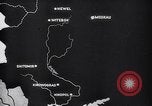
Field Marshal Ernst Busch is relieved of Command after German Army Group Centre suffers severe losses in World War II
Map shows Belorussian and Russian areas near the Dnieper river. Field Marshal Ernst Busch, ostensibly being honored for 40 years of service. (He has been notified that he is relieved from command of German Army Group Centre, following disastrous defeat by Soviets during their 1944 Belorussian Offensive of World War 2.) He steps from his headquarters in Belarus, receiving salutes from his staff. He accepts an elaborate candelabra, as a gift. Busch shares a document with a German General, and they both are amused by it. Members of the staff bid Marshal Busch farewell.
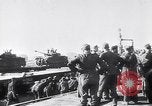
German tanks and supplies moved forward to attack Russians in Russia.
German Panther tanks of 5.Pz.Div, Pz.IV's and supplies are moved forward in Russia on railway flatcars. Troop trains move on the front. Soldiers in discussion and one smokes a cigarette. Trenches are dug and command post with radio operation is set up. German soldier climbs up tower. Mortars, artillery, and machine guns are fired at Soviet troop positions. Grenades are hurled and German Tiger tanks counterattack under protection of artillery fire. Tigers seen are from s.Pz.Abt.503 and SS.Pz.Rgt 2 (Das Reich) in 1943 and s.Pz.Abt.502 with ace Otto Carius in 1944. (World War II period).
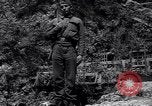
Marshall Tito, with American and British envoys and his headquarters staff at their Mountain Headquarters in World war II
Film opens showing a Partisan Sentry posted outside Marshall Tito's mountain stronghold in Drvar, Western Bosnia, Yugoslavia, during the Spring of 1944, in World War 2. Views of other sentries on guard duty. A Partisan officer steps onto the porch of the headquarters and looks through a pair of binoculars. Closeup of a sentry. Scene shifts to Marshall Tito stepping from the main porch to a lower one, accompanied by American Army Major Linn M. Farish, American Liaison to the Partisans, and British Brigadier General Fitzroy Maclean, Winston Churchill's special envoy to the Yugoslav leader. Tito smokes a pipe, as he and Farish converse. MacLean smokes a cigarette. In next scene Farish is also smoking a cigarette. Major Farish removes his hat and tosses it over the railing (perhaps because Tito is not wearing one). Tito pumps his arm several times while MacLean removes his hat. Then, speaking to MacLean, Parish pumps his arm as well. Next, they are joined by Tito's Chief of Staff, General Koča Popović. Views of Tito and Popović. Change of scene shows a British military photographer upon a railing taking a still picture of Tito and his Partisan Supreme Command (cabinet and principal staff officers). After the photographer leaves, they remain together with Tito's pet dog, Tigar.
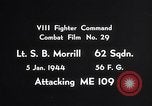
Attack on German World War II aircraft Messerschmit Bf-109
A film titled 'VIII Fighter Command Lt. S.B. Morill 62 Sqdn.(Squadron) 56 F.G.(Fighter Group) attacking ME-109 on 5 January 1944'. Luftwaffe aircraft ME-109 explodes during World War II in Germany.
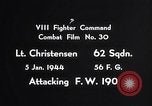
Attack on German aircraft F.W.190 by Eighth Air Force pilot Lt. Christensen of 62nd; 56th FG during World War 2.
A film titled 'VIII Fighter Command Lt. Christensen 62 Sqdn.(Squadron) 56 F.G.(Fighter Group) attacking on 5 January F.W.190 1944'. Attack on Luftwaffe aircraft F.W.190 during World War II in Germany.
CRITICALPAST.COM: About Us | Contact Us | FAQs - How to Order | License Agreement | My Account | My Lightboxes | Shopping Cart | Advanced Search | Featured Collections | Website Terms & Conditions | Privacy Policy ©2026 CriticalPast LLC.
License Agreement |
Terms & Conditions |
Privacy Policy
©2026 CriticalPast LLC.