


 Francais
 Deutsch
 Italiano
Refine Your Search
Etain France 1944 stock footage and images
- Showing 3445 to 3450 of 9964 results more
more Hide
Hide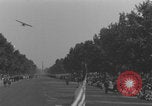
Allied victory parade to Place de la Concorde after liberation of Paris (WW2)
A glider flies over Paris after liberation from Nazi Germany during World War 2. Allied soldiers in Jeeps, motorcycles and other armored vehicles move towards the Place de la Concorde (75008 Paris, France). A huge crowd gathered at the Place de la Concorde. Soldiers standing guard in front of crowd. Crowds cheering in front of the Hôtel de Crillon (10 Place de la Concorde, 75008 Paris, France) near the Place de la Concorde. Guards and civilian men control a crowd of young French men and women. Cheering French men. Red Cross nurses wave at crowds from moving trucks to Place de la Concorde. French women and boys waving from balcony. Young French men, women and Red Cross officers sit at the back of a Jeep. Crowds cheer for Allied troops in vehicles on Rue de Rivoli.
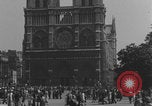
French 2nd Armored Division tanks arrive in front of Notre Dame, crowds watch a parade in Paris (WW2)
French 2nd Armored Division tanks in front of Notre Dame de Paris during World War 2 liberation of Paris. Pedestrians walking in front of Notre Dame de Paris (6 Parvis Notre-Dame - Pl. Jean-Paul II, 75004 Paris, France). French 2nd Armored Division tanks, some with names “Chateau Larose” and “Chateau Laffitte”, arrive in front of the Notre Dame. A soldier directs a tank to reverse. A French 2nd Armored Division M4 Sherman tanks “Pte de Vanves”, “Pte Maillot” driving in front of Notre Dame. French soldiers and civilians stand. Rows of tanks parked near civilians. Red Cross truck arrives. Red Cross medics rush with a wheeled bed. Crowds gathered in front of Notre Dame with the Free France banner hanging in front. Civilians and female nurses running. Groups of civilian men marching in three lines along a road. Crowds of French civilians cheering from stone balustrade. A nurse stands on a balustrade to watch a parade. A French woman smokes a rolled cigar while sitting on a balustrade with crowds. A man smoking a pipe and a girl stand among the crowd.
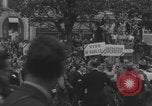
French Forces of the Interior (FFI) fighters and Free French 2nd Armored Division soldiers’ parade in Paris (WW2)
French Forces of the Interior (FFI) fighters and Free French 2nd Armored Division soldiers’ parade after liberation of Paris in World War 2. Crowds of French citizens gather on the sidewalk to watch victory parade. French people holding banners reading “Vive De Gaulle” and “Libération” (“Long live De Gaulle” and “Liberation” in English). French people cheering. Soldiers marching with the French tricolor flag along the Avenue des Champs-Élysées. The Arc de Triomphe (Place Charles de Gaulle, 75008 Paris, France) is seen on the background. Soldiers marching in front of a building displaying flags of Allied nations- the United States, Soviet Union, United Kingdom and France. FFI fighters (men and women) marching, some with rifles and banners, down a road. Banner reads “FFI”. Another Free French placard reads “2e. Section Libération”. FFI men and women in casual clothing marching along the Avenue des Champs-Élysées. FFI fighters march with rifles on their shoulders along Boulevard du Montparnasse, passing by Le Sélect brasserie, a notable meeting place for French intelligentsia. Staff car and a group of half-tracks along the Avenue des Champs-Élysées. Soldiers with a gun sit on top of a tank during a parade. Soldiers and FFI fighters celebrate their victory by raising the “Victory Sign” on top of a moving military vehicle during the parade. French 2nd Armored Division M4 Sherman tank “St. Anne d’ Auray” moves during the parade. Soldiers on top of a moving vehicle. Crowds running along the Avenue des Champs-Élysées. French people running on the sidewalk of Place de la Madeleine, near the Madelios menswear department store.
An injured Red Cross nurse gives a V-sign during a parade after liberation of Paris (WW2)
General Charles de Gaulle with French officials in Place de la Concorde during World War 2. Crowds gather in Place de la Concorde (Place de la Concorde 75008 Paris, France) to watch a parade. Men sitting on top of a statue. A French camera man shoots footage on top of a car with a sign “Please don’t kill the French cameramen”. French Forces of the Interior (FFI) fighters marching during victory parade. French civilians sit on top of moving military and Red Cross vehicles. French civilians give the V-sign. French women and soldiers riding on an M3 half-track. Red Cross medics and nurses, some carrying flags, marching from the Arc de Triomphe to the Place de la Concorde. Red Cross medics give the V-sign hand gesture (for victory) while cycling. A young Red Cross nurse with leg injury is carried on a stretcher during parade, near Hôtel de Crillon (10 Place de la Concorde, 75008 Paris, France). Smiling young nurse gives a V-sign while being carried on stretcher.
FFI fighters participate in a parade after liberation of Paris (WW2)
French Forces of the Interior (FFI) fighters during a parade in Paris after Allied liberation (World War 2). FFI fighters victoriously marching with French tricolor flags and rifles at the Place de la Concorde (Place de la Concorde 75008 Paris, France). Civilians watch the parade on the side of the plaza. Some people are seen clapping. A U.S. Army Jeep with soldiers drives near marching FFI fighters and French guards. A Piper Cub flies low near the crowds. Men and women hold United States, French and British flags and signs “Vive de Gaulle”, “Allies”, on top of a Free French trucks in front of Hôtel de Crillon (10 Place de la Concorde, 75008 Paris, France). Sign on the side of the trucks read “Liberation” with French, England, and United States flags displayed. Piper Cub light aircraft flying over the Arc de Triomphe as seen from the Avenue des Champs-Élysées.
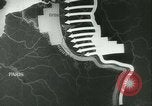
German tanks, horses and troops cross the Rhine on barges and rafts during their advance towards France in WWII.
The German assault on France during the Battle of France in World War II. An animated map depicts the German attacks on the Maginot Line and city of Paris. German Field Marshal Erwin Rommel (Desert Fox) confers with a German officer. German soldiers in a fields, pull an armored vehicle with ropes. Smoke from bomb explosions. Bomb damaged buildings. German tanks advance. The Germans cross the Rhine. Soldiers cross over a bridge and in boats, load and fire artillery. Explosions on either side of the river. Soldiers and civilians lay planks to build a bridge. Soldiers in amphibious vehicles cross the river. Tanks, horses and troops cross the Rhine on barges and rafts. Camouflaged German tanks. German officers review the advance. Soldiers eat rations, drink water and take rest. The horses are fed. Soldiers on motorbikes and in tanks on a street.
CRITICALPAST.COM: About Us | Contact Us | FAQs - How to Order | License Agreement | My Account | My Lightboxes | Shopping Cart | Advanced Search | Featured Collections | Website Terms & Conditions | Privacy Policy ©2026 CriticalPast LLC.
License Agreement |
Terms & Conditions |
Privacy Policy
©2026 CriticalPast LLC.