


 Francais
 Deutsch
 Italiano
Refine Your Search
Etain France 1944 stock footage and images
- Showing 349 to 354 of 9933 results more
more Hide
Hide
The ruins and explosion in Aachen, Germany following bombing by Allies in World War 2
Air and Ground Forces cooperation in Aachen, Germany. The ruins and collapsed buildings of Aachen Germany on October 15, 1944, following Allied bombing. Smoke rises from ruins. View of a field area and then a giant explosion as a ground target is detonated with explosives. Large cloud of smoke rises. U.S. Army soldiers inspect exploded area.
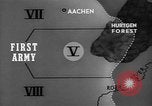
U.S. Army troops and engineers building roads, placing guns, transporting German POWs in Germany near Hurtgen Forest region.
Activities of American First Army from Aachen to Roer River in Germany. Animated map shows First Army entering into Hurtgen Forest and arrive Cologne plain going through the Roer River. 28th Division controls key roadways of Vossenack and Schmidt. Engineers build roads through the Hurtgen Forest. Large tree trunks are laid into place as foundation and then milled wooden planks are nailed atop to quickly create a usable road surface. Jeep passes over the newly built road. U.S. Army forces start a fire for protection against the cold. 28th Division troops with mortar and machine gun support advance (November, 1944) through a wooded area. Infantry columns move to the front. Smoke clouds rise. Ground forces move out from wooded area. German POW's file into an assembly area and are evacuated by truck. U.S. Army soldier hangs a sign around the neck of a Germany prisoner of war that says "200,000th prisoner of war captured by troops of U.S. First Army." Artillery and antitank guns are placed for defense. Soldiers work on telephone tower. Underground emplacements are built as snow falls. (World War II period).
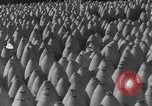
German Army fortifying coastal areas of Anzio and Nettuno, Italy, in World War II
German military preparations to fortify the Italian coast near Anzio and Nettuno, during World War 2. Thousands of German heavy artillery shells stacked in an ammunition dump in Italy during World War 2. German soldiers form line and pass shells and other ammunition to each other for loading into trucks. View from German Coastal shore guns overlooking the Anzio-Nettuno areas in Italy, before the Allied amphibious attack of January 22, 1944. German soldiers attend to their guns. German soldiers preparing more gun positions on side of a mountain. A German tank being covered with foliage, on a mountainside.
P-47 aircraft of the U.S. Army Air Force 368th Fighter Group take off and land at muddy Chievres Airfield in Belgium during World War 2
World War II P-47 aircraft of the United States Army Air Forces (USAAF) take off and land at Chievres Airfield (A-84) in Chièvres Belgium. Airplanes take off from the muddy air base. Trees in the background. Second plane landing has nose art that is difficult to read, but the aircraft serial number 42-76114 (which was piloted by George Swink of the 396th Squadron. Swink's aircraft was downed by flak on 25 December, 1944 and his status after was POW). Various scenes of P-47 Thunderbolts taking off and landing.
The strafing and bombing of locomotives, truck convoy, FW-190 and ME-109, European Theater.
The 8th Fighter Command Operations, European Theater. 29-June-1944; Captain M F Baker of 362nd squadron 357th fighter group flies the aircraft. High altitude view of the area. Strafing of locomotive and a truck convoy. Lieutenant Wright of 375th squadron 361st fighter group flies the aircraft. FW-190 attacked. Guns fired. Aircraft crashes. Strafing of ME-109 on ground. (World War II period).
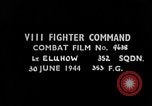
The strafing and bombing of railroad terminal and trucks, European Theater.
The 8th Fighter Command Operations, European Theater. 30-June-1944; Lieutenant Eluhom of 352nd squadron 353rd fighter group flies the aircraft. High altitude view of the target area. Strafing of railroad terminal, trucks, targets in thicket area. Fires from hit. Smoke arises from bombing. (World War II period).
CRITICALPAST.COM: About Us | Contact Us | FAQs - How to Order | License Agreement | My Account | My Lightboxes | Shopping Cart | Advanced Search | Featured Collections | Website Terms & Conditions | Privacy Policy ©2026 CriticalPast LLC.
License Agreement |
Terms & Conditions |
Privacy Policy
©2026 CriticalPast LLC.