


 Francais
 Deutsch
 Italiano
Refine Your Search
Etain France 1944 stock footage and images
- Showing 3901 to 3906 of 9964 results more
more Hide
Hide
Allied troops liberate Le Havre, Lyon, Brussels and Antwerp (WW2)
Allied troops set off for the final drive of the Liberation of France and Belgium in World War II. La Havre: Intensive bombing by Allied bombers at the 2nd port of France. Allied planes in flight, drop bombs. Smoke from the explosions. German positions are covered by Allied target indicators. Soldiers and tanks advance through fields. Smoke and fire from destroyed vehicles and bombardment. The first Allied platoon enters the town. Destroyed buildings and ruins. The dock area, reduced to a complete rubble. Surrendered German soldiers are marched in the streets. Antwerp: Liberation of Antwerp. A convoy of tanks. Allied troops cross a Bailey bridge over the Albert Canal. British Second Army enters the city. Tanks and soldiers. Machine gun fire. The dock side railway head is captured. Civilians welcome the troops. Belgian Forces of Interior and civilians celebrate. Allied aircraft drop arms and supplies attached to parachutes for use by the Belgian Army. A low flying British Short Stirling bomber dropping supplies. Soldiers collect the supplies and load it into a cart. Brussels: Members of the Belgian Government lay wreaths at the Brussels war Memorial in tribute to the capital's liberation. Soldiers march. Field Marshal Bernard Montgomery is given a grand reception. The Field Marshal in a convertible. He greets the people from a hotel balcony. Lyon: The U.S. Seventh Army liberates Lyon. German snipers in elevated position in the Hotel Dieu, beside the Rhone River, fire into crowded streets from the hospital. Soldiers fire back at them. Smoke and fire coming from the German firing position. Civilians crouch and take cover. Hospital patients removed to safety. Nurses tend to a wounded man. French and U.S. troops drive through the city. Civilians shake hands with the soldiers. Some men and mostly women collaborationists, accused of working with the Germans, are disgraced and paraded on the streets with their hands behind their heads. FrenchpPeople cheer and celebrate.
U.S. Military Chaplain (Roman Catholic) conducts mass on pier in Weymouth harbor, England, 3 days before D-Day
U.S. troops and Coast Guardsmen assemble for religious service on a pier in the port of Weymouth, England, three days before the invasion of Normandy, France, in World War 2. A Roman Catholic Military Chaplain conducts the mass. Landing Craft Infantry LCI(L) numbers 89 and 93 are tied up at the dock in the background. (These craft are part of LCI(L) Floltilla 10, operated by the United States Coast Guard.) A small dog stands at the feet of the Chaplain, as he conducts the mass. The service finishes as the Chaplain administers the sacrament of Holy Communion (Eucharist) to the troops. In concluding scenes, U.S. Landing Craft Infantry are seen underway from England, to join Assault Groups for the invasion of Normandy, France. One of the craft is seen to be Number 87 and another number 495.
82nd Airborne troopers prepare England for invasion of Normandy during World War II.
Preparations in England for the Allied invasion of France during World War II. U.S. Army 82nd Airborne soldiers with equipment as they prepare to board an aircraft. Men load into buses as a motorcycle escort leads a convoy of buses through a farmland. Men get down from the buses and walk into hangar being used as barracks. Soldiers issued new equipment including life vests, ammunition and grenades. Medical supplies are checked. A jazz band of servicemen plays and men do pushups and calisthenics. Men play handball and volleyball. They read and write letters to loved ones at home. Men sharpen, check and work on knives and rifles. They clean and oil the rifles and attach bayonets. Soldiers paint invasion stripe marks on C-47 aircraft readying it for the D-Day invasion of France.

Allied forces prepare for D-Day, also known as 'Operation Overlord' (WW2)
'Eve of Battle' depicts the Allied invasion of Europe during World War II. Slave labor from Nazi Germany-invaded countries construct Atlantic Wall. German artillery and fortifications in the Atlantic Wall. Nazi German soldiers marching in groups. Nazi leader Adolf Hitler shake hands with Italian fascist leader Benito Mussolini. Allied leaders Franklin D. Roosevelt, Winston Churchill and Joseph Stalin sit together during the Tehran Conference in December 1943. Exiled Allied leaders such as General Charles de Gaulle of France, Queen Wilhelmina of the Netherlands and Dr. Edvard Beneš of Czechoslovakia inspect Allied troops. Various Allied troops from Poland, Norway, England, United States, and Czechoslovakia prepare to launch an invasion in France. Eisenhower along with other officers plans the European invasion. Allied ships and aircraft on their way to Europe. Allied bombers drop bombs over Nazi German U-boats. Naval battle begins and explosions occur, smoky docks. In England war supplies unloaded. Supplies include weapons, military equipment, and food. A tank and locomotive trains being loaded into a ship bound for Europe. Allied aircraft take off at night. A man directs an aircraft taking off. Allied bombers bombard German targets resulting into fiery flare in Europe. British children playing jump rope as a supply train pass by in the background. Tanks and fighter planes transported by train. Supply boxes unloaded and stacked for transport to the battle front.
Allied bombing campaign against Germany and Luftwaffe defenses during World War II
German M-Class mine sweeper in waters off France in World War 2. It is armed with quad-mounted 2 cm Flak 38 AA guns (2 cm Flakvierling 38). German Navy sailors look up at contrails from high flying Allied aircraft. Officer sights aircraft overhead and hurries to report it. He records his observation in a log. German radio operator transmits information over wireless telephone by morse code telegraph key. A mass of contrails from Allied aircraft is seen in the sky. Scene shifts to a German airfield in France, where Focke-Wulf FW-190 fighters are lined up. Ground crewman shows motion picture gun camera for an airplane. Men push a Messerschmitt Bf 104 out of a hangar. Closeup of German pilots strapping into Me-104s and taxiing for takeoff. FW-190s and Me-109s taking off from airfield. German civilians entering a Flak tower for refuge as a bomb shelter. View from inside as doors close. Trams stopped on street. Hospital staff moving patients to bunkers (bomb shelters). Massive contrails from Allied bombers. View inside a German command post, where women workers and German officers with headphones plot positions of attacking planes on large maps. Flight of German Me-109 aircraft in formation. Gun camera showing A U.S. B-17 bomber being shot from rear with its wing on fire and explosion in its tail. Glimpse of head-on attack against B-17. Two Messerschmitt Bf 110 aircraft in flight. A lone U.S. B-24 Liberator bomber under attack. B-17 with piece of windshield missing and horizontal stabilizer shot away. B-17 bomber formation under attack from the rear. View of pilot and instruments inside German fighter plane. B-17 being shot to pieces in frontal attack. More attacks on formations of B-17s. German women in command post recording combat information on displays. Parachutes of American B-17 crew in sky. Captured U.S. fliers being escorted under guard, and one, with head bandaged, being questioned by German officers (English conversation is heard.) The flier says he is fine They ask another flier if he is wounded. He says only a twisted ankle. Temporary graves of dead American fliers, with wooden crosses and names on them, including one with name George J.Parker.
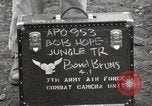
Various entertainers entertain U.S. Army soldiers during a jungle training in the United States.
Entertainment at a jungle training center in the United States. Bob Hope at a microphone with a band behind him. All of them are wearing camouflage suits. He is holding up a helmet. Pattie Thomas walks on a stage wearing a helmet and a camouflage suit. Tony Romano walks on wearing a camouflaged suit.. He carries his guitar. Frances Langford appears. Jerry Colonna and Bob Hope put on their act. Another member of the troop appears. Frances Langford sings. A band and a guitar player joins them. Jerry Colonna and Tony Romano perform an act. (World War II period).
CRITICALPAST.COM: About Us | Contact Us | FAQs - How to Order | License Agreement | My Account | My Lightboxes | Shopping Cart | Advanced Search | Featured Collections | Website Terms & Conditions | Privacy Policy ©2026 CriticalPast LLC.
License Agreement |
Terms & Conditions |
Privacy Policy
©2026 CriticalPast LLC.