


 Francais
 Deutsch
 Italiano
Refine Your Search
Etain France 1944 stock footage and images
- Showing 4105 to 4110 of 9964 results more
more Hide
Hide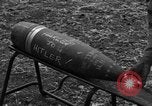
African American soldiers of Field Artillery Battalion of 92nd Infantry Division operate a 8-inch howitzer during WW2
United States Army Field Artillery Battalion of 92nd Infantry Division (Colored), "Buffalo Soldiers," equipped with tractor-drawn 8-inch Howitzers, in Mantes de Gassicourt, France during World War 2. Opening scene shows an 8-inch howitzer shell on a stand. It has the words: "Harlem to Hitler" written on it in chalk. A gunner screws a fuse into its nose. Closeup of the shell and chalk message. Four soldiers then pick up the shell and walk it towards the breech of their 8-inch howitzer. Cloeup of the gun breech as gunner locks breech and then unlocks and opens it for the camera. Scene shifts to gun crew member communicating on field telephone. Camouflage netting is visible behind him. Next, a gun crew member is seen holding his ears as if to protect against the noise of a gun firing. Change of scene shows members of gun crew relaxing near their 8-inch howitzer, near a grove of trees. New scene shows brief glimpse of a shell exploding in hill above Mantes. (The tower of the Mantes Notre Dame cathedral is seen in lower left of the shot.) (Note: These scenes probably show members of the 795th or the 999th Field Artillery Battalion)
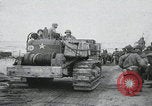
African American soldiers in foxholes; General Bradley in Normandy on D-Day (WW2)
A tractor after landing on the beach in Normandy, France during D-Day landings in World War II. The tractor carries soldiers and Jerry cans as Jeeps trail behind it. African American soldiers talking and eating in the foxholes on the beach. Barrage balloons flying over the beach. A sign in German reads “Minen” (“Mine”). General Omar Bradley, wearing his helmet and field jacket, stands next to another officer.
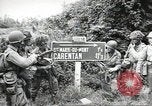
French civilians greet United States troops entering Sainte-Marie-du-Mont during World War II.
U.S. troops advancing into Sainte-Marie-du-Mont, France, after landing on Normandy during World War II. Troopers around road sign pointing toward Sainte-Marie-du-Mont and Carentan. Troopers talk to French woman on roadside. U.S. Army soldier gives chewing gum to French children and tries to explain how to chew (not swallow) it. Tanks advance along road. Troopers march along road. French civilians greet arriving U.S. troops. U.S. soldiers march on streets in Sainte-Marie-du-Mont.
U.S. M5 high speed tractors tow howitzers from LST in Colleville-sur-Mer after Allies invade Normandy, in World War II.
U.S. Task Force in Colleville-sur-Mer after the D-Day invasion of Normandy, France during World War II. A beachhead at Omaha Beach. M5 high speed tractors tow howitzers from LSTs (Landing Ship Tank). U.S. soldiers on the beach.
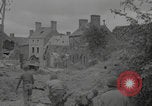
United States soldiers enter ruined La Haye du Puits, install phone lines, capture Germans (WW2)
Occupation of La Haye du Puits under American control during World War 2. United States infantry troops under General Omar Bradley enter the town of La Haye du Puits, with buildings significantly damaged and roads covered with debris. Two soldiers enter an empty and damaged “Café du Progres B. Folliot Lefranc”. Two soldiers carefully walk on debris during a mopping up operation. Soldiers on the street during a mop-up. United States soldiers on top of an M4 Sherman tank covered with tree branches rolls through the center of town. Shop sign for “Citroën”. United States infantry troops on foot enter the town limits. Town signage “La Haye du Puits” at the town limits. Infantry troops find damaged buildings and debris of La Haye du Puits. The town square of La Haye du Puits (now known as Général-de-Gaulle Place), with the Presbytère Church (18 Rue Loret, 50250 La Haye, France) on the background. United States soldiers stringing communication lines in La Haye du Puits. Soldier pulls telephone cable from cable spool. Another soldier installs cables on a post. A German prisoner-of-war raises his hands upon his capture. German soldiers with their hands on their heads after their capture by American forces.
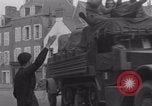
French civilians welcome Free French 1st Armored Division troops arrival in La Haye Du Puits, Normandy (WW2)
French men and women welcome the arrival of the Free French 1st Armored Division in La Haye-du-Puits during World War 2. A young French man waves at the Free French 1st Armored Division troops on top of moving M3 half-tracks and trucks. Tanks pass the damaged Eglise de La Haye ( 18 Rue Loret, 50250 La Haye, France. ) as two boys look on and wave. Willys MB army Jeeps and tanks. Two French men wave at passing Red Cross ambulances. French soldiers, civilian men, and women sitting on top of a tank at Pl. du Gen de Gaulle. The tower of the Eglise de La Haye in the background.
CRITICALPAST.COM: About Us | Contact Us | FAQs - How to Order | License Agreement | My Account | My Lightboxes | Shopping Cart | Advanced Search | Featured Collections | Website Terms & Conditions | Privacy Policy ©2026 CriticalPast LLC.
License Agreement |
Terms & Conditions |
Privacy Policy
©2026 CriticalPast LLC.