


 Francais
 Deutsch
 Italiano
Refine Your Search
Etain France 1944 stock footage and images
- Showing 49 to 54 of 9933 results more
more Hide
Hide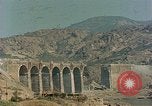
Aftermath of World War II. A wrecked bridge and abandoned United States Army gliders in France.
Reminders of World War 2, in France, 1945. A high bridge of about eight masonry arches with two bombed out, in mountainous region of France. Camera pans right, showing a number of substantial homes scattered across the valley, with tall mountains behind. Scene shifts to a different, flatter landscape, where about a dozen U.S. Waco CG-4A gliders are seen abandoned in a field, in various states of disrepair. Writing in chalk on the side of one glider reads, "Whispering Yoddles, Fort Worth Texas, Little One Alice". There are no D-day stripes on these gliders, indicating they were probably used subsequent to the Normandy invasion, in other operations such as "Bluebird & Dove" in the South of France, in August, 1944.
Various cities in Europe being liberated from Nazi occupation (WW2)
Allied campaign against the Axis powers in 1944 during World War II. People gathered outside the Colosseum (Piazza del Colosseo, 1, 00184 Roma RM, Italy) in Rome, Italy celebrate their liberation from occupation by Nazi Germany. Allied soldiers in trucks move past the cheering crowds. Pope Pius XII addresses the people from a balcony. Victory parade in Paris, France at the Arc de Triomphe (Pl. Charles de Gaulle, 75008 Paris, France) on August 26, 1944. French children clapping. People cheer as they carry banners. In Bucharest, Romania soldiers loaded onto trucks drive past crowds cheering after their liberation. On 3rd of September 1944 people cheer on the streets of Brussels, Belgium as Allied troops enter. A woman sits on top of a moving Jeep. In Belgrade, Yugoslavia on October 20, 1944 people celebrate their liberation. In Athens, Greece women carry a Greek flag and a flag being hoisted after their liberation.
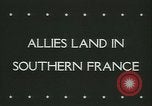
U.S. General Patch, U.S. Admiral Hewitt, and French Admiral Lemonnier lead the Allied fleet invasion of southern France.
Amphibious and airborne Allied forces land in southern France during World War II. (Operation Dragoon in August 1944). Map of France depicts Allied landings at Normandy on D-Day. Naples: An Allied naval force assembles, poised for landing in Southern France, 10 weeks after the Normandy D-Day invasion. Thousands of landing crafts, trucks, tanks, mobile cannons, military vehicles and equipment in the embarkation area. Barrages in flight overhead. Allied officers supervise as the vehicles are loaded into ships. US, French, British, Greek and Polish troops move up to their ships. The ships underway in the Mediterranean. U.S. Secretary of Navy James Forrestal, U.S. Army General Alexander Patch, French Admiral Andre Lemonnier and U.S. Navy Admiral Henry Hewitt (Chief of the Atlantic Invasion Fleet) aboard the flagship. Allied soldiers stitch sleeve patches. An animated map depicts the Allied invasion of southern France near Toulon in a combined amphibious and airborne assault. Hundreds of transport aircraft carry paratroop forces. The paratroopers get ready, jump, and descend to the ground. The amphibious forces near the French coast. German shore batteries fire at the approaching naval vessels. Explosions on ships and in water. Allied troops crouched in landing crafts. They hit the beach under shell fire and advance in land.
Allied troops aboard ships and gliders head for Normandy, France for the D-day invasion during World War II.
Allied invasion of Normandy, France during World War II. U.S. General Joseph McNarney, Deputy Chief of Staff at a desk as he outlines the importance of June 6, 1944 the day Allied forces attacked the Germans in Normandy. He speaks about the decision to knock down the Nazis first and then the Japanese during the World War. He says that the invasion of Normandy was planned in November 1943. He also states how General Dwight D. Eisenhower, Supreme Commander of the Allied forces in Europe, planned and executed the invasion. He also speaks about how the U.S. Army Air Forces and the Royal Air Forces aircraft bombarded the coasts of Normandy prior to the D Day invasion. Past events show American soldiers getting onto landing crafts in England as they leave for the invasion. The soldiers aboard the ships in the English Channel. The soldiers read the Bible and comics, sleep and cook aboard the ships. On June 5th , 1944 the ships head towards Normandy for the invasion. In England gliders carrying paratroopers take off from an airfield to bombard the German positions in Normandy. British soldiers receive ration and work on motorbikes. TNT (trinitrotoluene) charges being prepared by soldiers tasked with demolition duties. British soldiers check their guns and other weapons prior to the invasion. Jeep and artillery being loaded onto aircraft.
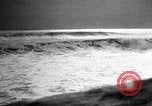
Montage of Scenes from Allied invasion of France in World War II
First scene of film shows waves rolling in on a shoreline. Next, four transport ships are seen underway in the Atlantic ocean. A transport ship is docked next to a large pier where war materiel is piled up and some allied soldiers are standing in formation, while others are proceeding across the pier. Closeup of the soldiers on the move reveals that they are British soldiers in battle gear. A wider view from atop a building shows the area to be industrial in nature, with smoke rising from foothills in the distance. Change of scene shows several U.S Landing Craft Infantry Large, LCI (L)s numbered: 322; 85; 86; and 325, docked in England, preparing for the D-day invasion of Europe in June, 1944. A formation of four American B-24 Liberator bombers is seen in flight. Clusters of bombs are seen falling from aircraft and exploding on the ground below. Paratroopers are viewed as they jump from an airplane. A convoy of LCI (L)s underway in the English Channel. Closeup of one (LCI number 31) is seen from a low flying airplane. Another view of LCIs silhouetted against light-reflecting water. American soldiers wading ashore, unopposed, from LCI number 36, during the continued invasion of Southern France, in August, 1944. Post D-day view from overflying aircraft of Allied troops assembling and moving inland from the Normandy beachhead. Closeups of Surrendering German soldiers carrying a white flag. Closeups of German prisoners. One of them displays his uniform sleeve identifying him as a member of Hermann Goering Division. He also wears the Iron Cross and another medal.

Twenty one former Nazi German SS men go on trial before military tribunal for the massacre of 1944 in Oradour-sur-Glane.
Twenty one former Nazi German SS men go on trial before military tribunal for the massacre of 1944, of 642 men, women and children at a village in Oradour-sur-Glane, France during World War II. While in the village, seven survivors survey the charred buildings of the hamlet which was put to torch. Abandoned bicycle with flowers. Mourners at graves.
CRITICALPAST.COM: About Us | Contact Us | FAQs - How to Order | License Agreement | My Account | My Lightboxes | Shopping Cart | Advanced Search | Featured Collections | Website Terms & Conditions | Privacy Policy ©2026 CriticalPast LLC.
License Agreement |
Terms & Conditions |
Privacy Policy
©2026 CriticalPast LLC.