


 Francais
 Deutsch
 Italiano
Refine Your Search
F-86 stock footage and images
- Showing 61 to 66 of 2472 results more
more Hide
Hide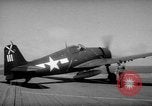
Flight deck operations on the USS Wasp (CV-18) at the end of World War II
Fleet Carrier Air Group 86 (CVG-86) embarked on the USS Wasp (CV-18) at end of World War 2. A pilot of Squadron VF-86, sits in an F6F with engine running, on flight deck of the Wasp. He runs the engine a while, then shuts it down, and climbs down from the aircraft. Another pilot greets him and they both walk across the deck together. An F4U, Corsair (Number 154) of Fighting Bombing Squadron 86 (VBF-86) takes off, followed by another (number 155). Next, a TBM-3E Avenger (number 301) of VT-86, takes off, followed by numbers 303, and 314. An SB2C-4 Helldiver (number 210) is the next to take off. View aft, shows sailors working around an F6F; a tug driving along the flight deck; and a destroyer (looks like Fletcher-class) underway in far background.
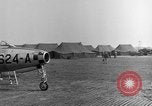
Commander of the United States Air Force 86th Fighter-Bomber Wing participates in the Allied forces Exercise Jupiter, in Europe.
Exercise Jupiter, the three-day, French-directed war game involving Allied forces in Europe. At Wiesbaden Air Force Base in West Germany, an F-84E aircraft of the USAF 527th Fighter-Bomber Squadron (86th Fighter-Bomber Wing) is parked on marsden matting. Many large tents are pitched in the background. USAF Colonel George Laven, Commander, of the 86th Fighter-Bomber Wing, walks to the plane and removes its nose gear pin. He then walks around to where his crew chief, Technical Sergeant G. Cavert is standing. Laven climbs into the cockpit dons his helmet and Sergeant Cavert helps him get strapped in. View shifts to U.S. Airmen relaxing near the tents and trucks. A dog follows one Airman as he walks across the grass.
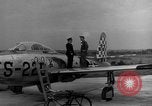
USAF 86th Fighter-Bomber Wing participates in Exercise Jupiter, at Wiesbaden Air Force Base in West Germany.during Allied Forces exercise Jupiter.
Exercise Jupiter activities at Wiesbaden Airbase, West Germany. (This was a three-day, French-directed war game involving Allied forces in Europe). An Italian Air Force officer and U.S.Air Force Sergeant J. Gormley stand on wing of an F-84E aircraft of the USAF 527th Fighter-Bomber Squadron (86th Fighter-Bomber Wing). The Sergeant opens the plane's canopy and steps into the cockpit, as the Italian officer stands on a ladder to lean in and observe. The aircraft is No. 49-2220. Sergeant Gormley points out features of the cockpit.
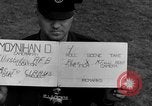
General Eisenhower makes inspection tour of Italian and American Air Force units at Wiesbaden Airfield, Germany
Operation Jupiter, Wiesbaden Germany. A motorcade of U.S. Army staff cars drives along the edge of the Airbase at wiesbaden, Germany. A USAF C-47 aircraft is parked nearby. Next, military officers are seen, from behind, walking toward large white tents pitched on the airfield grounds. General Dwight D. Eisenhower is recognizable, walking rapidly, with American and Italian officers. The most senior American officer in the accompanying group is USAF Major General Truman H. Landon, Deputy commander-in-chief and chief of staff for U.S. Air Forces Europe (USAFE). He seems content to stay pretty much in the background during the tour. Three Italian fliers are seen in closeup, standing in front of an Italian de Havilland DH-100 Vampire aircraft. They come to attention as General Eisenhower approaches. He shakes their hands and speaks with them. Italian and American officers huddle around him as he continues speaking with the Italian fliers. Eisenhower and his entourage walk through a line of parked Italian DH-100s and he speaks with several more Italian aircrews. Still moving at a brisk pace, Eisenhower crosses to a bivouac area of large brown tents, that he inspects. His principal tour guide from this point on is USAF Colonel George Laven, Commander, of the 86th Fighter-Bomber Wing. The group then crosses to an area paved with Marsden matting (Pierced steel planking) where several F-84E aircraft of the USAF 527th Fighter-Bomber Squadron (86th Fighter-Bomber Wing) are parked. Eisenhower stops to speak with a pilot and two airmen standing in front of one of the planes and continues on to meet several more.
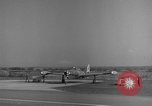
F-84 of USAFE (U.S. Air Forces Europe) taxis out for takeoff from Neubiberg Air Base, Germany
A straight-wing Republic F-84E Thunderjet of the USAF 86th Fighter-Bomber Wing taxis onto the active runway for takeoff, at Neubiberg Air Base , near Munich, Germany. The Wing's bold checkerboard markings on tail, nose and tip tanks are clearly visible. The aircraft's tail number is: 49-2254, and it belongs to the 527th Fighter-Bomber Squadron..
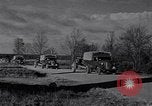
A hidden gun emplacement and Swedish troops fire with guns to forestall move by Nazi Germany in Sweden (WW2)
Swedish troops, guns and aircraft on alert to forestall Nazi German offensive move in Sweden. A truck tows a field gun and moves on a road. The barrel of an artillery piece visible as it is raised from a hidden gun emplacement. Swedish soldiers run between sandbags and take up positions. Swedish troops wearing M21 helmets fire a double-mounted Kulspruta m/36 water-cooled 8mm machine gun (a modified Browning design dual mounted). Next scene shows aerial view of biplanes: Swedish J8 Gloster Gladiator MK I bi-wing pursuit aircraft seen in formation. Brief closeup of a J8 in flight. Next, Swedish T3 aircraft seen in formation, flown by Swedish Wing F 17. These aircraft are Junkers Ju 86 K-13 aircraft built by SAAB, under license, and converted to torpedo bombers. Aerial views of the J8 biplanes conducting mock attacks on the formation of T-3 bombers, for training purposes. (World War II period).