


 Francais
 Deutsch
 Italiano
Refine Your Search
F-86 stock footage and images
- Showing 1279 to 1284 of 2472 results more
more Hide
Hide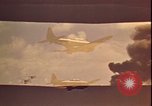
Pilots of Navy Squadron, VF-3, on the USS Yorktown (CV-5) after returning from mission in World War II, Battle of Midway
A formation of Douglas SBD-3 aircraft is seen flying overhead. Pilots of U.S. Navy Fighter Squadron (VF-3) on their Aircraft Carrier, the USS Yorktown (CV-5), after a mission during the Battle of Midway. They are seen climbing out of their aircraft after parking on the flight deck. The Squadron Commander, Lieutenant Commander John S. Thatch, in cockpit of his F4F aircraft with 7 Japanese flags painted on its fuselage. in out of sequence, earlier shot, he holds up four fingers in response to question of how many Japanese aircraft fell to VF-3, on this mission. Other VF-3 pilots climbing from their aircraft. Three pose in front of an F4F.
Vickers Wellington No. 149 Squadron RAF takes off during WW2
Period dramatization: British Royal Air Force (RAF) station groundcrew assist Vickers Wellington No. 149 Squadron RAF during taxiing and take off from RAF Mildenhall airfield during World War 2. A ground control crew member salutes to an officer, the air controller, entering the control room of a portable ground controlled approach radar equipment (GCA) room. Air controller stands on a wooden stool to look through a bubble window in the control room’s ceiling. Air controller tests his radio, saying, "ground control, are you receiving?" View of air direction indicator on air field. Engines running on Vickers Wellington bomber at sunset along with "OC" on fuselage. “You may taxi out and take off!” the air controller says after a pilot asks for clearance on the radio. A Vickers Wellington bomber taxiing. Evening view of lighted bubble window of air control trailer as air controller inside watches the Vickers Wellington bomber taking off. Vickers Wellington bomber flying over RAF Mildenhall airfield. “C for Charlie airborne sir! Nineteen hours thirty-five minutes!” a RAF officer says as he enters air control trailer. Air controller standing in control room dome relays information, saying, "C Charlie took off 19:35." Inside air control headquarters at RAF Mildenhall as RAF officer smokes a pipe while another RAF officer writes flight information on the blackboard. More Vickers Wellington bombers taxi and take off from the airfield one by one. Vickers Wellington OJ-F 'F for Freddie' kicking up dust as groundcrew watches. Vickers Wellington OJ-F 'F for Freddie' taking off as the last Vickers Wellington bombers in No. 149 Squadron departs for Germany at night. View of pilot in Vickers Wellington as he radios to crew, "OK chaps, here we go!" RAF officer writes down the last aircraft’s departure time as “19:51”.
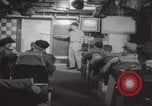
Briefing by Commanders Sell and Birdwell; aircraft take off from USS Hancock (CV/CVA-19) during the Vietnam War
United States aircraft carrier in South China Sea during the Vietnam War. Essex-class USS Hancock (CV/CVA-19) aircraft carrier sailing in the South China Sea. Inside the briefing room of the USS Hancock, Commander Warren H. Sells (Commander Air Wing 21) briefs the pilots prior to the Air Strike on North Vietnam. Commander C. BIRDWELL (Executive Officer of the VA-216) briefing pilots in ready room before an air strike. Commander Birdwell points to a diagram “VF-24 Checkertails”. Pilots listening to the briefing. A Douglas A-1H Skyraider and Vought F-8 Crusader coming in for arrested landing in the aircraft carrier. Pilot briefing recoveries of F8 and A4 aircraft and flight deck action. Pilot (Name: LCDR Rudy Miller) climbs the cockpit of Vought F-8 Crusader. Plane captain assists pilot before taxi. Aircraft label reads “LCDR Rudy Miller”. Pilot gives "thumbs up". Plane captain hands over helmet to pilot. Pilot wears helmet. Douglas A-1H Skyraider and Vought F-8 Crusader aircraft take off one by one from the aircraft carrier.
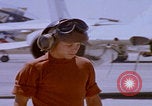
United States Navy VF-124 squadron crew witness preparations for test flight
A young United States Navy VF-124 squadron pilot walks towards a Grumman F-14 Tomcat aircraft at NAS Miramar (Miramar Way, San Diego, California 92145, United States). Crew push back Grumman F-14 Tomcat fighter from hangar. A female officer comments on young pilot, saying “That plane captain looks barely out of his teens!”. Petty officer holding a helmet replies “He’s old enough to be responsible for multi-million dollar aircraft!”. Petty officer puts on helmet and says “Yes, Ma’am”. Pilots read notes from a reception desk before test flight. Nose of the Grumman F-14 Tomcat fighter. Group of Grumman F-14 Tomcat fighters and yellow tow vehicles. Fighter pilots wearing helmets walk past a demonstration for ground crew members.
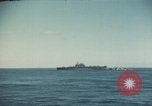
USS Bismarck Sea and USS Saratoga sailing in the Pacific Ocean (WW2)
The USS Bismarck Sea (CVE- 95) sailing in the Pacific Ocean during World War 2. Dr. Edgar Maurice Cortright, United States Navy Lieutenant, narrates his experience on board the USS Saratoga (CV-3) at the time of its bombing by Kamikaze planes during the Battle of Iwo Jima in World War II. Crewmen sitting on top of a damaged Grumman F6F Hellcat fighter plane on the USS Saratoga a day after the Japanese Kamikaze attack. Wreckage of a Grumman F6F Hellcat fighter on deck. A Jeep drives past the wreckage. Crewmen clearing debris on the flight deck. Fighter sitting on the starboard side by the flight deck crane. A gaping hole on the flight deck that went down five decks. Debris on the flight deck. Sailors removing the wreckage of destroyed fighters. They use a rope to pull the destroyed aircraft to the side.
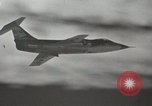
Images recorded from chase plane during the first powered flight of an X-15 Rocket Plane, at Edwards Air Force Base, California
Photograpy from an airborne chase plane, on the occasion of the first powered flight of an X-15 rocket plane. A Lockheed F-104 Starfighter chase plane seen flying in the contrails of the NASA B-52 mothership (NB-52A,52-003) flown by pilots Bock and Allovie, An F-100D fighter flies slightly ahead of the B-52. The X-15, 56-6671, with Scott Crossfield, in the cockpit, is cradled under the B-52's right wing. View from the photo chase plane, as it pulls closer to the B-52. The X-15 and leading F-100 chase plane are clearly visible. The camera plane has dropped back and the X-15 releases, from the B-52 mothership, as its rocket engines simultaneously ignite. It drops and accelerates below and in front of the B-52. It stays below momentarily, without leaving a contrail. Then it accelerates and climbs rapidly out of sight. Sunlight glares as two chase planes are seen.