


 Francais
 Deutsch
 Italiano
Refine Your Search
F-86 stock footage and images
- Showing 1657 to 1662 of 2472 results more
more Hide
Hide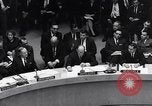
U.S. Ambassador Adlai Stevenson informs UN about steps taken in meeting of Organization of Consultation in United States.
Ambassador Adlai Stevenson addresses United Nations Assembly about United Sates action against Cuba and Russia, during timeframe of Cuban Missile Crisis. Ambassador Stevenson hopes and prays for peace. He tells Soviet Union to end their actions against United States. He refers to the initiative of President John F Kennedy to quarantine war. He informs about the Organization of Consultation meeting, which is a part of the Organization of American States. He then talks about the resolutions in 19 paragraphs adopted by them. First is immediate dismantling of offensive metals from Cuba. Second, he refers to article 6 and 8 and all necessary measure including use of arms against any offensive attempt on U.S. Third, is to inform security council of UN under article 54 of U.S. charter about the resolution, and the same information to be given to Cuba.
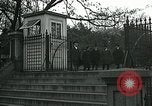
U.S. President Woodrow Wilson watches Armistice parade from side gate to the White house grounds
Armistice parade in Washington,DC, marking end of World War1. President Woodrow Wilson, and several officials, stand near guard shack at gateway to West Wing of the White House, where they watch a parade celebrating the armistice. An army officer on horseback rides past, saluting, followed by several others saluting. Behind them comes a marching military brass band. They are followed by another military band on horseback, leading a small contingent of mounted soldiers and two trucks pulling artillery caissons and field pieces. In succession, the following are seen: an army band; a navy band; a color guard; a contingent of sailors marching with presented arms,in salute; Yeoman (F) women in the U.S. Navy Reserve; and a team of horses pulling a float full of young women in white displaying flags of the World War 1 Allied nations. Marching beside the float are a representative from each of those nations, in uniform, carrying their respective national colors. The last group seen parading are women of the Knights of Columbus, dressed in flowing long-sleeved dresses, and caps. Many of them wear their hair long. A brief glimpse of President Wilson, walking back to the White House, conversing with Attorney General,Thomas Watt Gregory. (World War I; World War 1; WWI; WW1)
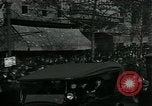
Washingtonians celebrate Armistice ending world War I.
Civilians and military spectators, including soldiers in uniform, line sidewalks and merrymakers pack trucks and cars driving on F Street in the commercial district of Washington,DC, to celebrate the Armistice ending World War 1. Scene shifts to Pennsylvania Avenue, with Treasury building in background. Among crowds in the streets are a group carrying a box labeled "Kaiser's Coffin."Scene shifts to Pennsylvania Avenue, again with the U.S. Capitol in the background. Soldiers do a snake dance between moving trolley cars, led by a man strutting ahead of them. (World War I; World War 1; WWI; WW1)
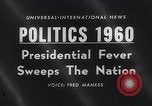
Activities of Democratic and Republican political parties in advance of U.S. National elections in 1960.
Democratic Party primary contest activity in Wisconsin. A building in Wisconsin, identified as local headquarters for John F. Kennedy Presidential campaign. Next is a billboard advertising Hubert Humphrey for President. Views of several Kennedy and Humphrey political campaign posters. Cars in parking plade at a olling place. Inside, Wisconsin Democratic voters cast ballots in the primary election. Several views of voters coming and going at the polling place. Next, Republicans are seem gathered at the Republican Womens' National Conference in Washington, DC. Republican notables eating from box lunches, include H. Ross Perot; Senator Barry Goldwater; President and Mrs (Mamie) Eisenhower; Vice President Richard Nixon and his wife, Pat. Next, President Eisenhower and Vice President Nixon are seen onstage, together, as Ike prepares to speak, indorsing Nixon for President.
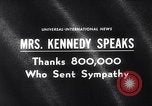
Jacqueline Kennedy thanks U.S. citizens for sending messages of sympathy to her following assassination of President John Kennedy
Mrs Jacqueline Kennedy acknowledge messages of sympathy in Washington DC. She says that she appreciates 800,000 messages that she and her children had received after the assassination death of President John F. Kennedy. She thanks Americans for the love people have given to Kennedy. She says she will acknowledge all the messages no matter how much time it takes.
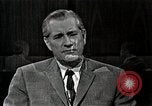
Senator J.William Fulbright in television interview about President Johnson's policy on Vietnam War in United States.
Senator J. William Fulbright in United States. Interviewer asks Fulbright about President Lyndon B Johnson's policies on Vietnam War and if he is in line with John F Kennedy and Dwight D Eisenhower. Fulbright says that it has been a difficult situation for the President. He states that he has been involved with the President in many of the campaigns and war can not be justified.