


 Francais
 Deutsch
 Italiano
Refine Your Search
F-86 stock footage and images
- Showing 1741 to 1746 of 2472 results more
more Hide
Hide
Ivory Coast President Houphouet Boigny arrives at the airport in Washington DC. and receives a warm welcome.
Documentary 'American Journey' depicts the visit of Ivory Coast President Houphouet Boigny and his wife visit to the United States. Low flying aerial views of the United States Capitol building and Washington monument in the background. Low aerial view of Jefferson Memorial and Lincoln Memorial in Washington DC. President Houphouet Boigny arrives in Washington D.C. The 21 gun salute being given by the U.S. soldiers during the arrival. President Houphouet Boigny with his wife get off the plane. President Boigny and First Lady Marie-Therese Houphouet-Boigny shakes hand with American President John F. Kennedy. United States Secretary of State David Dean Rusk shakes hand and citizens of Washington DC. cabinet members, diplomats and city officials welcome Ivory Coast President at the airport. Chief Justice and Ministers of Finance accompany President Boigny. The two Presidents and their wives at the podium. The U.S. President escorts his guest. They sit in a car and leave the airport for the Capitol. Flag of United States and flag of Ivory Coast. People stand on either side and the President Boigny waves as motorcade moves slowly through streets of Washington DC and U.S. military forces parade on streets as citizens watch and wave from sidewalks. A poster of both the Presidents. The Ivory Coast president arrives at Blair House. View of the Lincoln Memorial. The President with other dignitaries enter the Memorial. The statue of Abraham Lincoln at the Memorial.
Ivory Coast President Houphouet Boigny and First Lady visit the White House for dinner in Washington DC.
Documentary depicts the visit of Ivory Coast President Houphouet Boigny and his wife to the United States. Dusk view of the White House as nighttime approaches. Soldiers stand on either side of the lawn. Ivory Coast President Houphouet Boigny with his wife Marie Boigny and member party arrive at the White House for state dinner given by United States President Kennedy. The soldiers salute. They exit the car. Ivory Coast President shakes hand with the U.S. President John F. Kennedy; all guests are dressed in formal black tie. They walk into the White House as men take pictures. Two Presidents and the First Ladies stand together with other party members.
Jacqueline Kennedy visits various places in India and Pakistan during a tour of South Asia.
United Sates President John F. Kennedy's wife Jacqueline "Jackie" Bouvier Kennedy visits South Asia. The Taj Mahal (Dharmapuri, Forest Colony, Tajganj, Agra, Uttar Pradesh 282001, India) in Agra. Two men row a boat in the Yamuna river and Taj Mahal in the background. The Lake Place (Lake Palace Rd, Old City, Brahmpuri, Udaipur, Rajasthan 313001, India) in Udaipur. A woman washes clothes in the Lake. First Lady Jackie Kennedy visits an Indian hospital. She meets young children receiving treatment in the hospital. Traditional welcome being given to Jackie Kennedy by the people of Pakistan during a fair. Young children applaud. First Lady gets down from a cart. Military band plays music. Mrs. Kennedy seated on a podium with other people. Horse and camel perform dances at the fair. Pakistan President Ayub Khan gifts a horse to Jackie Kennedy.
John and Annie Glenn with Vice President Lyndon B. Johnson as they arrive at the White House in Washington D.C.
American astronaut John Glenn being welcomed after he successfully orbited the earth in a spacecraft. John Glenn and Annie Glenn in Washington D.C. Women in coats and holding umbrellas. Two women talk and drink hot coffee. A policeman controls the crowd. Water flows on the road due to rains. Spectators stand on either side of the road. The White House in the background. The door of the White House and people stand at the side of the door. A policeman enters the White House gate. Men with camera on a podium. A television in the garden . Two officers step from their car. People stand behind the tied ropes. A car carrying the Glens and President Kennedy arrives at the White House and is met by Vice President Lyndon Johnson. John and Annie Glenn leave the car, escorted by the President and Vice President. Men take pictures. U.S. President John F. Kennedy, John and Annie Glenn and Lyndon B. Johnson walk into the White House, followed by their children, David and Carolyn,and other officials. Newsmen and television reporters broadcast live from the White House lawn.
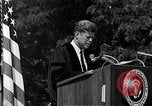
U.S. President Kennedy's American University Commencement Address in Washington DC about America and Soviet Union relationships.
U.S. President John F Kennedy delivers American University Commencement Address in Washington DC speaking about America and Soviet Union relationships. He raises questions about Nuclear war its consequences. Communist drive to impose their political and economic system on others is the primary cause of world tension. He points out that despite differences there are some common links between America and Soviet Union and they should conduct affairs in such a way that is acceptable to both. He emphasizes reexamining the American attitude towards the cold war. Also raises issues of strengthening the United Nations as an instrument of global security, direct line between Moscow and Washington DC, Geneva talks, outlawing of nuclear tests. He confirms that high level discussions will shortly begin in Moscow for Comprehensive Test ban treaty. 10 June 1963.
President Kennedy receives Indian Prime Minister Jawaharlal Nehru and Ms. Indira Gandhi at Newport and in Washington.
U.S. President John F Kennedy receives Indian Prime Minister Jawaharlal Nehru and his daughter Ms. Indira Gandhi at Newport airport, Rhode Island. American ambassador to India John Galbraith, Indian students from Brown University and the press are also present. Military honor guard holding flags stands with airport terminal in background. Scene changes to Washington DC. Daytime view of exterior of U.S. Capitol building under a bright blue sky. Wide view of Washington Monument and reflecting pool. Scene in a park with yellow and orange colored autumn leaves on trees and ground, and adults and children walking in the park, wearing typical early 1960s fashions. Wide view of tidal basin and Jefferson Memorial in the distance. Arrival of President and Mrs. Kennedy accompany the visiting Prime Minister and his daughter on Air Force One aircraft as it arrives in Washington DC. Military honor guard holds flags and military band members play music, including the U.S. Army Herald Trumpets fanfare ensemble. The arriving officials are received by Vice President and Mrs. Lyndon B Johnson, Secretary of State and Mrs. Dean Rusk, and other dignitaries. President Kennedy speaks at a podium with microphone and welcomes the Prime Minister on his third visit to the U.S. Prime Minister Nehru then speaks and expresses gratitude for the welcome and for the friendship expressed by the President. View of Air Force helicopter taking off to fly the guests and the President to the White House after the ceremony.