


 Francais
 Deutsch
 Italiano
Refine Your Search
F-86 stock footage and images
- Showing 2041 to 2046 of 2472 results more
more Hide
Hide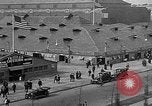
Famous personalities appear before crowds in the United States, in 1916
Famed Evangelist, Billy Sunday before a crowd in New York City. Scottish entertainer, Harry Lauder, raising funds for the Red Cross. French actress, Sarah Bernhardt appealing on behalf of France, during World War 1. Billy Sunday's Tabernacle at Broadway and 106th Street, in Manhattan, New York City, is seen in opening shots of film. Next to it is a YMCA cafeteria, Some cars are parked on the street and some pedestrians stroll along the sidewalk. Scene shifts to inside the Tabernacle, that seems filled to capacity. (It could seat 18 thousand persons.) Camera pans over the crowd. On a stage, Billy Sunday stands next to a desk and removes his tie. Displayed on the wall behind him is a huge patriotic circular bunting. Some men and women also occupy the stage with him. Next, Sunday is seen standing on the desk emotionally haranguing the audience with a fundamentalist Christian sermon. Change of scene to closeup of John Philip Sousa conducting an open air band concert, attended by a vast audience. Closeup of Harry Lauder, famous Scottish singer and comedian. Next, Scottish bandsmen in uniforms, including fur busby hats, crowd onto a raised platform in a park. A sign on the platform refers to B.F. Keith's and the Red Cross. Next, bandsmen are gone and the platform contains seated guests, including a British Army officer and several civilian officials. Harry Lauder is speaking to a crowd of mostly men, from the platform. Scene shifts to closeup of famous French actress, Sarah Bernhardt, seated next to a man in an open car. A huge patriotic bunting is hung in the background. A large crowd fills a park. Some wave American flags. Camera moves back revealing the setting with Bernhardt standing in the car speaking. The bunting is seen to decorate a raised speaker's platform. Her car, which displays the French tricolor flag, is surrounded by spectators. Photographers in foreground stand to take her picture.
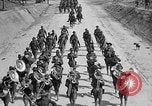
New Jersey National Guard units return from Punitive Expedition to Mexico and arrive at Camp Fielder in Sea Girt, during Fall of 1916
Film opens showing New Jersey National Guard soldiers returning to their training camp (Camp Fielder) at Sea Girt, New Jersey. Led by an army band, they march in formation along a sandy road with high berms on both sides.Glimpses of the marching troops from the side. As they proceed, toward the camera, they reach a point where they begin to march double-time. Scene shifts to a gate of the camp, where family, friends, and well wishers are gathered and a banner reading "Welcome" is stretched across the entrance. Led by officers on horseback, and the colors, the troops march through the gate. Next, soldiers are seen greeted by women family members. One soldier standing beside a tent, lifts his daughters, one at a time, and kisses them. He motions to his wife to pose with them. She does and he kisses her. Next, soldiers are seen briefly, with shouldered rifles, marching in formation. Scene shifts to another area of the Camp (named Camp Fielder for then Governor James F. Fielder). Here, army officers assist President Woodrow Wilson, to mount a horse. The President is dressed formally, including top hat. He poses for the camera. The President then rides with officers to review the National Guard troops drawn up in formation. He salutes with his top hat over heart, as they pass a color guard. He is next seen seated on horseback next to a commanding officer (possibly Colonel Daniel T. Mather) as they review the New Jersey National Guard troops passing in review.
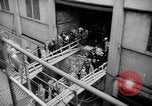
A large number of visitors board the USS Wasp at the Puget Sound Navy Yard, Bremerton, Washington
Visitors board and crowd the deck of the USS Wasp (CV-18) in June, 1945, near the end of world War II. The Wasp is about to depart again, for the Western Pacific, following repairs at Puget Sound Navy Yard, Bremerton, Washington. Two U.S. marines are escorting two women, and showing them an F4U Corsair airplane on the deck. Some of the visitors look up toward the camera. The aircraft on deck have been arranged for this static display. visitors are seen departing across a gangplank. Views from deck of the Wasp, of Navy personnel on the pier, below. Camera pans across the pier where spectators still stand. A few people stand on the water side of a building. A large group of visitors coming up from the hangar deck. Civilians and sailors wave at the camera. Visitors leaving the carrier on the gangplank.
U.S. Army Air Forces attack German fighter aircraft Messerschmitt bf 109 in the European Theater during World War II.
U.S. Army Air Forces VIII Fighter Command Operation during World War II. German fighter aircraft Messerschmitt bf-109 in flight. Lt J B Dickson from the 358 Sqdn.,355 F.G. attacks the Me 109 aircraft. Part of the tail section of the aircraft blows away.
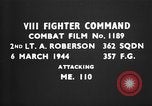
The explosion of German fighter aircraft Messerschmitt-110 in the European Theater during World War II.
U.S. Army Air Forces VIII Fighter Command Operation during World War II. German fighter aircraft Messerschmitt-110 in flight. 2nd Lt A Roberson from 362 Sqdn.,357 F.G. attacks the Messerschmitt-110.The aircraft explodes.
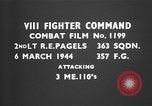
U.S. Army Air Forces attack the German fighter aircraft Messerschmitt-110s in the European Theater during World War II.
U.S. Army Air Forces VIII Fighter Command Operation during World War II. German fighter aircraft Messerschmitt-110s in flight above the ocean. 2nd LT R E Pagels from the 363 Sqdn.,357 F.G. attacks the aircraft. The aircraft explodes after the attack.