


 Francais
 Deutsch
 Italiano
Refine Your Search
F-86 stock footage and images
- Showing 307 to 312 of 2472 results more
more Hide
Hide
United States F-105s in flight and return after air striking North Vietnam during the Vietnam War.
United States F-105Ds and F-105Fs return after a mission in North Vietnam during the Vietnam War. Eight F-105s fly in formation of four. F-105s in flight over head. Flakes burst in mid air. A F-105 climbs as another United states F-105D comes in for landing. Aircraft lands and taxis along the runway as it returns after air striking north Vietnamese positions during the Vietnam War. A number of F-105Ds land and taxi along as a parachute opens at the tail section of the plane.
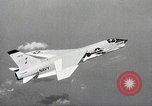
Flight operations of United States Navy F8U-2N Crusader fighter, United States.
Training film introduces U.S. Navy F8U-2N Crusader aircraft and summarizes its flight operations, United States. F8U-2N in flight. Pilot turns auto-pilot switch to on. Engage-disengage button being pressed by pilot. F8U-2N in flight. Pilot moves bank control knob. F8U-2N banks. Animated chart details roll control and pitch control of F8U-2N. Pilot uses pitch trim wheel. Pilot disengages autopilot, levels off, re-trims, and reengages autopilot for level flight. Altitude hold switch being pressed to engage. Animated chart depicts altitude control of F8U-2N. Pilot uses pitch trim wheel. F8U-2N in flight. Pilot rides control stick.
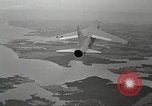
Capabilities of United States Navy F8U-2N Crusader fighter aircraft, United States.
Training film based on recognition features and capabilities of U.S. Navy F8U Crusader fighter aircraft, United States. F8U in flight. F8U taxis and takes off from a runway. F8U in flight over water. Incidence wings of F8U. F8U as seen in flight and taking off from a carrier. Various sections of F8U including wings, tail fins, jet inlet below nose, and fuselage.
The armament and fire control system of U.S. F-105B Thunderchief fighter bomber being explained.
Different features of the U.S. Air Force F-105B Thunderchief fighter bomber. An animated and actual footage explains the armament and fire control system of the F-105B. A pilot climbs into U.S. Air Force RF-84F Thunderstreak. A rear view of the aircraft as it taxis. Insignia of the United States. Tthe bomb pylon as the bomb is being released. RF-84F in flight as the bomb is dropped. Explosion on the ground. A jet aircraft in flight and vapor trails comes out from the engine. The F-105B in flight and the bomb bay opens. Bomb bay shows special weapon being dropped. The number printed on the side of the weapon is '28-5 and T-5'. A ground tent firing of F-105B armament. The F-105B taxis on a taxi strip. The aircraft climbs rapidly after the take off.
Loading and firing of Falcon air to air missiles from a U.S. Air Force F-102A interceptor aircraft. in United States.
Loading and firing of Falcon air to air missiles from a U.S. Air Force F-102A Delta Dagger interceptor aircraft. Several men load Falcon missiles into an F-102A at Holloman Air Force Base, New Mexico. Three contractor representatives going over graphs and charts in a conference room. The representatives going up steps of the Convair General Office Building at San Diego, California. Two Convair technicians check electrical connections and firing circuit of a Falcon missile on flight line at Holloman AFB. They load a Falcon onto launcher of a F-102A and insert the ignitor into the motor. The rockets are drawn into the aircraft and the bay doors closed. The F-102A taxis on flight line and takes off. F-102Ain flight, bomb bay doors open. The Falcon missiles are extended and fired in two salvos of three each. F-102A flying to the right.
P-51 and F-51 aircraft of the U.S. Air Force in Korea.
Pilots of P-51 and F-51 planes of the U.S. Air Force prepare to take off in Korea, during Korean War. Interior of a briefing room. An officer briefs the pilots. The officer points towards a map. Close view of pilots' faces as they listen to the officer. The pilots come out of the briefing room. Several F-51s in a row. A pilot climbs onto the wing of F-51. The pilot talks to a crew chief. Another pilot checks a note book while standing on the wing of the plane. Yet another pilot climbs into the cockpit of a P-51. Rockets and bombs on the plane. Shadow of rotating propeller on the ground. Close view of nose section of the plane. A pilot in the cockpit of a stationary P-51. 'Pilot-Lieutenant Bell, Crew Chief—Sergeant Olson' written on the side of the plane. A P-51 taxies on the ground past a partially complete hangar. Two men talk. A number of F-51 planes on runway await signal for take off. A jeep and a man across airfield. Several stationary Sikorsky R-5 helicopters in the background. A ground crew member signals P-51s to take off. The planes take off. Two crew chiefs stand and watch the take off. A truck parked across the runway. The driver looks at the planes as they take off. Roof of the hangar shows large hole in the steel framework. F-51 flies overhead. F-51s in flight. Four P-51s in flight. .