


 Francais
 Deutsch
 Italiano
Refine Your Search
F-86 stock footage and images
- Showing 517 to 522 of 2472 results more
more Hide
Hide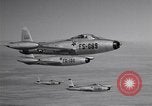
Formation of four SAC B-50 Superfortress bombers escorted by four straight wing F-84s
Four B-50 Superfortress, USAF Strategic Air Command (SAC) bombers, escorted by four straight wing F-84 thunderjets, flying immediately overhead. The B-50s belong to the 43rd Bomb Wing and display "circle K" tail codes. F-84s peel off to left and leave the formation. Desert terrain and mountains in background (probably in vicinity of Davis-Monthan Air Force Base, Tucson, Arizona).

Comparative evaluation of C-119C, XC-123, SA-16 and C-47F at Eglin Air Force Base in Okaloosa County, Florida.
comparative evaluation of four USAF planes: C-119C, XC-123, SA-16 and C-47F for the Strategic Air Command, Escape and Evasion mission. Unassisted take-offs of the planes form Eglin Air Force Base in Okaloosa County, Florida is shown. SA-16 taking off from hard surface runway, followed by C-119C, C-47F and XC-123.
Testing C-47F at Eglin Air Force Base in Okaloosa County, Florida.
Testing the short landing capabilities of various aircraft as candidates for Strategic Air Command Escape and Evasion mission. A U.S. Air Force C-47F (equipped with fully reversible propellers) performs maximum performance landing in rough terrain at Eglin Air Force Base in Okaloosa County, Florida. The C-47F makes a normal full flap approach and landing but fully reverses its engines upon touchdown, which significantly adds to the stopping effect of braking. The effects of reverse thrust are readily seen as the dirt of the landing area is blown forward of the aircraft during the process. Several views of the test landing are shown.
Ground crew of 18th Fighter Bomber Wing of the U.S. Air Force in Korea arming F-51 gun with 50 caliber shells
A ground crew member of the 18th Fighter Bomber Wing of the U.S. Air Force loads guns with 50 caliber shells on F-51 at Chinhae Base (K-10), in Korea. 50 caliber shells on the wing of F-51. The ground crew member loads guns with shells. He closes a lid and fastens the screws with the help of a screwdriver. (Korean War)
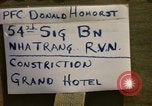
Construction around the Grand Hotel at Camp John F McDermott in Nha Trang, Vietnam.
U.S. Military Police (MP) Camp in Vietnam. A sign reads: 'US ARMY HQ-CO I-F-Force V'. The Grand Hotel in Camp John F McDermott area. Vietnamese workers at a cement mixer. Cement is poured from mixer into wheelbarrow. Workers push wheelbarrows to construction site and empty them. American MP stands at the entrance to the Grand Hotel. (Vietnam War period).
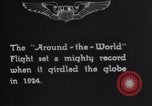
Animated map of U.S. Army's flight around the world. Expedition Commander, Major Frederick F. Martin congratulates crews.
Animated map shows the course taken by Douglas World Cruiser aircraft of the U.S. Army Air Service in their round-the-world flight in 1924. It also highlights mishaps, such as the location of Major Fredrick F Martin's crash in mountains off Alaska and where Lt. Wade was forced down and wrecked near Iceland. Animation shows route from England to Newfoundland to Greenland to Labrador to east coat of United states and aerial route across states. The expedition was completed by 2 of the 5 original Douglas World Cruiser aircraft, namely: the "Chicago," crewed by Lt. Lowell Smith and Lt. Leslie Arnold; and the "New Orleans," crewed by Lt. Erik Nelson and Lt. Jack Harding. They are seen being congratulated by their Expedition Commander, Major Frederick F. Martin at the completion of the mission, on September 28, 1924, in Seattle, Washington.
CRITICALPAST.COM: About Us | Contact Us | FAQs - How to Order | License Agreement | My Account | My Lightboxes | Shopping Cart | Advanced Search | Featured Collections | Website Terms & Conditions | Privacy Policy ©2026 CriticalPast LLC.
License Agreement |
Terms & Conditions |
Privacy Policy
©2026 CriticalPast LLC.