


 Francais
 Deutsch
 Italiano
Refine Your Search
Florennes Belgium 1945 stock footage and images
- Showing 13 to 18 of 6929 results more
more Hide
Hide
3rd Armored Division soldiers examine damaged tanks in Sterpigny, Belgium during World War II.
U.S. Army 3rd Armored Division advance in Belgium during World War 2. U.S. Army Captain examines a snow-covered disabled M4 Sherman tank, with shell holes in it, in Sterpigny, Belgium. Damaged buildings all around. American soldiers look at a damaged German Panther tank. View of jeep approaching on road. Shattered trees along the roadside. (Note:This footage was shot in the town of Sterpigny, Belgium just after 16 January 1945. The 2nd Battalion, U.S. 330th Infantry Regiment was attached to the 3rd Armored Division and fought alongside tank units of the 3rd Armored Division against elements of the 9th SS Panzer Division to capture the town on 16 January.)
Reinforcements for U.S. 35th Infantry Division are briefed. U.S. troops occupy Houffalize, Belgium during World War 2
The United States Army on the Western Front during World War II. A map depicts Allied offensives at Malmedy, Houffalize and Bastogne. New reinforcements for the 134th Infantry Regiment of the U.S. 35th Infantry Division are briefed by an officer near Bastogne, Belgium, on January 10, 1945. Aerial view of tanks and infantry of the U.S. 6th Armored Division moving across a snow-covered barren landscape as they attack German troops in Belgium West of the Luxembourg border. Officers observe through binoculars. U.S. patrols of 1st and 3rd United States Armies meet on January 16 as they capture Houffalize. View of bombed out buildings in Houffalize on January 18.. U.S. troops occupy Houfflaize. A damaged German Pz.III tank on a street and an overturned Panther tank with a hole in its underside in a river. The troops walk along bombed out buildings in Houffalize.

Montage of scenes during World War II on the Western front during January 1945
January, 1945, on the Western front during World War 2. Troops of the U.S. 8th Infantry Division test new white camouflage coveralls for use in snow. They patrol in snow covered forest areas on the Western Front. A sergeant makes outdoor field adjustments to the coveralls using a knife and captured German sewing machine. He helps a soldier who tries on his new coverall. The material used is from old mattress covers. Several soldiers are seen putting on the camouflage coveralls. Scene shifts to U.S. troops with a jeep towing a 20mm Italian dual purpose gun for use in Germany. On January 2, 1945, they set up and fire the gun at targets a half mile away. In Belgium, U.S. Army engineers of Company B, 238th Engineer Battalion, improvise remote controlled bazooka shells as road blocks. They set them up on fence posts and fire them by ordinary flashlight batteries. U.S. soldiers from a Signal Company of the 99th Infantry Division are seen using a Weasel vehicle (officially designated an M29C light cargo carrier) to lay communication cables through snow in the 1st Army Sector, Belgium. Views of the wire spool on back of the weasel, and soldiers pulling wire from it.
German prisoner, Otto Richard Struller, is transferred by jeep from Béverce near Malmedy, Belgium during World War II.
A U.S. Military policeman leans against his jeep in front of a small building in Béverce near Malmedy, Belgium during World War 2. Two German prisoners emerge from the building escorted by an armed American soldier. A military photographer passes to the left, in front of them, as two American military policemen escort another German prisoner (Otto Richard Struller) from the building. They each hold one of his arms. The prisoner is bareheaded. They pause and pose for a photographer (unseen). Closeup of the prisoner with MPs at his sides. Camera zooms in on prisoner, Struller. The MPs direct him to a waiting jeep. They all get in and drive away. Closeup of the jeep passing the camera. It drives away along a muddy road, past an overturned vehicle. (Note: The principal prisoner in this film, is Otto Richard Struller, a ballet dancer, who during the war served as a corporal with Panzerbrigade 150 unit Stielau/Stab solar, where he masqueraded as an American soldier behind the lines. He was executed, as a spy, on January 13, 1945 at the Palace of Justice in Huy, Belgium)

Villagers of Bande, Belgium, massacred by Nazis on Christmas Eve, in retribution for deaths of three German soldiers, in World War II
A sign identifies the village of Bande, in Belgium, during World War 2. View of snow-covered village rooftops from a distance. Closeup of a cafe in the village. Bodies of 34 young men from the village are seen lying in the cellar of the cafe. All had been executed on Christmas Eve, by a unit of the Nazi SD (Sicherheitsdienst) affiliated with the SS (Schutzstaffel) in retribution for the deaths of three German soldiers killed by Belgian maquis (Resistance fighters) on September 5, 1944. (Bande had been occupied by U.S. forces soon thereafter, but was retaken by German forces in the December Ardennes offensive, setting the stage for the massacre.) British troops that re-occupied the village on January 10th, 1945, are seen removing the bodies from the cellar and placing them on the snow-covered street. Wooden coffins are stacked up at the side of the building. Some closeups of the victims are seen. Scene shifts to a snowy field where the bodies are on the ground and men wrap them in sheets and place them in coffins. Closeup of British soldiers placing cover on a coffin and affixing an identification tag on it. Next, the Village Priest presides over a mass funeral for the victims, as villagers stand along the line of coffins. Women in black grieve over the victims. British soldiers carry the coffins to army trucks.The villagers follow behind the trucks as they proceed to the graveyard for burial. The coffins are placed on the ground at the cemetery.
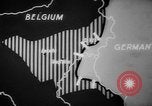
British and American troops join together for attack during Battle of the Bulge, scenes from Malmedy massacre and Houffalize (WW2)
Map points to Allied positions during Battle of the Bulge in World War II. British soldiers walk in a trench on the prong of the attack south of La Roche en Ardenne (La Roche-en-Ardenne or sometimes just Laroche). Trench in the snow covered area. British soldiers wear warm clothes and try to stay warm in the trench. British soldier knocks hole in ice and draws water into a bucket. British soldiers wash and shave with the freezing water. They heat water and use it to make cups of tea. They move on tanks to location where British and American forces meet and greet. The soldiers talk amongst themselves. On 14 January 1945 armored recce cars of the 2nd Derbyshire Yeomanry, 51st Highland Division, meet GI's of the 347th Infantry, 87th U.S. Infantry Division, near Ortheuville. The first link up between troops of VIII Corps and British 30 Corps. Another encounter between British soldiers, dressed in white camouflage smocks, with Americans of the 87th U.S. Infantry Division at Champlon. Later that same day. Field Marshal Montgomery wearing a new beret, commands the northern forces. British soldiers advance on a roadway and supplies move on vehicles. Houses in the background. U.S. 3rd Army soldiers shovel snow during a blizzard, clearing the way for trucks with supplies and mail to pass. Large tractors with snow plow attachments clear snow. On January 14, 1945, American forces gently sweep snow from the bodies of American soldiers at Malmedy who had surrendered to the Germans a month prior but were then massacred. (These were mostly U.S. forces of the American 285th Field Artillery Observation Battalion) German prisoners of war look on apprehensively as the Americans uncover the victims of the Malmedy Massacre. American soldiers look at from a snow covered hillside into the village of Houffalize in Belgium. A twisted sign for Houffalize is seen, and wreckage and destruction in the town. Close views of wrecked and burned homes in Houffalize. Destroyed tanks with one tipped in a river
CRITICALPAST.COM: About Us | Contact Us | FAQs - How to Order | License Agreement | My Account | My Lightboxes | Shopping Cart | Advanced Search | Featured Collections | Website Terms & Conditions | Privacy Policy ©2026 CriticalPast LLC.
License Agreement |
Terms & Conditions |
Privacy Policy
©2026 CriticalPast LLC.