


 Francais
 Deutsch
 Italiano
Refine Your Search
Florennes Belgium 1945 stock footage and images
- Showing 541 to 546 of 6929 results more
more Hide
Hide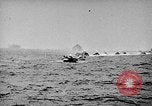
Japan Kamikazes attack U.S. Navy Task Force 58, in battle of Okinawa in World War II
Role of U.S. Navy Task Force 58 in Okinawa, Japan during the Battle of Okinawa in World War 2. Film begins showing amphibious assault by U.S. forces of Navy Task Force 58, against Okinawa, on Easter Sunday, April 1, 1945. Higgins Boats from U.S. transport ships race through the water and discharge troops on the land, with no signs of Japanese resistance. Some of the boats' markings show they came from the U.S transport ship USS Barnett (APA-5). Sailor aboard a transport ship uses ax to cut a line and release a power boat from its davits. The boat drops into the water with a huge splash. View of lines of U.S soldiers and marines wading through shallow water toward mud flats on the land. Closeups of Troops with landing craft behind them. advance overland with no signs of Japanese resistance. Troops sitting on a landing vehicle tracked (LVT) parked in sand. U.S. infantry begin moving inland accompanied by armor and military trucks and other vehicles. The area is very quiet, with no sign of enemy activity. Views of Army and Marine Corps infantry walking beside an M4 Sherman tank. Views of soldiers using binoculars in effort to detect any signs of the enemy. Crews in combat gear, at battle stations aboard Navy ships waiting patiently for enemy action. It came suddenly in the form of Kamikaze attacks on April 6, 1945, when the Navy's radar picket ships were attacked followed by general attacks against U.S. Capital ships. A kamikaze is seen striking an Essex-class aircraft carrier amidst ship, setting off explosions on the ship. Anti-aircraft gunners on various ships are seen firing at the Japanese planes. Another ship is struck by a Kamikaze. Douglas Dauntless and F4F aircraft being launched from carriers. The Battleship, USS Maryland (BB-46), is struck by a kamikaze that knocks out some of her gun emplacements, but she continues her mission in spite of the damage. A kamikaze aircraft is seen attacking the USS Yorktown (CV-10). It is hit by anti-aircraft fire and just misses the ship, splashing into the water nearby. Air is filled by black smoke puffs, from anti-aircraft fire as Japanese aircraft maneuver overhead. One is struck and falls burning to crash in the water, just off the flight deck of a carrier. Gun camera clip showing a multi-engine Japanese aircraft being shot down from behind, by a U.S. aircraft. Closeup of a Japanese Kawasaki Ki-61 aircraft in flight, peeling off to attack. More gun camera footage of a Japanese multi-engine aircraft being shot down from behind. A Kamikaze airplane diving down under anti-aircraft fire and crashing into the sea. Gunners firing Bofors anti-aircraft guns from gun emplacements beside the flight deck of an aircraft carrier. Skies filled with black flak clouds. On 11 April, a low-flying kamikaze Zero, although fired upon, is seen crashing on the battleship, USS Missouri USS (BB-63). It strikes her starboard side, just below her main deck level. The starboard wing of the plane was thrown far forward, starting a gasoline fire at 5 in (127 mm) Gun Mount No. 3. At the same time, another kamikaze crashes into the sea in the foreground. An aircraft carrier's gunners fire anti-aircraft Bofors guns at a Kamikaze plane that swoops over her flight deck and crashes, exploding, into the sea just off the flight deck. A low flying Kamikaze aircraft crashes into the sea off the bow of an escort carrier, underway. Heavy black smoke rises from the airplane blowing up. A huge explosion with a white cloud of smoke is seen above the battleship USS Missouri.
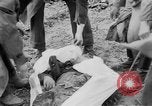
German Civilians wrap dead bodies in shrouds and place them in individual graves during a mass burial in Gardelegen, Germany.
A mass burial in Gardelegen, Germany during World War II, for victims of the Gardelegen massacre. German civilians wrap dead bodies in shrouds and place them in individual graves. They pour dirt in the graves with shovels. Burned barn building in background.. They are burying concentration camp and slave laborer victims of nazi atrocities who died after being locked in the barn that was then set on fire, in Gardelegen, Germany, on April 13, 1945. The atrocity was discovered by the U.S. Army 102nd Infantry Division on April 14, which directed the German civilians to properly bury the victims from April 21-25, 1945.
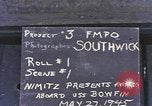
U.S. Navy Fleet Admiral Chester William Nimitz presenting awards to officers and sailors aboard USS Bowfin in Guam, during World War II
United States Navy Fleet Admiral Chester William Nimitz, aboard the USS Bowfin (SS-287) in Apra Harbor, Guam, during World War 2. He is there to decorate the Captain and crew of the boat. Admiral Nimitz is seen at a microphone, addressing officers and sailors. Cameramen taking the photographs of the event. Navy band playing in the background. Admiral Nimitz presents the Navy Cross to Commander Alexander Kelly Tyree, for extraordinary heroism in the line of his profession as Commanding Officer of the U.S.S. Bowfin (SS-287), on the Seventh War Patrol of that submarine during the period 25 January 1945 to 25 March 1945. Admiral Nimitz then proceeds to decorate more officers and sailors from the crew. Nimitz returns to the microphone, reads a citation, and decorates several more crew members. He and other officers hold long hand salutes as the ceremony is concluding. Admiral Nimitz then announces the end of the ceremony and walks away. Camera focuses on a sailor with medal pinned on his shirt.
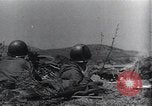
United States Army 187th Airborne Regimental Combat Team returns to Japan from Korea and is welcomed by City of Beppu, Oita
Clip opens with rapid changing scenes: American troops in trench in Korea during the Korean War. American tank on street in Germany. American Ski troops in Alaska. Amphibian assault training in Puerto Rico. Rotating Globe shows: U.S. Army on alert to defend against aggression. Sergeant Stuart introduces episdoe and states that U.S. Army has come to Japan to know their culture and make friends after war and occupation. U.S. Army troops of the 187th Airborne Regimental Combat Team, are seen arriving by railroad train at a train stateion near their base near Beppu,Oita on the island of Kyushu, Japan. U.S. Army soldiers, including white and African American soldiers, exit train cars. They receive a warm welcome from Japanese population. Banner reads:" Welcome Pala Troop comin back from Korea, City of Beppu."[sic] Women holding flowers and families with small children waving American and Japanese flags, welcome them on the train station. A sign over the train station platform reads: "Welcome 187 Para Troop Coming Back From Korea, City of Beppu." The troops stand in formation on the platform while the unit's officers receive the flowers from the women. Japanese men in fraternal uniforms and the general population all join in the welcoming ceremonies. The troops march off the train station under another sign reading: Welcome Home 187 RCT." and march down the main street of Beppu under a swirl of paper confetti. Next scenes are from autumn of 1945, as U.S. soldiers march through streets of Japan during occupation following the end of World War 2. U.S. troops seen marching behind Japanese police to occupy Japan, in 1945, amidst the aftermath of suffering and destruction of the war. The local population standing at road sides and watching with worry and concern. Scenes of postwar destruction in Japan. Rubble of bombed buildings. Scene of simple wooden dwelling shacks and wreckage nearby. A Japanese boy with his baby brother on his back. The baby is crying. Next scene moves again to circa 1950 in streets of a Japanese city, possibly Tokyo, rebuilt and with busy scenes of traffic on streets and commerce. Large outdoor rally with a Communist speaker addressing large crowd of Japanese people who sit and listen. Scenes from a what the narrator describes as a Communist rally in Japan, against America, which turns violent. Protestors running in streets during demonstration, with signboards and police and fire fighters extinguish flames at scene of an overturned, burning car. Flashback again to 1945 or 1946 as U.S. Army soldiers use tractors and heavy equipment to clear and level an area of war rubble and debris during rebuilding efforts after World War 2. Japanese citizens look on, watching the machines at work.
Early allied victories in Europe during World War II are challenged by German counter attacks in late 1944
Elements of U.S. Army arriving in a town in France, in August, 1944, during World War 2. Local people line the sides of the roads to welcome them. Young French women reach up to American soldiers in the back of an open stake truck and later mingle with them on the ground. Some of them kiss the soldiers. Some American flags are displayed by people in the crowd of well-wishers. One American soldier holds up a souvenir Nazi flag.Large crowds of French people gathered in a square to welcome the Americans. Many display the "V for Victory" sign with their hands. Film fades to a brief glimpse of a fallen soldier, and new slate reads: "Counterattack." Next, U.S. Medical Corpsmen are seen carrying American wounded to ambulances in the field in December, 1944.Several views of medics attending to American wounded soldiers. American infantrymen advancing across a field beside a Pershing T26E3 tank. (Note: It has 6 bogey wheels. Not designated M26 until 1945.) American infantry advancing into area of burning buildings and then into built up part of town, where they take up defensive positions inside a building. A U.S. soldier firing out a building window. Other U.S. soldiers firing from positions behind a wall. One is next to a mortar. Buildings burning and destroyed all around them. Close-up of American soldiers firing M1 Garand rifles from behind the wall. Infantrymen hunkered down behind a stone wall with light snow atop it. An explosion from a hand grenade raises smoke. A medical Corpsman checks a fallen American soldier for sign of life. Next, a Chaplain is seen reading from a small bible or prayer book, as he stoops over the fallen soldier. Fallen and wounded soldiers are carried to a truck, from the battlefield, on stretchers. Scene shifts abruptly to captured German film depicting two junior officers conversing in the field and then to German Field Marshal Erwin Rommel conversing with an artillery assault gun officer. Rommel holds a pair of eyeglasses in his right hand. The gun officer wears binoculars around his neck. A war torn city. German Volkssturm (People's Militia) parading. Some carry panzerfaust anti-tank weapons over their shoulders. A field full of German King Tiger II Ausf. B Heavy Tanks. One being driven out of the field. A German SdKfz 251 halftrack maneuvering in woods. it is covered with foliage for camouflage. German soldier in an open single seat courier car. It and he are spattered with mud. Close-ups of the mud-spattered driver smoking an cigar. German infantry moving across a field and moving along a road, in the mist. German infantry moving along a muddy road near a forest. A German V-1 Buzz bomb seen overhead with engine running. It flames out. Next an explosion and rising smoke is seen inside a town.
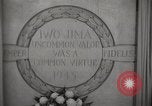
Dedication of Marine Corps War Memorial at Quantico Virginia, and sculptor Felix de Weldon working on sculpture for Arlington location.
The U.S. Marine Corps War Memorial original statue during its unveiling ceremony at the Marine Corps base in Quantico, Virginia on November 10, 1951 (This is after the statue had been moved from its original Constitution Avenue location in Washington DC in 1947, and subsequently renovated under sculptor de Weldon's supervision while it was in Quantico.). A sign on the memorial reads "Uncommon valor was a common virtue, 1945." Next scenes show sculptor Felix de Weldon as he works to build the larger Marine Corps War Memorial in Arlington, Virginia, which was dedicated in November 1954. Felix de Weldon measuring a model of the flag raising on Iwo Jima made by him. de Weldon and others on his team work to carve the large war memorial in plaster before it is cast in bronze. Views of the sculpted faces of the six Marines who raised the flag on Iwo Jima: Faces of John Bradley, Rene Gagnon, Ira Hayes, Franklin Sousley, Harlon Block and Michael Strank. Brief glimpse of the original flag raising scene on Mount Suribachi in February 1945. Next scene, circa 1954 or 1955, shows the completed Marine Corps War Memorial in bronze, in Arlington Virginia, with Washington Monument and Lincoln Memorial landmarks of Washington DC in the background. Close-up views of faces of a young boy, an elderly woman, and a middle aged man who removes his hat. American flag fluttering in the breeze atop the war memorial.