


 Francais
 Deutsch
 Italiano
Refine Your Search
Foggia Italy 1944 stock footage and images
- Showing 7987 to 7992 of 8000 results more
more Hide
Hide
U.S. troops board landing craft from transport ships and wade to beach during the D-Day invasion of France during World War 2
Medium shots of U.S. soldiers as they climb down rope nets from transport ship (AP) and board landing craft mechanized (LCM). Second shot from the LCM in the water shows a second and third, larger, landing craft, also full of soldiers. Scene changes and beach is in view. Soldiers disembark landing craft and wade to shore with backpacks on and rifles in hand. Groups of soldiers organize on the beach in the background during WW2 Allied Normandy invasion.
Wounded evacuated from shell-damaged landing craft off Normandy coast during World War 2
Stretcher carrying wounded is lowered onto transport ship (AP). Close and medium views of U.S LCI (Landing Craft, Infantry) damaged by shell fire during WW2 invasion of France (D-Day operations). The ship is badly listing with its starboard side low in the water. Distant shot shows multiple ships near the damaged LCI. Elevated close up from transport ship of damaged LCI as wounded are hoisted onto the transport ship using a stretcher. Landing Craft, Mechanized (LCM) in the water beside the damaged LCI. Medium shot of bridge of damaged LCI where soldiers speak with unseen party on the taller transport ship.
Rescue of wounded personnel of the coast of Normandy during World War 2.
Elevated shot of 83-foot U.S. Coast Guard cutter serving as a military rescue ship during Allied invasion of France. Distant convoy of LCIs (Landing Craft, Infantry), each with a barrage balloon overhead. Wide view of area with multiple ships including LCIs, transport ships, and destroyer escort on patrol. Barrage balloons overhead. Closer shot of destroyer escort. Scene changes to view from transport ship of wounded personnel being evacuated off LCT (Landing Craft, Tank) on stretchers. The wounded soldiers are lifted aboard the transport ship and carried off.
U.S. Army mobile mortar crew operates and transports a mortar on Bougainville Island, Papau New Guinea, during World War 2
A mobile mortar crew from the U.S. Army operates a 4.2 inch mobile mortar. The shirtless U.S. Army soldiers fire multiple shells rapidly. A soldier using a field telephone receives information on a new Japanese enemy position and the mortar crew disassembles the weapon in a practiced manner. The soldiers load the heavy mortar into a two-wheeled cart, which is lifted into the bed of a truck to be transported to the new position. The crew unloads the mortar and wheeled cart from the truck and runs toward their destination. Men follow behind with ammunition boxes. At the new position the crew swiftly reassembles the mortar, laying for fire. A soldier is hoisted up to an observation post in a tree. Wide view of the surrounding jungle and wetland with Mount Bagana in the background. The narrator notes that the Japanese have been located at the base of the mountain. Close up shots of the mortar crew loading and firing shells toward the Japanese position.
Stockpiles of Allied invasion materials at various supply depots in England during World War 2, including at Burtonwood, England.
Stockpiles of Pierced Steel Planking (PSP), also called Marsden matting at Burtonwood supply and repair depot, the largest depot in the world during WW2. Dozens of tractors, trucks, and other military vehicles parked in neat rows. Assorted rolls of metal meshes, platforms, wiring, and cable. A crane in action lifting supplies, teams of men working to organize, stock, and inspect the materials. Numerous shots of men at work, supplies such as fuel barrels, small boats, and tractors. Aircraft including American and British gliders, P-47 Thunderbolt, A-20 Havoc, P-38 Lightning, B-17 Flying Fortress, and B-26 Marauder. Engineering equipment at a British depot in Thatcham, England. Additional scenes of men at work in the depots.
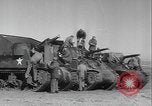
Armored vehicles undergo waterproofing and testing in Bideford, England.
U.S. Army soldiers waterproof U.S. tanks and military vehicles by hand during World War 2. Close up shots of men applying putty to seal the vehicles. Tanks with deep wading exhaust trunks, also called "breathers," are tested and driven in water. The wading snorkels are released off the back of an M4 Sherman tank and M10 tank destroyer as the tanks begin to drive on land.
CRITICALPAST.COM: About Us | Contact Us | FAQs - How to Order | License Agreement | My Account | My Lightboxes | Shopping Cart | Advanced Search | Featured Collections | Website Terms & Conditions | Privacy Policy ©2026 CriticalPast LLC.
License Agreement |
Terms & Conditions |
Privacy Policy
©2026 CriticalPast LLC.