


 Francais
 Deutsch
 Italiano
Refine Your Search
Foggia Italy 1944 stock footage and images
- Showing 1795 to 1800 of 8000 results more
more Hide
Hide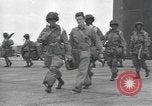
U.S. paratroopers board C-47 airplanes in England for the D Day invasion of Normandy, France in World War 2.
Paratroopers of the U.S. 502nd Parachute Infantry Regiment, 101st Airborne Division, at RAF Station, Greenham Common, proceed, in full battle gear, to board C-47 aircraft for their flight to Normandy, France, on June 5, 1944, during World War 2. Camouflage is seen on their helmets and their faces are blackened. One group is seen boarding C-47, tail number 43-15296. An officer reads briefing notes to them.They don life vests. A Captain and two Sergeants discuss briefing notes.Paratroopers help others who have difficulty climbing aboard the aircraft because of their heavy and ungainly equipment. Ninth Air Force Commander, Lieutenant General Louis H. Brereton speaks to Chaplain, Lieutenant Colonel Louis R. Goodrich, and shakes hands with some of the troopers, wishing them well, as they board C-47 number 42-92847, named, "That's All...Brother."(This was the lead aircraft for the airdrop, just behind the C-47s dropping pathfinders. It was piloted by the commander of the 438th Troop Carrier Group, Colonel John Donalson, and 87th Troop Carrier Squadron Commander, Lieutenant Colonel David Daniel.) The C-47s taxi out for takeoff, as senior officers watch them depart. (Note: There has been confusion about the name of the lead aircraft, C-47, 42-92847, because Colonel Donalson normally flew one named "Belle of Birmingham. " Research, including information from his daughter, indicate that he chose 42-92847, as lead aircraft, because it would have to be cut open to accommodate SCR 717C radar equipment, and he didn't want that done to his favorite airplane.)
U.S. paratroopers being trained at North Witham , England prior to Allied invasion of France in World War II.
Training of U.S. paratrooper pathfinders prior to Allied invasion of Normandy, France during World War 2. U.S. Army Air Forces C-47 aircraft in flight as American paratroopers make practice jumps. A paratrooper lands at drop zone at North Witham training area in England during practice. On June 5th, 1944 C-47 aircraft with invasion stripes parked at an airfield in England.
Scenes of Casablanca, French Morocco, taken by U.S. Paratrooper during a stopover in World War II.
Scenes taken by U.S. paratrooper (not shown) during stopover in Casablanca, French Morocco, on July 13, 1944. A street sign points to Washington, Tokyo, London, Berlin, and Paris, showing distances. Sidewalk entertainers play musical instruments as people gather around them. A government building in the city with tricolor streamer on it. Panning views of the surrounding area. Aerial views of the ruins of Monte Cassino Abbey (very dark underexposed).

Two U.S. Army Air Forces P-51fighter planes crash in a residential area of Jacksonville, Florida.
Aftermath of an accident on July 20, 1944, when two U.S. Army Air Forces P-51C Mustang fighter planes,flying low in close formation, struck a palm tree and collided over the 2800 and 2900 blocks of Post Street, in between Willow Branch and Cherry Streets. The crash caused a three-alarm fire involving twelve houses, three apartments, and three garage apartments. Both pilots, one a Lee High School Graduate, died in the crash. The only other fatality was a person killed by an airplane engine that crashed into his residence. (Reportedly, the aircraft were buzzing the home where parents of one of the pilots lived, in the 2700 block of Post Street.) Firefighters extinguishing the fire. Smoking houses. Debris lying in the area. People gathered around the houses. A damaged house. A wrecked car. (World War II period).

German film giving their perspective on Allied invasion of Europe in World War II
Film opens with slate showing date: 6 June 1944, in World War 2. German newspapers report that combined forces of Britain, and the Soviet Union finally decided to launch their invasion of Europe. Headlines say "Invasion launched at Moscow's orders." A map highlights cities along the coast of France. Formations of Allied warplanes shown in flight overhead. Light signals seen in the dark as German forces send information about the attacks. Closeups of German military men communicating by radio and telegraph. Defense forces are called to battle stations by alarms and announcements. Responding soldiers grab rifles from a rack and rush through tunnels in their fortifications. They climb to man weapons atop their bunkers. Artillery shells being raised by hoists to them from bunkers below. Searchlights scan the dark sky for Allied aircraft, and anti-aircraft guns fire in the night, including a 2 cm Flakvierling 38, four-barreled gun. German forces firing on Allied paratroopers. German sailors aboard destroyers and fast attack "E" boats fire at Allied warships. Daylight scenes of Allied ships and German shore batteries firing at them. U.S. Porter-Class, and Benham-class destroyers firing at land targets in France. German soldiers loading and firing Atlantic Wall coastal defense guns. An allied ship explodes off the coast. More views of German coastal guns firing and another Allied ship hit and exploding. More coastal gunfire.
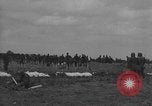
Graves being prepared for fallen U.S. troops at the temporary American St. Laurent Cemetery, in France, during World War II.
German prisoners of war at work digging graves for fallen American soldiers, at the temporary American St. Laurent Cemetery, established by the U.S. First Army on June 8, 1944, shortly after the D-Day invasion of Normandy (Operation Overlord). This is the first American cemetery on European soil in World War II, and located on a cliff overlooking Omaha Beach and the English Channel, east of St. Laurent-sur-Mer and northwest of Bayeux in Colleville-sur-Mer. (It is now the Normandy American Cemetery and Memorial.) Vertical posts with dog tags attached, mark the gravesites of the fallen troops. American soldiers sit near covered dead bodies of the fallen and perform tasks of identification and grave assignment. Covered remains of one soldier are carried across the field on a stretcher. Barrage balloons are seen in the sky overhead.
CRITICALPAST.COM: About Us | Contact Us | FAQs - How to Order | License Agreement | My Account | My Lightboxes | Shopping Cart | Advanced Search | Featured Collections | Website Terms & Conditions | Privacy Policy ©2026 CriticalPast LLC.
License Agreement |
Terms & Conditions |
Privacy Policy
©2026 CriticalPast LLC.