


 Francais
 Deutsch
 Italiano
Refine Your Search
Foggia Italy 1944 stock footage and images
- Showing 1831 to 1836 of 8000 results more
more Hide
Hide
Various views of OSS airlift operations behind Japanese lines in Burma during World War II
Montage of scenes illustrating Office of Strategic Services (OSS) airlift activities in Burma during World War II. C-47 with number 26 on its tail seen on landing roll at an airfield. A C-47 (serial number: 41-19476) with number 33 on its tail. Men in khaki are loading supplies in the aircraft and several wearing parachutes board the aircraft. View of a C-47 with number 42 on its tail taking off from well established airport. A man with parachute stands in open cargo door of the aircraft during takeoff. (This segment of film is reversed.) A C-47, tail number 31 is seen cruising in flight. View from inside an airplane cruising over fog filled valleys and then later over jagged mountains. View of C-47 number 31 from cabin of another C-47. View of passengers inside C-47 cabin. A fighter escort of Two USAAF P-51s passes close to the C-47. Inside a C-47, crew members prepare supplies and then airdrop them behind enemy lines. View from below of supplies being dropped from a C-47. Views of airdrops from inside and outside C-47 aircraft. Commandos including indigenous personnel,parachute from C-47s. Views from camera strapped to leg of one paratrooper. View from ground of a parachutist descending. (Note: C-47 serial number: 41-19476 was assigned to the 10th Air Force, 443rd Troop Carrier Group in Burma, during world War 2, and was lost on on a mission, January 18, 1944, piloted by Ferde A. Larsen, of the 2nd Troop Carrier Squadron.)
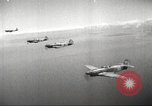
Soviet aircraft engage German aircraft and Soviet forces bombard and take Sevastopol in World War II
Formation of Soviet YAK fighter aircraft in flight. A lone German Messerschmitt Bf 109 in flight. The YAKs peel off and dive to attack. Aerial dogfight footage as the Soviet aircraft pursue the German airplane and shoot it down. It crashes into the ocean. The flight of Soviet aircraft attack a lone German Me-110 and it descends in flames to crash and explode on the ground.The Soviets attack another German aircraft that also crashes and explodes. German pilot is seen descending in parachute. A downed German airplane begins to burn on the ground and bursts into flames that consume it. In separate sequence, Soviet General, Fedor Ivanovich Tolbukhin, looks through binoculars as he observes artillery fire on Sapun Mountains, Ukraine. Views of the General's staff. Soviet gun crews firing 203mm B-4 heavy artillery. Soviet officers discussing target map. Animated map showing the Soviet advances and capture of Sevastopol in May 1944
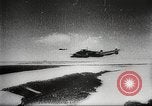
Soviet troops advance and enter Romania on the Eastern Front during World War II.
Allied campaign against the Axis in 1944 during World War II. The Soviet Army advances towards Romania after running over Ukraine. The tanks advance. German soldiers captured by the Soviet Army.
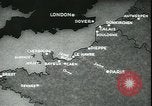
German forces fire at Allied vessels. Battle of Villers-Bocage in World War II
German soldiers in France during the Battle of Villers-Bocage of World War 2. A pictorial map showing cities along French coastline. A German soldier looking through binoculars. Allied ships at sea. German soldiers prepare artillery and fire. Smoke rising from explosions. German soldiers beside artillery. Smoke rising from Allied vessels at sea. Explosions on land and smoke rising. Two German soldiers talking. A wrecked landing craft at a beach. Debris of wreckage spread on the beach. A bomb wrecked U.S. LST (Landing Ship, Tank) on the beach and armored vehicles aboard the ship. Vehicles moving along a road. recked British Cromwell tanks and M3 Halftracks along the side of a road. A German soldier beside a damaged tank. Wide shot of a Stuart light tank. A damaged signboard which reads 'Villers Bocage'. Damaged buildings on the street of Villers-Bocage and a wrecked Tiger tank beside the buildings. Debris strewn on the ground and a damaged tank among the debris. A damaged tank with its front part into a building. A British helmet in the debris on a Cromwell tank. (Note: During this battle, On June 13th, 1944, German tank commander, Michael Wittmann, in a single Panzerkampfwagen VI Tiger tank reportedly destroyed up to 14 tanks and 15 personnel carriers along with 2 anti-tank guns. Many were of the British 22nd Armored Brigade of the 7th Armored Division, AKA the 'Desert Rats'.)

Anna Roosevelt reviews troops and Jean Marie Faircloth MacArthur Christens the Australian Destroyer, Bataan the during World War II
Opening scene shows a Boeing B-24 Liberator bomber arriving at an airfield in the Caribbean during World War 2 . U.S. First Lady, Eleanor Roosevelt steps from the aircraft, stopping here on one of her many trips. She strolls among U.S. servicemen and others. She is escorted by a General and reviews American Troops on parade at an army base. Scene shifts abruptly to the Cockatoo Island Dockyard, Sydney in New South Wales Sydney Australia, where the Australian Destroyer, Bataan, is being Christened on 15 January 1944 by Jean MacArthur, the wife of General Douglas MacArthur. Dockyard workers drive wedges from beneath the destroyer's hull, to free her for launching. Mrs. MacArthur announces the name, Bataan, and swings a bottle of champaign to christen her. The ship proceeds down the ways. View from below of sailors on deck as she launches.
The amphibious assault on Peleliu in World War II
The invasion of Peleliu, Palau Islands during World War 2. A Marine Major General is seen on the bridge of the Flagship USS Mount McKinley, off the coast of Peleliu during the amphibious assault by U.S. forces on September 15, 1944. He is observing the action through a set of binoculars.The island under bombardment. Task force ships firing their Naval guns include the heavy cruiser USS Louisville (CA 28) seen at TC: 01:29, 01:46, & 02:13. Other officers on the deck also watch the action through binoculars. Smoke columns rise from the island under bombardment.
CRITICALPAST.COM: About Us | Contact Us | FAQs - How to Order | License Agreement | My Account | My Lightboxes | Shopping Cart | Advanced Search | Featured Collections | Website Terms & Conditions | Privacy Policy ©2026 CriticalPast LLC.
License Agreement |
Terms & Conditions |
Privacy Policy
©2026 CriticalPast LLC.