


 Francais
 Deutsch
 Italiano
Refine Your Search
Foggia Italy 1944 stock footage and images
- Showing 1861 to 1866 of 8000 results more
more Hide
Hide
Bomb damaged military and naval installations in Toulon, Southern France during Operation Dragoon of World War 2
Allied Invasion of Toulon, Southern France during Operation Dragoon of World War II on 28 August 1944. Troops occupy Toulon. Damaged naval base by allied air bombing. View of damaged port. Mountains in the background. View of damaged French battleship Dunkerque. Damaged Submarine and torpedo plant at Toulon Port. Weapons installed by French includes 320mm naval guns. Civilians cheer arrival of the French troops. View of Mont Faron overlooking Toulon. Tanks advance through streets. Map depicts the route of advancement.

Civilians cheer the arrival of the French troops in Laragne,Southern France during Operation Dragoon of World War 2
Allied Invasion of Southern France during Operation Dragoon of World War II on 29 August 1944. Civilians cheer the arrival of the French troops in Laragne. Allied soldiers enter Grenoble. Aerial view of city. Prisoners of war seated. Czech,Polish and Russian prisoners walk through streets. American troops pass through streets. French FFI round up Nazi sympathizers. 2nd Battalion of the 7th Infantry Regiment 3rd Division fights with Germans and take many prisoners, seen marching through streets of town.

U.S. industrialist, Henry J. Kaiser appeals to Americans to donate used clothing for war victims throughout the world
American industrialist, Henry J. Kaiser appeals for donating clothing to war victims in China and Europe during World War II. Seated at desk in office, he addresses the nation and announces a drive, commencing April 1, 1944, to collect used clothing for war victims, all over the world. Scenes shows : War victims in food lines. Starving and wounded civilian victims of war. An American woman and a girl at home in America select clothing for donation. Mr. Kaiser shows a banner which reads "what can you spare that they can wear?"
U.S. engineers construct bridge on the Ledo Burma roads in South East Asia during Allied Invasion of France during World War 2
Bridge construction on the Ledo Burma roads in South East Asia during World War II on 5 August 1944. Aerial view of the flooded and damaged roads and bridges. United States engineers watch as the worker operates crane. They instruct the bridge building. Mountains in the background. Cable is pulled over tower by the block and tackle. Cable anchors are embedded in hillside caves. View of the completed suspension bridge. American and Chinese workers clear debris using bulldozer. Allied soldiers look at the map and discuss. Soldiers move with the horses loaded with their belongings. They cross flooded stream. Aircraft in flight. Supplies are dropped by parachutes on field.
Explosions of the German ammunition stores at an island in Saint Malo harbor during Allied Invasion of France.
Allied Invasion of France during World War II. German ammunition stores at an island in Saint Malo harbor are exploded on 17 August 1944. Allied troops explode stores as Germans refuse to surrender. Large smoke column arises.
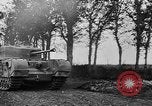
Soldiers refuel the Crocodile flame thrower used with the Churchill tank during Allied Invasion of France during World War II.
Allied Invasion of France during World War II. Demonstration of the Crocodile flame thrower used with the Churchill tank on 25 August 1944. Soldier hands over the special fuel tank from the armored trailer to another soldier who refuels flame thrower. Soldiers advance through field and operate flame thrower tanks. They attack on trenches and hill boxes. Huge smoke column rises.
CRITICALPAST.COM: About Us | Contact Us | FAQs - How to Order | License Agreement | My Account | My Lightboxes | Shopping Cart | Advanced Search | Featured Collections | Website Terms & Conditions | Privacy Policy ©2026 CriticalPast LLC.
License Agreement |
Terms & Conditions |
Privacy Policy
©2026 CriticalPast LLC.