


 Francais
 Deutsch
 Italiano
Refine Your Search
Foggia Italy 1944 stock footage and images
- Showing 229 to 234 of 7968 results more
more Hide
Hide
Generals George Marshall and Mark Clark at advance quarters in Italy.
Generals George Marshall, U.S. Army Chief of Staff and Mark Clark at advance quarters in Italy. General Clark decorates Distinguished Service Medal on General Alphonse Juin. General Marshall meets officers of 5th army.
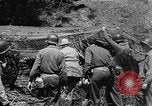
Henry L. Stimson and Lieutenant General Mark W. Clark watch firing of guns at an artillery gun position in Italy (WW2)
Secretary of War, Henry L. Stimson visits Italy during World War II. Mr. Stimson along with Lieutenant General Mark W. Clark at an artillery gun position, watch firing of guns. The artillery gun position is under camouflaged netting. The muzzle of the gun points outside the camouflaged net. Mr. Stimson and Lieutenant General Clark close their ears during the firing.
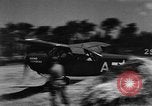
Henry L. Stimson and Lieutenant General Mark W. Clark review troops and visit wounded soldiers at a hospital in Italy (WW2)
Secretary of War, Henry L Stimson visits Italy during World War II. United States aircraft parked. Mr. Stimson along with Lieutenant General Mark W. Clark at an airfield. They get into an army jeep and talk to each other. They visit wounded troops in a hospital. They review troops. The troops salute. Mr. Stimson and Lieutenant General Clark drive away in an army jeep.
Combat fatigued U.S. soldiers are interviewed and sent for treatment in the Training and Rehabilitation Center, Italy.
Psychiatric procedures for United States soldiers in combat areas during World War 2 suffering stress following trauma of battle. Battle scenes: Strong and courageous soldiers sent for fight. They attack enemy and fire rifles from hidden places. Smoke rises. They face danger in battle day after day. View of wounded, burned and dead soldiers in battle. Strongest soldiers of the army maneuver over field. Soldiers seated facing the stress of combat and become psychiatric casualties. Chart depicts fighting front and its three levels: division, army and base. Soldiers are sent to battalion aid station and back to clearing stations for treatment. Medical van brings the wounded soldiers and psychiatric casualties to battalion aid station. One officer checks the ID card of soldiers. ID card reads: '1st battalion, 168 infantry regiment, yes incurred in Italy'. Chart shows training and rehabilitation center (T& R center) near clearing station. Soldiers reach to training and rehabilitation center. A Sign of 'Training and Rehabilitation Center'. Combat fatigue cases are reconditioned by battle training. A psychiatrist interviews a soldier suffering from reactive depression and asks about troubles and feelings faced by him when he got wounded. After interview soldiers are send to clearing center. Soldier enters into tent at camp. They take rest, make social contacts with other soldiers, write letter, get shaved and eat food. Two days later, soldier is re-interviewed about improvement after relaxation in training center. He shows improvement and is encouraged. Recovered soldiers fill the artillery outside the tent near training center. (Modern equivalent - PTSD or post traumatic stress disorder treatment)
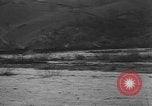
Troops of the U.S. 92 Infantry division (Buffalo Soldiers) evacuate a flooded bivouac area in Italy during World War II.
Throughout the film, flood waters from heavy rains are seen inundating the normally dry Idice river bed in the vicinity of Borgo di Bisano, 17miles from Bologna, Italy, where U.S. troops of the 92nd Infantry Division (Buffalo Soldiers) were encamped, in World War 2. Army vehicles are moving cautiously through the flood waters as troops work to rescue supplies and equipment. Camera pans over the wide area covered by the fast moving waters.
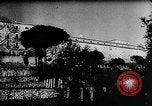
Courtyards and stairways of Monte Cassino Abbey as men remove art treasures and books from Monte Cassino in Italy.
Germans defend Cassino and Monte Cassino abbey in Italy during World War II. Courtyards and stairways of Monte Cassino Abbey. Views of Monte Cassino. German officers with monks. Men remove art treasures, and books. Books and art treasures in a case.
CRITICALPAST.COM: About Us | Contact Us | FAQs - How to Order | License Agreement | My Account | My Lightboxes | Shopping Cart | Advanced Search | Featured Collections | Website Terms & Conditions | Privacy Policy ©2026 CriticalPast LLC.
License Agreement |
Terms & Conditions |
Privacy Policy
©2026 CriticalPast LLC.